Friday, 9 August 2024

Cheating Translation - a neat trick

 I am very much enjoying working through the new GCSE textbook as I plan for the new GCSE starting in September. They have achieved a good balance between progression and accumulating language, and sharp focus on developing pupils' exam skills in a cultural and motivating context. It's a great fit for the overall vision we have in our school of how we want the course to work for our pupils. I have been creating a booklet to go with Module 1 to really draw this out and get us off to a great start.

In this post I am going to show you one clever way to make use of the texts and activities in the book: Cheating Translation.

Put simply, Cheating Translation is where you have a series of texts for pupils to translate - some from English into French, and some from French into English. And what you do, is you hide the language pupils need for one translation, inside one of the other texts. So they can do most of the translation using language they know, but if they are stuck, they know they can hunt for the words in the other texts on the page.

Here's an example from our Year 8 Unit 1 booklet.


You can see that text B helps pupils with text A. And text A helps pupils with text B. This is great for a cover lesson where you need a worthwhile activity that works smoothly for the cover teacher.

So how does this work to make using the new GCSE textbook go smoothly?

This is from the Module 1 Booklet I have written to go with the new textbook.


You can see from the list that there is an awful lot going on on this page. Irregular verbs, plus jouer à, jouer de, faire du sport, j'aime le sport and important time words. All of these things must not just be seen but actually learned. With attention drawn to them and planning for how they will be met again and again, and added to the repertoire of French which pupils can use confidently and accurately.

Here's the first text on the page:

Pearson AQA GCSE French


This "Manon" text is in fact one of four in the first exercise. And what the book does is ask the pupils to look at all 4 texts and match them to the pictures. This is a perfectly logical way in. The pupils have a first read through of the text, picking out the vocabulary for the activities (cooking, cycling etc) and matching them to the pictures. It's a natural and important way to approach the text. But it works entirely by asking them to find obvious known language or cognates, and ignores entirely the features of the text which are actually useful.

Of course there are follow up tasks. Firstly to translate the sentences in blue which contain the irregular verbs. And then secondly to find mentions of other people in the texts. Although this will need teacher input to steer pupils away from just listing her brother, her friends and actually focus on nous and the verb endings.

The various other features such as jouer de, faire du, are picked up in grammar boxes on the page, but I want to get as much as possible out of the text itself.

Let's look at just the Manon text again:
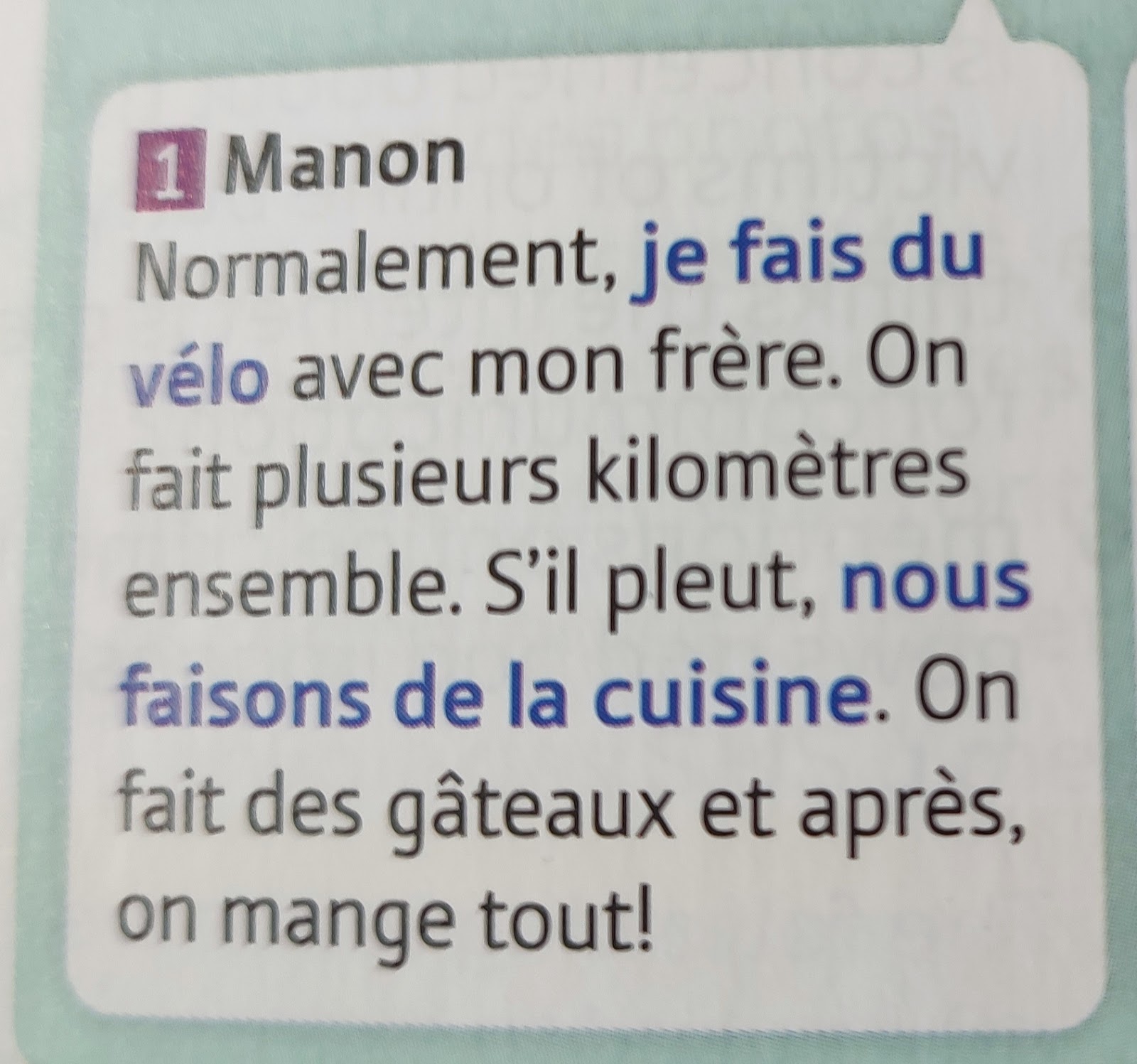


It's fabulous. It's just what's needed as pupils move from KS3 to GCSE. They are already brilliant at saying what they like to do and why, adding if sentences and linking it up. They are poor at adding convincing detail, nuance and they are only just starting to work out how to move from talking about themselves to talking about other people, either as a conflict of opinions or as working together.

I want to get at the move between je... mon frère... nous... on... And I want the nuance words like tout and plusieurs, the time words like après and normalement, and the handling other people words like ensemble.

We know in an AQA markscheme for the reading exam a candidate who writes "They cycle a long way with their brother" might get 0 marks if AQA insist it has to contain the words several and together. We know they do that in the current GCSE. And in the new GCSE with its increased focus on high frequency vocabulary, they are just as likely to work this way. And in planning our teaching for the new GCSE, I am also determined to keep the focus on these non topic words which can appear in any text. And which also make the difference, in pupils' own speaking and writing, between a good candidate and an outstanding one. Ultimately these are the words which allow pupils to frame narrative, move coherently from one idea to another, and to develop longer, detailed answers.

So where does Cheating Translation come in?

Have a look at this translation text and compare it to the Manon text.


It is designed so that pupils can translate almost all of it from their repertoire of French. But it is deliberately a mirror of the text they are going to meet when they get to the Manon text in the book. So when they meet a word they don't know, they can find it in the Manon text.

It is doing two things, both as important as each other. In doing the tennis/football translation, it is showing them how to extend and give detail/nuance to an answer they can already produce. They see that the words in bold type naturally fit well into their repertoire and enhance their expression.

And secondly it means that the first time they encounter the Manon text, it's not as a problem or a threat or a challenge. It's as a useful helping hand. It gives them the words they need. Instead of tackling the text as a skimming for known words exercise, it takes them straight in to looking for unknown words. And very useful unknown words!

But that's not even half of how Cheating Translation works! Next you can do this!


They move from translating my mirrored text into French, using the Manon text for help, to translating the Manon text into English, using my mirrored text for help if needed. And then they shut the textbook and translate it back into French. You can choose whether to do this as a sequence of translations in one lesson, or if you want to spread it out over several lessons to boost the requirement for pupils to retain and retrieve what they learned in the previous lesson.

So instead of fishing around in the Manon text for known words and then new grammar, they are straight in to working with every word in the sentence, for comprehension and for extending their own repertoire of French. The support is there to make them successful, the challenge is there, and the vision of how it all builds their learning is definitely there.

This idea of rewriting texts from the textbook on different topics is something I am going to continue. Either as here to anticipate texts, or to deliberately revisit them in new contexts later. As well as revisiting being important for retaining vocabulary, you can see from this example that it's even more important for switching the focus to the non topic words and for how they are integrated into the pupils' repertoire, ready to be deployed.


Wednesday, 7 August 2024

New GCSE Module 0 Booklet

 I have created a booklet for our Year 10s called Module 0. Why Module 0? Because it's for before they start the textbook. And because the 0 is the shape of the snowball of French I want them to have so it doesn't melt and so more French sticks to it. And because a 0 Module approach is lurking behind this GCSE, where as much as possible we are not sticking to one topic at a time and then moving on.

And I've put all that in the booklet for the pupils too. Here's a slide from the powerpoint that introduces it:


The first thing we do is to ask pupils to analyse their own snowball from KS3 with this double page activity. They place the French they know and always use at the core, working outwards to French they don't know yet. In 2005 I wrote that this is all the grammar that you need for GCSE - what matters is how well you use it. And nothing has changed!


Then we go straight in with 3 key aspects in turn. The Role Play, the Unexpected Questions, and The Conversation.

For The Role Play, I have picked out from the Sample Assessment Materials all the Role Plays that I think pupils can do successfully using their snowball of French and the vocabulary they have learned in KS3. The questions are in English and they can write down their answers. They should write short answers in a sentence. The answers aren't about their own lives; they are role playing a conversation between two imaginary people.


This will give the pupils and the teachers the opportunity to see how well KS3 has prepared them for GCSE, and any gaps that will need to be filled. It tackles exam technique from the start of the course, and immediately demonstrates the power of the snowball of French.

The messages I hope to come out of this are:

  • You are already well on the way to GCSE French.
  • You have to think about how to use French you know, to give a correct answer.
  • You may want to say other things. We have 2 more years to work on that.
  • There may be things you can't do. In particular asking questions or describing. We will work on that.
  • Many of the topics are familiar, but there are more topics that we will cover.

Then we look at the Unexpected Questions. There are four of these and for AQA they all follow the Read Aloud task. This is a big step up from the Role Play questions, firstly because you don't see these questions written down. They are fired at you by the examiner. And secondly because unlike the Role Play, you are expected to give some development of your answers.

The first thing we do is to say you may NOT fully understand the question. We know this from the current GCSE where the Role Play contains one unexpected question. The stress and confusion of the exam situation means very few pupils process the question fully. I must remember that I have an excellent example of this to share with you once we are out of the exam purdah period. So the first thing in the booklet is how to deal with this emergency situation:


Imagine this is what it feels like in the exam. Can you still give an answer and hope it gets some credit? This is exactly what happens with the current GCSE unexpected question. For the new GCSE, this is only the starting point, because we are really going to be working on this!

Next we do some work on Question and Command words. So the pupils are seeing the questions written down, and can also plan their developed answers in writing. The Box the question word relates to a whole school policy of BUG where pupils Box, Underline and Go over elements of an exam rubric. 

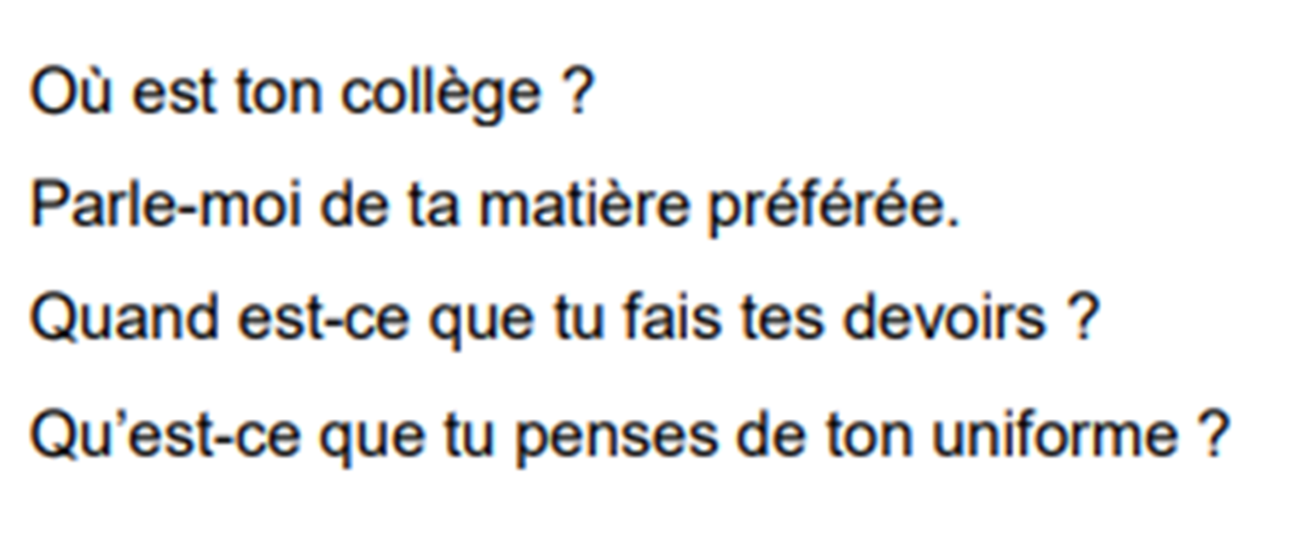
The point in Module 0 is for the pupils to see that they do have the French to do the task. So they do see the questions printed in the booklet:


The booklet then asks the pupils to work with a partner, reading questions to each other. Can they get the topic of the question? Can they get the exact question? Can they give an answer? Can they develop the answer? Again, they have questions from the Sample Assessment Material, so they can see they are using GCSE questions already.

This is just a taster, as responding to unexpected questions is going to be a major focus in every Module we do. The key messages are:

  • Don't panic, pick up as much as you can of the question and always give an answer.
  • Thinking up what to say is often as hard as knowing the French. How do you extend an answer to "Where is your school?" especially when you are both sitting in it!
  • Use French you know in order to answer the question, then use your snowball to give further follow up details even if this takes you away from the original question.
  • Throughout your GCSE course, starting right now, make the most of opportunities to practise speaking. It's not the French. It's how good you are at using it.
  • Do something with scaffolding one lesson, but come back in future lessons and see if you can still do it without the scaffolding.

Then we tackle the Conversation.

The conversation has changed in some respects from the current GCSE. There is no longer any mention of the word narrate. And the exemplification of "extended answers" given in the AQA materials is just 3 clauses. But the pupils will have to talk for up to five and a half minutes on just one theme, which is much longer than for the current GCSE. And the AQA notes do recommend that teachers use follow up prompts such as Why? And? For example? So I will carry on teaching pupils to develop their answers and respond to prompts for more details.

The first thing is a model answer done as a listening (or a reading if needed).


The pupils listen and tick when they hear each of the elements of the answer:


Then they listen again and take notes on what is said for each element. Then they write up their version of the answer in French.

This answer models:

  • How to use their snowball of French to create an extended and coherent answer which meets exam criteria and shows off the range of their language.
  • How one thing always needs to another in a logical development.
  • How to have a formula or trigger that helps you decide what to say next - thinking up what to say is harder than coming up with the French.

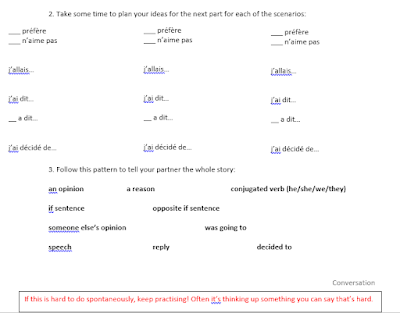
Then they transfer this across to other topics, either in writing and then in speaking:


This has taken the pupils way beyond what is tackled in Module 1 of the textbook, but this isn't about progression in French. The pupils' snowball from KS3 already contains all the French they need for the Conversation. The message to pupils here is that it's about having 2 years to get good at using their French.

The rest of the booklet contains a selection of Keep Talking sheets, to transfer their French across a range of topics, and to scaffold their answers. These may look like what people call Sentence Builders, but they are different in two key ways. Firstly, they are all built around the same snowball of language. And secondly, they are designed for building extended answers, not sentences. Here's one example:


One key page, which I will also be making into a poster, gives them a repertoire of activities for speaking that they can come back to throughout the GCSE course, and take ownership of making their speaking lessons purposeful and productive:


Many of these activities have their own posts on this blog, so it's worth checking them out:

Links to Speaking Activities 1. Links to Speaking Activities 2.

This is post number 200 on this blog. And I am glad that we are still talking about teaching GCSE pupils that it's not just knowing more French that matters. It's how well you can use it to express yourself and develop increasingly coherent and personal answers. That feels pretty good, I have to say!

Thursday, 25 July 2024

The Best of Both Worlds

 It's been tempting over the course of the last couple of years, to feel as if we are being asked to choose between two different visions of language learning.


On the one end of this spectrum, is the idea that language learning is all about Meaning. Creating meaning by saying things and communicating. Understanding meaning by listening, reading and interacting. It's important that language learning isn't just learning and being tested on your knowledge of a collection of vocabulary and grammar items. You shouldn't wait until pupils have mastered the whole system before showing them they can use the language to communicate.

At the other end, are the new exhortations from the Ofsted "Research Review" and the new GCSE panel, that language learning shouldn't just be a collection of things that pupils can say or understand. We shouldn't be learning by osmosis to give set phrasebook style answers for different situations. It is primarily about learning vocabulary and grammatical concepts. Communication can wait.

Here is a slide from Steven Fawkes from an ALL talk to enthuse new MFL teachers. Here are things that we have always thought are the strongest points of our subject:


and here's a snippet from Common Ground by Florencia Henshaw and Maris Hawkins:


Language learning happens when pupils use the language for real, for purposeful creation of meaning or understanding. Not just by practising the language.

We are being asked to consider what if this approach is not just wrong and misguided, but dangerously counter-productive.


When pupils struggle with language learning and seem frustrated or unmotivated, we reach for the levers of communication, relevance, authenticity, culture, creavity, expression... And we expect these to switch on a love of learning and engagement, a sense of purpose.  But might it be that these levers are the wrong ones? By doing this, we are increasing the cognitive demand on pupils, asking them to communicate too soon? Is it a successful approach only with those learners who come equipped with the cultural capital, awareness of language, confidence, self-efficacy and literacy skills needed to cope with this "in at the deep end" approach? The danger of sink or swim is that some just sink.

Instead, we are being asked to consider an approach focused on the language. Vocabulary and grammar, carefully selected and sequenced. Not so that pupils can say things or understand things. But so they can see how the language works. With everything explained clearly, with no guessing or glossing over or assumptions about what pupils can work out or don't need to know.


That's the thinking behind this slide from an Ofsted webinar accompanying their "Research Review." It is a view of language teaching where everything is planned and sequenced logically, boiled down to the essentials and carefully avoiding rich and complex contexts.

The examples given in the webinar are that we should teach pupils to say red dog, red tortoise but we should avoid green dog, green tortoise because this brings in adjectival agreement. And leaners already have enough on their plate with learning the vocabulary and the word order. A logical step-by-step teaching strategy. But one which is totally distanced from learners using the language to say things they want to say.

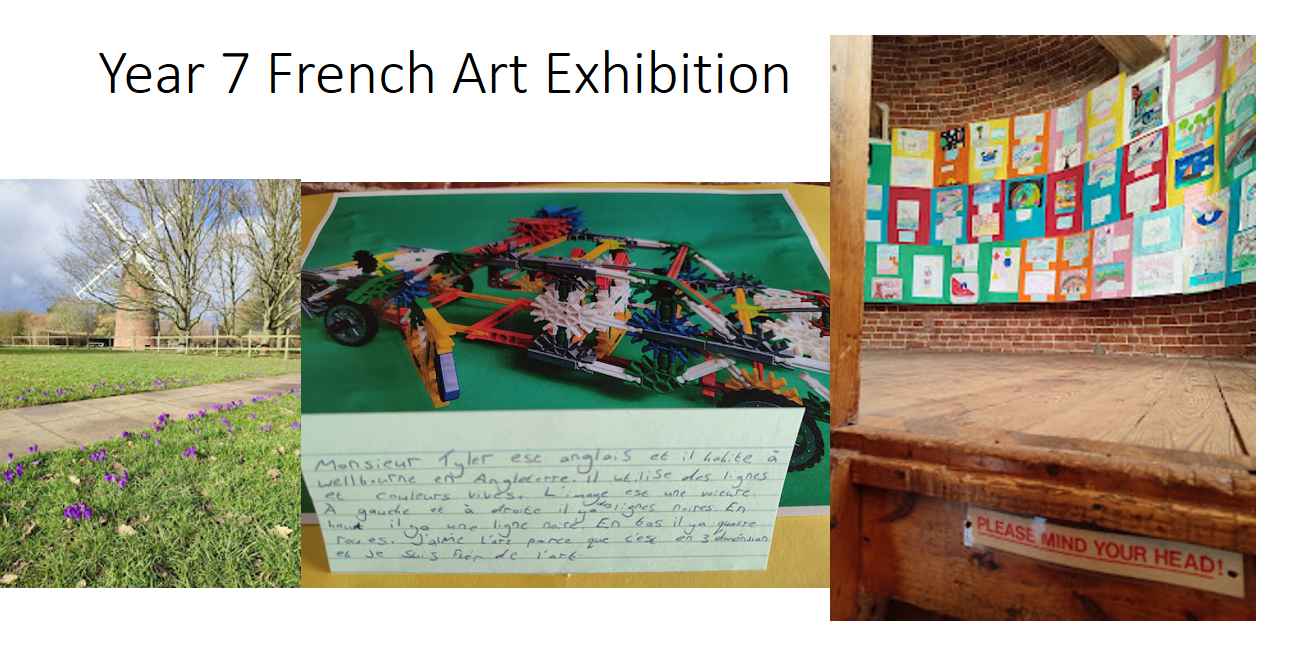
This has huge implications for things like our Year 7 French Art Exhibition.


What if...

What if we are focused on the product not the process? There's a deadline and we skip over important learning because we need to get the picture and the text done.

The pupils' attention might be too directed towards the meaning and not enough towards the forms of the words.

What if the pupils' descriptions bring in random words that they are never going to need again? 

What if pupils are trying to say things they can't? So they fall into error but we gloss over it because they are "communicating well."

That could mean that the things we think are the best for our learners turn out to be the worst!

Let's look at that spectrum diagram again. Is it really how it has been painted? How about we move things about a little.


Are those positions really incompatible?


Let's move the things we do want from language learning, into the middle. Language Learning is about Understanding and Creating Meaning. And about Knowledge linked by Conceptualisation. Sounds good to me. Spot on in fact. I want all those things.

How about the things we don't want? Language Learning isn't just a collection of knowledge of vocabulary and grammar. And neither is it a collection of phrasebook style things pupils can say. Absolutely spot on.

So instead of being asked to choose, in reality we are being given the best of both worlds.

So when I teach Year 7 j'ai un chien, I know that we are not going to be spending 5 years remembering words for pets. I know that the important things are j'ai and un/une and the sound-spelling link in oiseau and poisson. But the pupils are focused on a game where you have to guess if people are telling the truth about their pets and their names. Because the meaning and communication and link to reality matter to pupils. More than links and patterns between words at this stage.

And when I teach je n'ai pas de..., we will spend time looking at contractions of je - j'ai and ne - n'. But we will also chante je n'ai pas de over and over again to a video of a rhythmic steam train. The best of both worlds.

And I know that when I teach Year 8, we will separate out the process of randomly using the language in a ridiculous world record length "sentence" and then later working on coherence and quality of expression.


Because both are important, and there is no conflict.

And when it comes to the Year 7 French Exhibition. Why do we teach the grammar of word order, adjectival agreement, definite and definite articles, prepositions and high frequency words? We teach it so that 200 pupils can all create their own art work and they can all write about their own picture. Grammar is creativity and communication. There is no incompatibility.


Saturday, 13 July 2024

Pupil Voice in Modern Languages - Year 9 Options 2024

Two years ago I wrote a post on Year 9 pupils' thoughts about GCSE languages and how they were generally positive. Then, last year a similar survey discovered a high proportion of Year 9 pupils who thought that languages was not a useful GCSE for employment or for university application. So we acted to address this, including supportive messages from the Headteachers. In our school, languages are very much supported, although not over and above other subjects. But in this instance we were addressing a specific misconception, and numbers in the current Year 10 were definitely boosted as a result, compared to what our survey had shown in September.

This year, a similar survey in September didn't ring as many alarm bells, with 80% of pupils at least considering taking a language, before they saw the structure of the options available. Our interest this year wasn't focused so much on overall numbers, so much as on looking into why certain groups are under represented in GCSE languages. We are very successful in attracting learners with lower prior attainment. Often it's the pupils who you know would "excel in French" or be "a natural linguist" who aren't picking it as an option. (Here's a post where you can see exactly why I am resisting those labels.)

Susannah Porsz of the Beeleigh Languages Hub interviewed a panel of eight high flying Year 9 pupils, some of whom had and some of whom hadn't picked a language at GCSE.

Here's some of what they said:

General Attitudes

They were all very confident in their progress and test results in French. This was something we had been deliberately setting out to achieve with our revised KS3 assessments. And I know some of the pupils had also received emails to parents congratulating them on their results and progress.

They were very positive about the usefulness of languages, mentioning travel, careers and meeting people, and the fact that a language is something that it is "nice to know." They included mentions of parents' attitudes as positive, but other pupils' attitudes as negative. Some of them spoke other languages at home or had international family connections, which were seen as important and positive. They were positive about their lessons, although some said, "It's just not for me." And one said, "I don't dread it, but it's not my favourite either."

Picking Options

When it came to talking about Options, most had been considering taking a language, but were in the situation where there were "Too many choices and not enough options." Several had put French down as a second choice. This is interesting because any changes to the options offer structure would ultimately follow pupil numbers. Are a significant number of pupils putting French as a second choice when there is another column where they would have put it as a first choice if it were on offer?

As we had also discovered in previous years, our pupils make very detailed and specific career decisions very early. Before Year 9, they already had clear ambitions, which included scholarships and international study. But a language didn't seem to them to be directly relevant to their specific career choice.

They spoke about how teachers for each subject "hyped" their own subject. They felt Geography, for example, had been particularly well sold, and some were even starting to wonder if they should have chosen French instead. This reinforces the value of the work we do in talking to pupils about the value of languages. And highlights the importance of them hearing it from third parties such as University outreach or careers advice, because their French teacher "would say that, wouldn't they."

Some pupils talked about hearing from older pupils that French GCSE is hard and a big jump. One interesting comment was that if other pupils talk about taking history because they have heard it is "easy", then you might end up in a class with lots of people with the wrong attitude!

Experience of French in KS3

As we regularly find in the feedback we get from pupils as part of their assessments, their overall aim in learning French is "to have a basic real conversation." Most pupils wanted their lessons to be more varied and to have more speaking French. They were very much aware that this depended on having someone to work with who also wanted to practise speaking French. Someone you would be comfortable working with. They greatly valued it when they could be trusted to work with a partner and to take responsibility for working together. It is important to remember that when it seems easier to manage a class if we reduce the demands of interaction and speaking, these pupils wanted (like us) to be developing speaking. It's important we realise this and we can use this knowledge to make sure it happens.

There was discussion around how much repetition was necessary in French. They again compared it to Geography where they felt there was more variety and excitement. Although they were realistic about the need for scaffolding in a language. This was something I was particularly wondering about, in terms of the level of work and the level of interest for these particular pupils. 

They did mention that they wanted more cultural input. They could list some things they had done, for example food, places, songs, videos, the Windmill Art Exhibition and letter exchanges with France. But they didn't think it was enough. They talked about CLIL immersion approaches they had seen in the video of the school in France we look at, where they do maths in German. They thought this was a great idea but didn't think it was practicable. And on the other hand, some thought that French should be more transactional rather than doing things like the unit on the Environment. "More trips" was their emphatic answer to what would make the biggest difference.

Listening to them comparing Human Geography and Physical Geography, I wondered also if they could talk about French in the same way. Do we give them metalanguage and categories and labels? Would these pupils enjoy more explicit grammar to learn and terminology to make their learning feel more intellectual and less implicit? They mentioned adjectival agreement and a few other linguistic areas, but otherwise were mainly thinking of French in terms of topic content. Do we have work to do here?

But their understanding of their language-learning did come through very strongly in their comments on the school's "Learning Cycle." They immediately said that this was exactly how their lessons worked. Explanation, modelling, scaffolding, practice and feedback. And dual coding also got an enthusiastic mention from more than one pupil.

Feedback


If anything, I think the experience of giving feedback in itself was the most important thing. The more we can give pupils the opportunity to voice their thoughts on their language-learning, and for these to be taken seriously, the better. And for this to be with a neutral third party makes them feel their experiences are being valued. I will think how we can do this more often and systematically, perhaps by involving languages teachers from a nearby school on a reciprocal basis. And I'll have to think about how we can show to pupils that we've listened and discussed their feedback, because I don't suppose they read boring language teacher blogs...

Sunday, 30 June 2024

The Messy Middle.

 Last week I wrote a long post about Language-Learning and the arguments between Knowledge and Skills. I looked at the lovely idea that Skills are not just a result of some people being "skillful". Their skills can be broken down into steps (knowledge and concepts) that can be taught explicitly to all pupils. These steps can be practised until pupils are fluent in them and become "skillful".

This lovely and useful idea has been taken up by the Knowledge Rich Curriculum project and broken. Instead of focusing on analysing and then building up skills, they have taken a different starting point. They started from Knowledge. From the expert's overall view of how the complete system works and can be conceptualised. Instead of breaking down the Skills into Knowledge, they have broken down Knowledge. And then concentrated on force feeding the Knowledge to pupils. And they haven't even been surprised that this doesn't add up to acquiring Skills. Because they have forgotten that part entirely. Or maybe they were never actually interested in it at all.

This post is now going to be much shorter and sweeter. And from now on, entirely focused on Language-Learning.

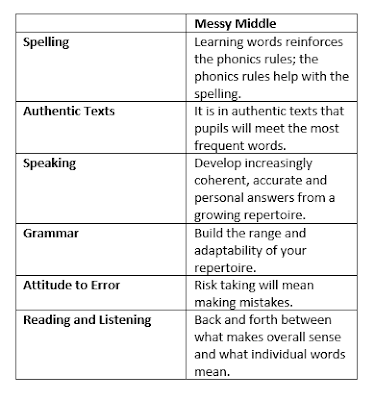
In fact, here's the whole post in one table:


Where do you see yourself and your teaching for each of these aspects?

In Language-Teaching, the Knowledge/Skills debate is also framed around Learning/Acquisition. You will remember from my post last week, that I am not in favour of neat binary extremes. It turns out lots of the "Research Based" ideology is about judging conformity to an idea of how learning should be. Not looking at the reality of learning in the classroom.

I have tried to look at different aspects of language-learning and find "The Messy Middle" for each of them.


This is how I try to teach. In every case it's messy, it's real, and it's focused on the learners. It builds up their knowledge and their skills in tandem. I monitor their knowledge through what they can do with the language. And I deliver the knowledge that they need in order to do more with their language. I work on the increasing independence, accuracy, fluency and coherence with which they can deploy their language.

Instead of splitting into camps and looking for simplistic doctrines and magic pyramids, can we start to get stuck into the Messy Middle? That's the question I posed in the following snippet right at the start of my previous post. Let's enjoy the Messy Middle. This is us:


Friday, 28 June 2024

Nitty Gritty Teaching

 Time to reflect on some of the things we put in place in the light of the Ofsted "Research Review". One idea was that we had been pulling the wrong levers in order to engage young people with learning languages. We always thought that communication, meaning, interesting content, culture and authentic material would engage. Whereas grammar and accuracy would confuse, frustrate and demotivate.

We were asked to think about this the other way round.

What if our focus on communication and culture put cognitive demands on pupils that pushed language learning further out of reach? What if authentic texts were full of little words and grammar that we told the pupils to gloss over in search of meaning from context, leaving pupils frustrated and confused that no-one ever told them what all the little words meant? What if we taught them whole phrases without telling them what the individual words meant and how the grammar worked? Was this the true obstacle to making language-learning accessible?

One thing we brought in was our Fluent in 5 lesson starters. At first to recycle language from previous units, but then increasingly in order to focus on the little words that we might skip over.


The lesson starters were a first step to all teachers tweaking the focus away from the "big words" of topic content, to the "little words" that make sentences work in all topics.

So this is where I find myself with Year 7. All year we have come at it from both angles. We learned "je n'ai pas de" by looking at how Mr Apostrophe ate the e of je and ne. But we also chanted it to a video of a steam train puffing up a hill:  "je n'ai pas de  je n'ai pas de  je n'ai pas de  je n'ai pas de."

And now we are doing rooms in the house. They have learned the rooms using dual coding. They learned the furniture by watching a house tour video in French. And we are focusing on recycling all the words we have done in Year 7 like il y a, j'ai, nous avons, est... All seems to be going well.

Then I got to this exercise in the booklet:


You can see what it is trying to do. It is giving the pupils the "big words" and asking them to focus on the "little words."

Of course it didn't work. Firstly, most pupils just read the English sentences and put in the words they thought made most sense: a bed, my desk... Not a problem. We often talk about the idea of getting things wrong and then sorting it out, and how powerful this is in learning. Because you remember your mistakes. And because you focused on the detail.

So next step was to ask the pupils to circle in the French the exact words that were meant to go in the gaps. They could do this. We checked the difference between un/une/le/la/des. Here we started to find the problem. The pupils who knew it, knew it perfectly and easily. The pupils who didn't know it, knew the concept and knew they were supposed to know it. But they just didn't care. They were not interested.

I'm not sure what to say to them about it. When I was learning French, getting un/une right mattered so much that when I went to France on my own, I ordered two of everything I bought, rather than get it wrong. Or I avoided saying things. I'm not entirely sure that was a good thing. With my own pupils, I have seen that the time masculine/feminine really starts to matter is when the exchange pupils are here, and all of a sudden it's important to get the gender right when telling a boy what you think of him!

Here's the next exercise in the booklet:


Pupils can see it is to help them describe their house. They can see that it's helping reinforce different verb constructions so their sentences aren't repeating il y a all the time. They can see it's testing if they can spell the words they have learned or if not, to know to check the spelling.

Do they see it as an invitation to express themselves and talk about a real or imaginary house? 

Or do they see it as a grammatical exercise checking if they correctly use le/la/les/un/une/des?

How can we balance these two? Pupils tend to see it as an invitation to communicate. To think about their house, think of the French words, and build the sentence. And I don't think we would want it to be the other way round. A pupil who isn't fussed about what they are saying, but knows they have to get un/une/le/la correct. I don't seem to have a lot of those pupils in my class. And I think that's probably alright. As a teacher, I need to make sure they know how to use the right articles. And I will slowly try to encourage them to see the importance of using the right one. I don't want to make it something that becomes an obstacle, where a pupil panics so much about picking the article, that they lose their focus on communicating. But there seems very little risk of this. The pupils who get it have no problem with it. And the other pupils just aren't bothered.

I'm not sure where this leaves the idea that we were frustrating pupils by not focusing enough on these words. It's not turning out to be a magic bullet. And the answer seems to lie in the middle ground between the two extremes. Which sums up most educational debates! 


Wednesday, 19 June 2024

Planning the new GCSE: The Vision

An audio podcast summary of this post created by notebook LM AI is available here https://notebooklm.google.com/notebook/b5b305aa-6a70-472b-8dec-fedae45e7588/audio May take a minute to load.


 As I start to plan and resource the new GCSE, my vision is this:


A lovely snowball of French. The pupils' French is compacted together into a big ball. It won't melt. It can roll around between topics. More and more French will stick to it. It belongs to them, and they can have fun with it.

I don't want an even covering. An even covering looks pretty, but you come back next lesson and your French has all melted.

Are textbooks good at building a snowball? Or are they designed to create an even covering? What if they cover everything once, ticking it off on a contents page? What if the language in one topic doesn't transfer to another?

In my teaching I want to recycle the same core of language in every unit. I want as much time as possible for the pupils to get good at using that core of language.  I want it to be the language they need in order to perform the exam tasks and to meet the exam criteria. And I want it to be of GCSE standard from the start.

There are plenty of other posts on this blog about the core of language I want my pupils to be confident using on any topic. Here's some examples of work - you can see the same language in every case.

Holidays


School

Shopping


So the first thing I am going to do is to write a Speaking/Writing booklet pulling together pupils' core repertoire from KS3, and using it across the exam topics. It will have GCSE tasks from the Speaking Exam and the Writing Exam. And it will show pupils, even before they start the course or open the textbook, that they have the French they need to tackle the tasks.

The message will be:

  • You have the French. You need to get good at using it.
  • You can do the exam. You may not be able to say exactly what you want to say. We will work on that.
  • You can do the exam. You may not be getting the grade you want yet. We will work on that.
  • You have a snowball of French. Don't let it melt, and more French will stick to it.

Then we will start the book.

I am not entirely sure we will work through the book in order.

Some topics are very similar and are a great opportunity for pupils to practise using their core of language and to practise transferring it across topics: Free Time, Holidays, House, Town and Region, School. As in the examples of work above, I want pupils to be able to deploy their language confidently on any of these topics.

Then topics like Jobs, the Environment, and Technology are slightly less familiar but use more or less the same core language. Pupils can still talk about what they want to do, can do, should do, hope to do, plan to do, usually do... Once they have the snowball of French from the familiar topics, the French from these topics will stick to it.

What topics are left? The ones which are less First Person. Both grammatically and in terms of content. Celebrities, and Culture. We will deliberately tackle the ways in which the language for these topics can be made to stick onto the same snowball. Not to form a separate snowball.

And then there's Self, Relationships, Family. Possibly the most melty topic. Irregular verbs, adjectival agreement. Ser and estar. Short descriptions that don't develop into the same sort of narrative answer. I would want to think about delaying this topic until the snowball is big enough for it to just stick. If it was the first topic, I would be afraid it wouldn't form a strong enough core. I will look very carefully at the role of description in the exams. There are a greater proportion of adjectives on the list than previously. And the sample role play questions (AQA) do ask for a description of someone.

But a short simple description is something I would want to pop into every unit, so it fuses. Rather than trying to build a whole unit out of short descriptions that have nothing to stick to. Reminds me of the rainy day on holiday when I tried to make a man and a dog out of wotsits. If you make the ends wet you can fuse them. But they have no structural integrity and when they dry out they all fall apart. Probably have a photo somewhere.

So I am thinking of re-ordering, combining or revisiting topics. With booklets that sit alongside the textbooks. I am going to deliberately rewrite variations on texts in the book, re-versioning them for a different topic. This will highlight the words that get kept across topics, and make sure they are deliberately revisited.

And in these booklets, I will want to tackle more of the things that perhaps a book can't do well. Things like Unexpected Questions. In the current GCSE there is one unexpected question in the Role Play. And if pupils say a random thing they may or may not get lucky. I have a fantastic example to share from this year once the exam results are all out. In the new GCSE there are 4 of this type of questions. And pupils have to think about giving a developed answer to them. This isn't going to happen without work.

Here are sample unexpected questions (AQA):


The pupil won't see these questions. They will hear them from the examiner. They have to process the question and give a developed answer immediately. What I am doing, is writing texts based on these questions.


We can work on the texts. Maybe for reading aloud or for comprehension, or as model texts. Then I will fire the unexpected questions at the pupils. They will have to process the question. And then the answer is located in the text. They can read it. So the focus is on processing the question. Then we can move on to the pupils giving their own version of the answer.

This kind of work on questions can be done across topics, including coming back to texts we saw in class in previous units. Or we could use texts from the coursebook, that we come back to in later lessons and the pupils have to answer quick fire questions using the text in the same way.

And the last thing that was worrying me was the pupils' snowball of homework vocabulary learning. It will need to:

  • Revise words seen in lessons.
  • Prepare them for the next lessons.
  • Revisit words from previous units.
  • Consolidate topic and non topic vocabulary and the highest frequency vocabulary that is in every topic.
  • Practise the core repertoire.
  • Cover the vocabulary list.

 But it's not worried me before, so I'm going to stop worrying about it now. If I can plan enough revisiting, recycling and crossing over of topics, then when I put together the vocabulary learning for each week, then it should all be taken care of. In a nice big snowball.


Sunday, 9 June 2024

Language Teaching: Building knowledge into Skills

 Where does MFL sit in the current debate about knowledge and skills? We could be the perfect subject to see this play out and explore the rich and fruitful interplay of memory, conceptualisation, accuracy, fluency, expression, and creativity.

There is a lovely idea that skills can be broken down into knowledge. What appears to be a skill is in fact the accumulation and fluent practice of lots of bits of knowledge that can be learned. It's NOT that some people are magically "skillful" or "talented" with some ability that others can't attain. It's that they have learned and practised things that mean their knowledge can be deployed with fluency, confidence and... skill.

It's another way of expressing the idea of "growth mindset." When I was at school, the mindset was one of "talent." Some people were "good" at things and some people just weren't. This became a self-fulfilling prophecy, where a small headstart meant some people went on to excel. And other people gave up or saw themselves as doomed to failure. We've all experienced this narrative of talent (or lack of talent) whether it be in drawing, sport, music, maths, or languages. Growth mindset is the opposite of this. Find out what it is that the "talented" people are doing and practise doing it, in the confidence that you too can learn.

The "skills = knowledge you can learn" argument is currently in vogue, just as people are starting to sneer at the growth mindset. Which is odd. Because it's basically the same idea. I suppose it's a recognition that if we are serious about this, it needs real work and analysis of breaking skills down into micro skills, and won't just happen because of a mindset.

As an amusing aside, we can see how the "knowledge" fad is closely related to other previous fads which are now ridiculed. We used to be exhorted to look at Bloom's taxonomy as a nice pyramid and to beware of only teaching on the lower rungs (memorisation of knowledge) and to try to bring in more "higher order thinking." The knowledge fad is basically the Bloom's pyramid, but this time the exhortation is to spend more time on the lower rungs, working on memorisation. But it's still the same pyramid. It's the use of a neat diagram used to try to pretend teaching is neat and tidy. That knowledge and thinking and creativity can be separated out. 

Or the ridiculous "Learning Pyramid" showing that "You remember 5% of what you are told, 10% of what you read..." With its risible 5% increments, its familiar pyramidal structure and again with its neat segregation of learning. Rightly denounced by everyone. Except of course, it's exactly what the knowledge fad is promoting. They've turned it upside down and reversed the percentages so that being lectured is the most important and experiential discovery is the least effective. But it's still the same pyramid with all its neat simplified hierarchy. 

And VAK learning styles. Learning styles only makes any sense at all if you are approaching from a knowledge perspective. Pupils self diagnose as weak at reading or auditory processing in a dubious test. Only if the teacher sees learning as the inculcation of important knowledge, would they then swerve those areas of perceived weakness (rather than seeking to develop them), in order to get the knowledge across. 

This is because the lovely idea that skills can be broken down into knowledge has been bowdlerised. In fact that's the bowdlerisation right there in that sentence. "Skills can be broken down into knowledge" is only half the deal. The full idea is: Skills can be broken down into knowledge, and that knowledge enables us to successfully and deliberately build up skills. With the second half being the most important: That knowledge enables us to successfully and deliberately build up skills.

And in the toxic mutation that we are seeing, it's that second half which is being neglected.

I will get on to Languages teaching, I promise, and I'm sure you can see that the idea of "knowledge enables us to build up skills" is a perfect fit for what we do.

It goes beyond bowdlerisation. There are toxic mutations. The idea that skills can be broken down into knowledge has been hijacked by the "Knowledge Curriculum" right wing political fad. You hear assertions such as "You can't think without knowledge" advanced to try to separate out memorisation first and thinking maybe later. Knowledge first. Skills... maybe later. Knowledge first, creativity maybe later. The problem with maybe later is that maybe it's always postponed. Clearly this is a problem because it stunts learning and curtails the paradigm of skills broken down into knowledge so it can be built back into skills. I'll come back to this. But first more toxic mutations.

This idea that you can't think, critique, create until a later stage, has been corrupted by the right wing knowledge project in its view of children. There is a philosophy that education is about rescuing children from their ignorance, deplorable communities and degenerate behaviour. There are schools where compliance, conformity, repetition, rote-learning are pushed to exaggerated extremes. Learning is dictated, with an emphasis on authority and "the voices of the best."

The idea that pupils can develop their ability to express themselves, be creative, hear voices like their own, have agency and be empowered, is scorned.

This is all presented as the key to entry into the workforce and escape from deprivation and depravity.

Fortunately this deficit model is limited to a small number of schools. But worryingly, we are in a system of competition and targets where this view of education is incentivised and rewarded and seen as successful.

This political Knowledge Curriculum project likes to hide behind the cognitive science. But it's not the same thing. The Knowledge Curriculum is about what pupils "should be taught." It's political, not educational. And it is not ultimately compatible with the cognitive science. The cognitive science tells us that thinking and memorisation as aspects of learning, cannot be separated.

The mantra of knowledge first, thinking later, is bogus.

We learn by thinking about things. We fit new knowledge into the schemata we already have. Or we alter our schemata in the light of new knowledge. This is fundamental to the "science of learning." It's also born out by what we see. Those pupils who have the confidence to question, to make links, to think of implications, contradictions, associations and even personal leaps of imagination, are the ones who learn best. I'll say it again: the mantra of knowledge first, thinking later, is bogus.

It's the same as the other bogus fads. The Bloom's triangle, the Learning Pyramid. It's a simplistic neat answer by selecting one facet and rejecting the others. Instead of getting stuck in to examine the overlap, the feedback loops, the integration, the reality. It likes to say it's research based. But the "research" is about conforming to a neat model of learning. Not research on the reality of learning. It's an abdication of research. It's reaching for easy clear-cut answers. It is the Nigel Farage of the education debate.

And Languages is a great area to see where the ultimate problem lies.

The foundation of all this mistaken approach, is the way the Knowledge fad sees schemata. The network of knowledge and concepts that pupils are forming. The Knowledge fad thinks that it is transferring the intact conceptual framework along with the knowledge. That well presented diagrams and carefully sequenced teaching will transfer the network of logical links and patterns along with the knowledge. It thinks that the expert who is in possession of a conceptualisation of the whole system, can break it down into neat logical chunks and feed it into the brain of the pupil as if you are programming a robot. (Except we know that even with programming AI robots, you don't do it this way.)

This is familiar territory for us in Languages. This is the Scott Thornbury omelette idea.

Scott Thornbury talks about the synthetic grammar teaching approach that Ofsted were pushing in their "Research Review" and webinars, where someone has chopped up the linguist's overview of the grammar of the language into what seems like logical and organised pieces. He says it is as if you were to show pupils how to create an omelette by taking a cold dead omelette and chopping it into bits. Then you give it to the pupils and ask them to put it back together again. That's not how you make an omelette. You make an omelette from raw ingredients. And you cook them. It's messy, it's different in every case, it's a process.

What if chopping up the Knowledge is not the same as analysing the skills and building them up? What if chopping up the knowledge is just chopping up the knowledge?

So with language learning, it's not the linguist's model of the chopped up grammar that matters. It's what is coalescing in the learner's mind.

And what is going on in the learner's mind is not neat. Or complete. Pupils' conceptualisation of the language is partial, messy, personal, and includes misconceptions and random associations. It's a process of making patterns, extrapolations and assumptions, making links, (mis)understanding rules. Constantly evolving, and beyond the direct control or conscious knowledge of the teacher or the pupil. And although the teacher may be focused on links between words, the pupil may well be more focused on links between words and the real world. Creating meaning and learning the words for things.

So when we teach the topic of pets, the teacher knows that genders, plurals, pronunciation and the verb to have are most important. But the pupils just want to tell you all their pets and their names. And we wouldn't have it any other way. Once the drive to communicate is lost, language learning doesn't happen.

This is what teaching is. Working with pupils and their evolving understanding. Of course well sequenced planning and clear explanation is important. But the sequencing is the process of growing what the pupil understands and can do. It's not the prearranged sequencing of chopping up the expert's overview into what they imagine should be logical from their position.

Chopping up the Knowledge is not the same as analysing the skills and building them up. Chopping up the knowledge is just chopping up the knowledge.

You're not following a neat foolproof recipe. When you make a roux, your attention is on what's happening in the pan. Stirring, adjusting the heat, adding more liquid as required. Don't keep looking at the recipe or throwing in the amount of liquid it stipulates. Keep your eyes on what's happening in the classroom. That's why having a lovely coloured triangle with percentages or a magic bullet simple pseudo science theory is limited. And what we really should be researching is the reality. How thinking and memory combine. How skills and knowledge inter-relate.

I think I've made my point there. I had some ideas about what that means in my experience of language teaching to include. I will look at them in a later post. I'm running out of space here, but I'll sketch them out because the point of this post is to say it's the reality that matters:

  • It's always been my mantra that "It's not about learning more language. It's about getting good at using what you know." This is what ex pupils always identify as the key insight they got from my teaching.
  • Try to make pupils' partial stock of language a working repertoire they can deploy. Rather than bits of a plane that will only fly once they eventually have the whole kit.
  • Define grammar as the kit of language that can be deployed to generate meaning. Not an abstract set of intellectual rules.
  • Use metaphor for metacognition so that pupils understand they are accumulating a compact snowball of language. They mustn't let it melt, and more will stick to it.
  • Encouraging pupils to use their partial interlanguage to express themselves, understanding that the more they take risks, there will be mistakes. But that's how learning works.
  • Understanding that we have to work on thinking up what to say, making it more coherent, more developed, personal, spontaneous. This is as important as learning more language.
  • Teaching routines and strategies that pupils can deploy, so that their knowledge is built up into skillful performance and used creatively.
  • Constant monitoring of the balance of explicit and inductive conceptualisation and deployment of rules.
  • Seeing that it is in using the language that pupils create the links and articulations of their knowledge, explore its limits and possibilities.

If you are familiar with how I teach or with posts on this blog, you will see that this is what I have spent the last 30 years developing. Teaching that engages with where the pupils are. A sequencing of language that creates a living, working repertoire that can be deployed and which will grow.


Saturday, 1 June 2024

A Year 8 French group who are really on the ball

 A scientific hypothesis has to be tested against reality. And the biggest test is whether it can be used to predict outcomes. Not just to test its validity but for it to be useful, creative and to contribute to a better world. A similar thing can happen with metacognition. Our understanding of the learning process and how we share that understanding with pupils. One of the best ways to do this is through a metaphor. (Spoiler. All theories of cognition rely on metaphor.) A robust metaphor isn't just a description of a concept. It can guide thinking and be extended to knew knowledge and how it is deployed.

I have written before about metaphors which can unlock the language-learning process for pupils. This post is going to look at how the Football Game Plan metaphor for learning to develop extended answers has gone down with my Year 8 class. And importantly, how a tried and tested metaphor took a new twist. A new twist that meant what they were learning fell into place and transformed a piece of knowledge into a new skill they could deploy.

I had already shown them the overall GCSE speaking/writing game plan so they could see how their learning fitted into the overall picture. Here's a Spanish version of the game plan.


You can see there is a defensive half, where pupils have to be able to play out from the back, moving the ball around with confidence. And the attacking half, where pupils can take risks, show off some fancy moves and try to score some goals.

My Year 8 are totally in control in the defensive half.


There's no need to take risks. They can talk all day if necessary without giving the ball away: I like... because I can... but I don't like... if I have to... because I love... and if... then I can... but if... then I prefer... but I don't like... because I can't... and I have to... so if... then I prefer...

Just about all of the girls and most of the boys in my Year 8 class are very keen on football. So it's a nice metaphor to use. There are a few who aren't as obsessed with football, but if they learn a bit about the modern game through their French lessons, then that's all valuable knowledge.

It gives them key tactics - Note the one-two with the if sentences. If it is sunny then I like to go to the beach... but if it rains, I prefer to go to the pool. But it also shapes their attitudes to learning French - Well drilled skills, quick thinking, decision making, control and risk taking.

But this term, it's really clicked with this group. And it's taken care of an element that isn't in the original game plan, and made it work in a way it wouldn't otherwise. I'm talking about conjugated verbs.

You'll notice the preponderance of 1st person verb + infinitive forms in the game plan. My Year 8 French group have been working on er verbs in the present tense. This doesn't fit with the game plan. It's something they learn, but not something they deploy readily enough.

Here's what happened.

We are building a model answer together on the board.


Every pupil in the class will automatically know to pass the ball and move into space with because I can or especially if... Just like this:


What we have here, is a new opportunity. If you mention someone else (in this case mes amis), then that is when you have the chance to use your conjugated verb.


I like to teach pupils this as a rule or as a trigger. When you mention someone else, always follow it up with using a conjugated verb. If you say with my brother... then you can say he... or we... And some pupils get it. But with this Year 8 class, this is where the football metaphor kicked in. With an idea that just clicked and meant the pupils really went for it.

I used the words they will have heard time and time again from their football coach, or seen pundits show in TV analysis: When you mention another person, "even before you receive the ball, you get your head up, have a look, and see what your options are."


You can see how pupils now look at the arrows on the whiteboard in a different way. Instead of being some confusing French words that don't mean much, it's now a range of options for them to pick from as part of a quick decision-making process where they need to be on the ball.


The only thing was. When they started to use it for themselves, it turned out the verb they really needed in the present tense was aller


Which is lucky. Because that's exactly what's next in the plan!