Sunday, 30 June 2024

The Messy Middle.

 Last week I wrote a long post about Language-Learning and the arguments between Knowledge and Skills. I looked at the lovely idea that Skills are not just a result of some people being "skillful". Their skills can be broken down into steps (knowledge and concepts) that can be taught explicitly to all pupils. These steps can be practised until pupils are fluent in them and become "skillful".

This lovely and useful idea has been taken up by the Knowledge Rich Curriculum project and broken. Instead of focusing on analysing and then building up skills, they have taken a different starting point. They started from Knowledge. From the expert's overall view of how the complete system works and can be conceptualised. Instead of breaking down the Skills into Knowledge, they have broken down Knowledge. And then concentrated on force feeding the Knowledge to pupils. And they haven't even been surprised that this doesn't add up to acquiring Skills. Because they have forgotten that part entirely. Or maybe they were never actually interested in it at all.

This post is now going to be much shorter and sweeter. And from now on, entirely focused on Language-Learning.

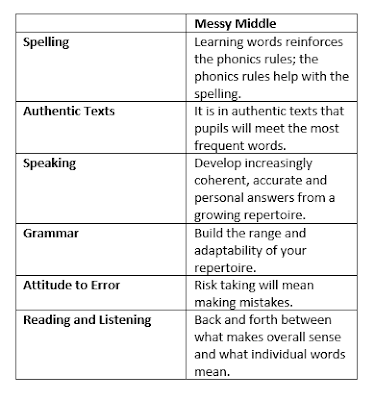
In fact, here's the whole post in one table:


Where do you see yourself and your teaching for each of these aspects?

In Language-Teaching, the Knowledge/Skills debate is also framed around Learning/Acquisition. You will remember from my post last week, that I am not in favour of neat binary extremes. It turns out lots of the "Research Based" ideology is about judging conformity to an idea of how learning should be. Not looking at the reality of learning in the classroom.

I have tried to look at different aspects of language-learning and find "The Messy Middle" for each of them.


This is how I try to teach. In every case it's messy, it's real, and it's focused on the learners. It builds up their knowledge and their skills in tandem. I monitor their knowledge through what they can do with the language. And I deliver the knowledge that they need in order to do more with their language. I work on the increasing independence, accuracy, fluency and coherence with which they can deploy their language.

Instead of splitting into camps and looking for simplistic doctrines and magic pyramids, can we start to get stuck into the Messy Middle? That's the question I posed in the following snippet right at the start of my previous post. Let's enjoy the Messy Middle. This is us:


Friday, 28 June 2024

Nitty Gritty Teaching

 Time to reflect on some of the things we put in place in the light of the Ofsted "Research Review". One idea was that we had been pulling the wrong levers in order to engage young people with learning languages. We always thought that communication, meaning, interesting content, culture and authentic material would engage. Whereas grammar and accuracy would confuse, frustrate and demotivate.

We were asked to think about this the other way round.

What if our focus on communication and culture put cognitive demands on pupils that pushed language learning further out of reach? What if authentic texts were full of little words and grammar that we told the pupils to gloss over in search of meaning from context, leaving pupils frustrated and confused that no-one ever told them what all the little words meant? What if we taught them whole phrases without telling them what the individual words meant and how the grammar worked? Was this the true obstacle to making language-learning accessible?

One thing we brought in was our Fluent in 5 lesson starters. At first to recycle language from previous units, but then increasingly in order to focus on the little words that we might skip over.


The lesson starters were a first step to all teachers tweaking the focus away from the "big words" of topic content, to the "little words" that make sentences work in all topics.

So this is where I find myself with Year 7. All year we have come at it from both angles. We learned "je n'ai pas de" by looking at how Mr Apostrophe ate the e of je and ne. But we also chanted it to a video of a steam train puffing up a hill:  "je n'ai pas de  je n'ai pas de  je n'ai pas de  je n'ai pas de."

And now we are doing rooms in the house. They have learned the rooms using dual coding. They learned the furniture by watching a house tour video in French. And we are focusing on recycling all the words we have done in Year 7 like il y a, j'ai, nous avons, est... All seems to be going well.

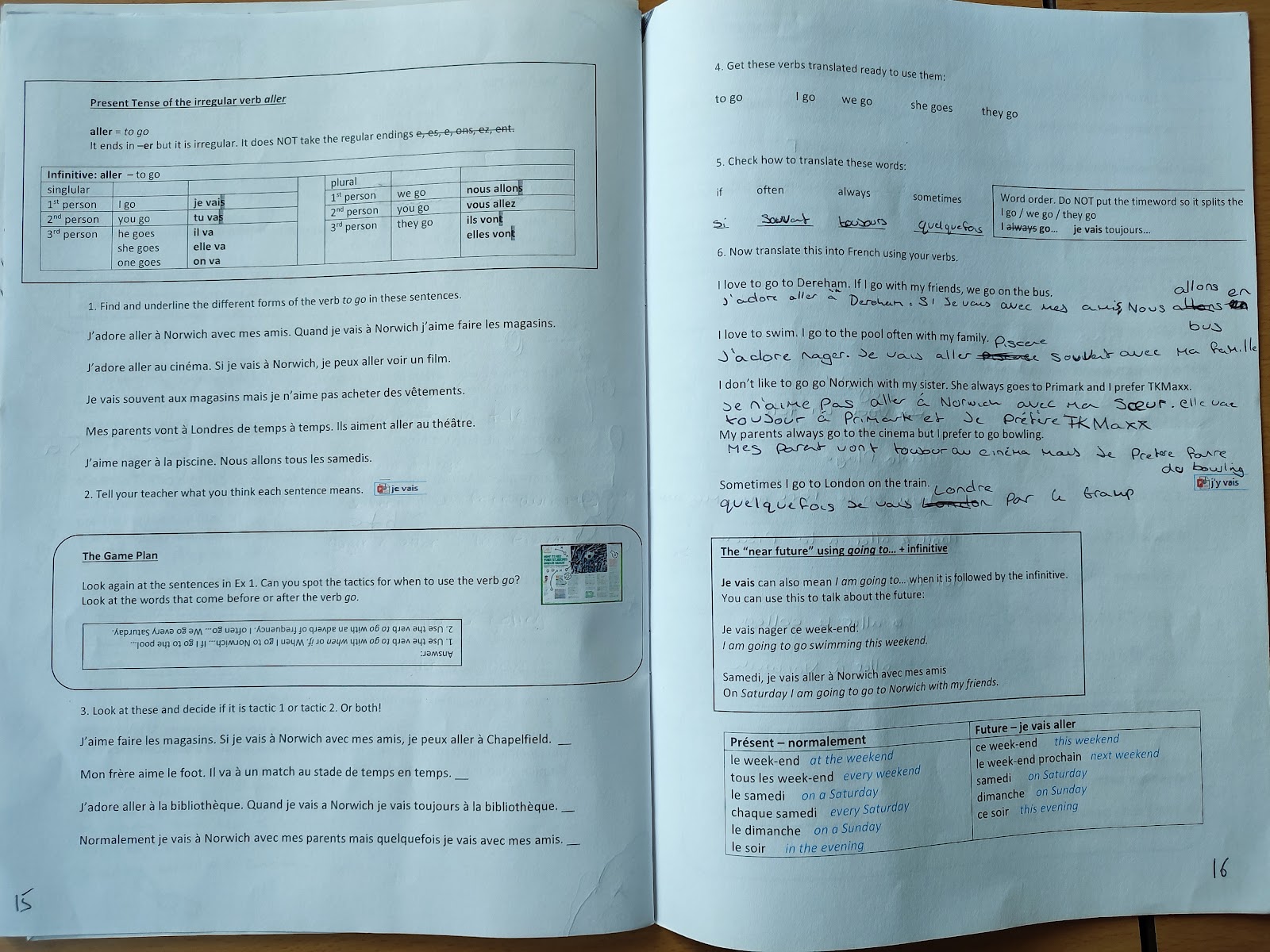
Then I got to this exercise in the booklet:


You can see what it is trying to do. It is giving the pupils the "big words" and asking them to focus on the "little words."

Of course it didn't work. Firstly, most pupils just read the English sentences and put in the words they thought made most sense: a bed, my desk... Not a problem. We often talk about the idea of getting things wrong and then sorting it out, and how powerful this is in learning. Because you remember your mistakes. And because you focused on the detail.

So next step was to ask the pupils to circle in the French the exact words that were meant to go in the gaps. They could do this. We checked the difference between un/une/le/la/des. Here we started to find the problem. The pupils who knew it, knew it perfectly and easily. The pupils who didn't know it, knew the concept and knew they were supposed to know it. But they just didn't care. They were not interested.

I'm not sure what to say to them about it. When I was learning French, getting un/une right mattered so much that when I went to France on my own, I ordered two of everything I bought, rather than get it wrong. Or I avoided saying things. I'm not entirely sure that was a good thing. With my own pupils, I have seen that the time masculine/feminine really starts to matter is when the exchange pupils are here, and all of a sudden it's important to get the gender right when telling a boy what you think of him!

Here's the next exercise in the booklet:


Pupils can see it is to help them describe their house. They can see that it's helping reinforce different verb constructions so their sentences aren't repeating il y a all the time. They can see it's testing if they can spell the words they have learned or if not, to know to check the spelling.

Do they see it as an invitation to express themselves and talk about a real or imaginary house? 

Or do they see it as a grammatical exercise checking if they correctly use le/la/les/un/une/des?

How can we balance these two? Pupils tend to see it as an invitation to communicate. To think about their house, think of the French words, and build the sentence. And I don't think we would want it to be the other way round. A pupil who isn't fussed about what they are saying, but knows they have to get un/une/le/la correct. I don't seem to have a lot of those pupils in my class. And I think that's probably alright. As a teacher, I need to make sure they know how to use the right articles. And I will slowly try to encourage them to see the importance of using the right one. I don't want to make it something that becomes an obstacle, where a pupil panics so much about picking the article, that they lose their focus on communicating. But there seems very little risk of this. The pupils who get it have no problem with it. And the other pupils just aren't bothered.

I'm not sure where this leaves the idea that we were frustrating pupils by not focusing enough on these words. It's not turning out to be a magic bullet. And the answer seems to lie in the middle ground between the two extremes. Which sums up most educational debates! 


Wednesday, 19 June 2024

Planning the new GCSE: The Vision

An audio podcast summary of this post created by notebook LM AI is available here https://notebooklm.google.com/notebook/b5b305aa-6a70-472b-8dec-fedae45e7588/audio May take a minute to load.


 As I start to plan and resource the new GCSE, my vision is this:


A lovely snowball of French. The pupils' French is compacted together into a big ball. It won't melt. It can roll around between topics. More and more French will stick to it. It belongs to them, and they can have fun with it.

I don't want an even covering. An even covering looks pretty, but you come back next lesson and your French has all melted.

Are textbooks good at building a snowball? Or are they designed to create an even covering? What if they cover everything once, ticking it off on a contents page? What if the language in one topic doesn't transfer to another?

In my teaching I want to recycle the same core of language in every unit. I want as much time as possible for the pupils to get good at using that core of language.  I want it to be the language they need in order to perform the exam tasks and to meet the exam criteria. And I want it to be of GCSE standard from the start.

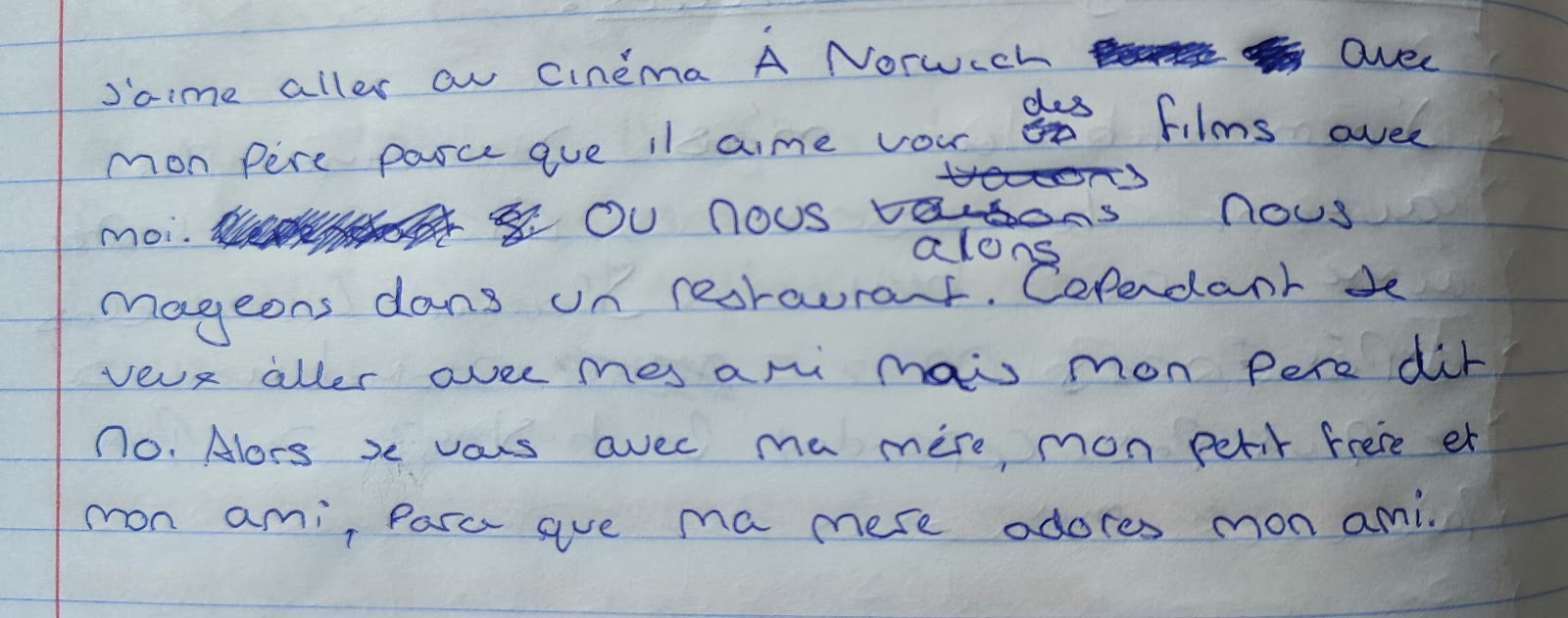
There are plenty of other posts on this blog about the core of language I want my pupils to be confident using on any topic. Here's some examples of work - you can see the same language in every case.

Holidays


School

Shopping


So the first thing I am going to do is to write a Speaking/Writing booklet pulling together pupils' core repertoire from KS3, and using it across the exam topics. It will have GCSE tasks from the Speaking Exam and the Writing Exam. And it will show pupils, even before they start the course or open the textbook, that they have the French they need to tackle the tasks.

The message will be:

  • You have the French. You need to get good at using it.
  • You can do the exam. You may not be able to say exactly what you want to say. We will work on that.
  • You can do the exam. You may not be getting the grade you want yet. We will work on that.
  • You have a snowball of French. Don't let it melt, and more French will stick to it.

Then we will start the book.

I am not entirely sure we will work through the book in order.

Some topics are very similar and are a great opportunity for pupils to practise using their core of language and to practise transferring it across topics: Free Time, Holidays, House, Town and Region, School. As in the examples of work above, I want pupils to be able to deploy their language confidently on any of these topics.

Then topics like Jobs, the Environment, and Technology are slightly less familiar but use more or less the same core language. Pupils can still talk about what they want to do, can do, should do, hope to do, plan to do, usually do... Once they have the snowball of French from the familiar topics, the French from these topics will stick to it.

What topics are left? The ones which are less First Person. Both grammatically and in terms of content. Celebrities, and Culture. We will deliberately tackle the ways in which the language for these topics can be made to stick onto the same snowball. Not to form a separate snowball.

And then there's Self, Relationships, Family. Possibly the most melty topic. Irregular verbs, adjectival agreement. Ser and estar. Short descriptions that don't develop into the same sort of narrative answer. I would want to think about delaying this topic until the snowball is big enough for it to just stick. If it was the first topic, I would be afraid it wouldn't form a strong enough core. I will look very carefully at the role of description in the exams. There are a greater proportion of adjectives on the list than previously. And the sample role play questions (AQA) do ask for a description of someone.

But a short simple description is something I would want to pop into every unit, so it fuses. Rather than trying to build a whole unit out of short descriptions that have nothing to stick to. Reminds me of the rainy day on holiday when I tried to make a man and a dog out of wotsits. If you make the ends wet you can fuse them. But they have no structural integrity and when they dry out they all fall apart. Probably have a photo somewhere.

So I am thinking of re-ordering, combining or revisiting topics. With booklets that sit alongside the textbooks. I am going to deliberately rewrite variations on texts in the book, re-versioning them for a different topic. This will highlight the words that get kept across topics, and make sure they are deliberately revisited.

And in these booklets, I will want to tackle more of the things that perhaps a book can't do well. Things like Unexpected Questions. In the current GCSE there is one unexpected question in the Role Play. And if pupils say a random thing they may or may not get lucky. I have a fantastic example to share from this year once the exam results are all out. In the new GCSE there are 4 of this type of questions. And pupils have to think about giving a developed answer to them. This isn't going to happen without work.

Here are sample unexpected questions (AQA):


The pupil won't see these questions. They will hear them from the examiner. They have to process the question and give a developed answer immediately. What I am doing, is writing texts based on these questions.


We can work on the texts. Maybe for reading aloud or for comprehension, or as model texts. Then I will fire the unexpected questions at the pupils. They will have to process the question. And then the answer is located in the text. They can read it. So the focus is on processing the question. Then we can move on to the pupils giving their own version of the answer.

This kind of work on questions can be done across topics, including coming back to texts we saw in class in previous units. Or we could use texts from the coursebook, that we come back to in later lessons and the pupils have to answer quick fire questions using the text in the same way.

And the last thing that was worrying me was the pupils' snowball of homework vocabulary learning. It will need to:

  • Revise words seen in lessons.
  • Prepare them for the next lessons.
  • Revisit words from previous units.
  • Consolidate topic and non topic vocabulary and the highest frequency vocabulary that is in every topic.
  • Practise the core repertoire.
  • Cover the vocabulary list.

 But it's not worried me before, so I'm going to stop worrying about it now. If I can plan enough revisiting, recycling and crossing over of topics, then when I put together the vocabulary learning for each week, then it should all be taken care of. In a nice big snowball.


Sunday, 9 June 2024

Language Teaching: Building knowledge into Skills

 Where does MFL sit in the current debate about knowledge and skills? We could be the perfect subject to see this play out and explore the rich and fruitful interplay of memory, conceptualisation, accuracy, fluency, expression, and creativity.

There is a lovely idea that skills can be broken down into knowledge. What appears to be a skill is in fact the accumulation and fluent practice of lots of bits of knowledge that can be learned. It's NOT that some people are magically "skillful" or "talented" with some ability that others can't attain. It's that they have learned and practised things that mean their knowledge can be deployed with fluency, confidence and... skill.

It's another way of expressing the idea of "growth mindset." When I was at school, the mindset was one of "talent." Some people were "good" at things and some people just weren't. This became a self-fulfilling prophecy, where a small headstart meant some people went on to excel. And other people gave up or saw themselves as doomed to failure. We've all experienced this narrative of talent (or lack of talent) whether it be in drawing, sport, music, maths, or languages. Growth mindset is the opposite of this. Find out what it is that the "talented" people are doing and practise doing it, in the confidence that you too can learn.

The "skills = knowledge you can learn" argument is currently in vogue, just as people are starting to sneer at the growth mindset. Which is odd. Because it's basically the same idea. I suppose it's a recognition that if we are serious about this, it needs real work and analysis of breaking skills down into micro skills, and won't just happen because of a mindset.

As an amusing aside, we can see how the "knowledge" fad is closely related to other previous fads which are now ridiculed. We used to be exhorted to look at Bloom's taxonomy as a nice pyramid and to beware of only teaching on the lower rungs (memorisation of knowledge) and to try to bring in more "higher order thinking." The knowledge fad is basically the Bloom's pyramid, but this time the exhortation is to spend more time on the lower rungs, working on memorisation. But it's still the same pyramid. It's the use of a neat diagram used to try to pretend teaching is neat and tidy. That knowledge and thinking and creativity can be separated out. 

Or the ridiculous "Learning Pyramid" showing that "You remember 5% of what you are told, 10% of what you read..." With its risible 5% increments, its familiar pyramidal structure and again with its neat segregation of learning. Rightly denounced by everyone. Except of course, it's exactly what the knowledge fad is promoting. They've turned it upside down and reversed the percentages so that being lectured is the most important and experiential discovery is the least effective. But it's still the same pyramid with all its neat simplified hierarchy. 

And VAK learning styles. Learning styles only makes any sense at all if you are approaching from a knowledge perspective. Pupils self diagnose as weak at reading or auditory processing in a dubious test. Only if the teacher sees learning as the inculcation of important knowledge, would they then swerve those areas of perceived weakness (rather than seeking to develop them), in order to get the knowledge across. 

This is because the lovely idea that skills can be broken down into knowledge has been bowdlerised. In fact that's the bowdlerisation right there in that sentence. "Skills can be broken down into knowledge" is only half the deal. The full idea is: Skills can be broken down into knowledge, and that knowledge enables us to successfully and deliberately build up skills. With the second half being the most important: That knowledge enables us to successfully and deliberately build up skills.

And in the toxic mutation that we are seeing, it's that second half which is being neglected.

I will get on to Languages teaching, I promise, and I'm sure you can see that the idea of "knowledge enables us to build up skills" is a perfect fit for what we do.

It goes beyond bowdlerisation. There are toxic mutations. The idea that skills can be broken down into knowledge has been hijacked by the "Knowledge Curriculum" right wing political fad. You hear assertions such as "You can't think without knowledge" advanced to try to separate out memorisation first and thinking maybe later. Knowledge first. Skills... maybe later. Knowledge first, creativity maybe later. The problem with maybe later is that maybe it's always postponed. Clearly this is a problem because it stunts learning and curtails the paradigm of skills broken down into knowledge so it can be built back into skills. I'll come back to this. But first more toxic mutations.

This idea that you can't think, critique, create until a later stage, has been corrupted by the right wing knowledge project in its view of children. There is a philosophy that education is about rescuing children from their ignorance, deplorable communities and degenerate behaviour. There are schools where compliance, conformity, repetition, rote-learning are pushed to exaggerated extremes. Learning is dictated, with an emphasis on authority and "the voices of the best."

The idea that pupils can develop their ability to express themselves, be creative, hear voices like their own, have agency and be empowered, is scorned.

This is all presented as the key to entry into the workforce and escape from deprivation and depravity.

Fortunately this deficit model is limited to a small number of schools. But worryingly, we are in a system of competition and targets where this view of education is incentivised and rewarded and seen as successful.

This political Knowledge Curriculum project likes to hide behind the cognitive science. But it's not the same thing. The Knowledge Curriculum is about what pupils "should be taught." It's political, not educational. And it is not ultimately compatible with the cognitive science. The cognitive science tells us that thinking and memorisation as aspects of learning, cannot be separated.

The mantra of knowledge first, thinking later, is bogus.

We learn by thinking about things. We fit new knowledge into the schemata we already have. Or we alter our schemata in the light of new knowledge. This is fundamental to the "science of learning." It's also born out by what we see. Those pupils who have the confidence to question, to make links, to think of implications, contradictions, associations and even personal leaps of imagination, are the ones who learn best. I'll say it again: the mantra of knowledge first, thinking later, is bogus.

It's the same as the other bogus fads. The Bloom's triangle, the Learning Pyramid. It's a simplistic neat answer by selecting one facet and rejecting the others. Instead of getting stuck in to examine the overlap, the feedback loops, the integration, the reality. It likes to say it's research based. But the "research" is about conforming to a neat model of learning. Not research on the reality of learning. It's an abdication of research. It's reaching for easy clear-cut answers. It is the Nigel Farage of the education debate.

And Languages is a great area to see where the ultimate problem lies.

The foundation of all this mistaken approach, is the way the Knowledge fad sees schemata. The network of knowledge and concepts that pupils are forming. The Knowledge fad thinks that it is transferring the intact conceptual framework along with the knowledge. That well presented diagrams and carefully sequenced teaching will transfer the network of logical links and patterns along with the knowledge. It thinks that the expert who is in possession of a conceptualisation of the whole system, can break it down into neat logical chunks and feed it into the brain of the pupil as if you are programming a robot. (Except we know that even with programming AI robots, you don't do it this way.)

This is familiar territory for us in Languages. This is the Scott Thornbury omelette idea.

Scott Thornbury talks about the synthetic grammar teaching approach that Ofsted were pushing in their "Research Review" and webinars, where someone has chopped up the linguist's overview of the grammar of the language into what seems like logical and organised pieces. He says it is as if you were to show pupils how to create an omelette by taking a cold dead omelette and chopping it into bits. Then you give it to the pupils and ask them to put it back together again. That's not how you make an omelette. You make an omelette from raw ingredients. And you cook them. It's messy, it's different in every case, it's a process.

What if chopping up the Knowledge is not the same as analysing the skills and building them up? What if chopping up the knowledge is just chopping up the knowledge?

So with language learning, it's not the linguist's model of the chopped up grammar that matters. It's what is coalescing in the learner's mind.

And what is going on in the learner's mind is not neat. Or complete. Pupils' conceptualisation of the language is partial, messy, personal, and includes misconceptions and random associations. It's a process of making patterns, extrapolations and assumptions, making links, (mis)understanding rules. Constantly evolving, and beyond the direct control or conscious knowledge of the teacher or the pupil. And although the teacher may be focused on links between words, the pupil may well be more focused on links between words and the real world. Creating meaning and learning the words for things.

So when we teach the topic of pets, the teacher knows that genders, plurals, pronunciation and the verb to have are most important. But the pupils just want to tell you all their pets and their names. And we wouldn't have it any other way. Once the drive to communicate is lost, language learning doesn't happen.

This is what teaching is. Working with pupils and their evolving understanding. Of course well sequenced planning and clear explanation is important. But the sequencing is the process of growing what the pupil understands and can do. It's not the prearranged sequencing of chopping up the expert's overview into what they imagine should be logical from their position.

Chopping up the Knowledge is not the same as analysing the skills and building them up. Chopping up the knowledge is just chopping up the knowledge.

You're not following a neat foolproof recipe. When you make a roux, your attention is on what's happening in the pan. Stirring, adjusting the heat, adding more liquid as required. Don't keep looking at the recipe or throwing in the amount of liquid it stipulates. Keep your eyes on what's happening in the classroom. That's why having a lovely coloured triangle with percentages or a magic bullet simple pseudo science theory is limited. And what we really should be researching is the reality. How thinking and memory combine. How skills and knowledge inter-relate.

I think I've made my point there. I had some ideas about what that means in my experience of language teaching to include. I will look at them in a later post. I'm running out of space here, but I'll sketch them out because the point of this post is to say it's the reality that matters:

  • It's always been my mantra that "It's not about learning more language. It's about getting good at using what you know." This is what ex pupils always identify as the key insight they got from my teaching.
  • Try to make pupils' partial stock of language a working repertoire they can deploy. Rather than bits of a plane that will only fly once they eventually have the whole kit.
  • Define grammar as the kit of language that can be deployed to generate meaning. Not an abstract set of intellectual rules.
  • Use metaphor for metacognition so that pupils understand they are accumulating a compact snowball of language. They mustn't let it melt, and more will stick to it.
  • Encouraging pupils to use their partial interlanguage to express themselves, understanding that the more they take risks, there will be mistakes. But that's how learning works.
  • Understanding that we have to work on thinking up what to say, making it more coherent, more developed, personal, spontaneous. This is as important as learning more language.
  • Teaching routines and strategies that pupils can deploy, so that their knowledge is built up into skillful performance and used creatively.
  • Constant monitoring of the balance of explicit and inductive conceptualisation and deployment of rules.
  • Seeing that it is in using the language that pupils create the links and articulations of their knowledge, explore its limits and possibilities.

If you are familiar with how I teach or with posts on this blog, you will see that this is what I have spent the last 30 years developing. Teaching that engages with where the pupils are. A sequencing of language that creates a living, working repertoire that can be deployed and which will grow.

Saturday, 1 June 2024

A Year 8 French group who are really on the ball

 A scientific hypothesis has to be tested against reality. And the biggest test is whether it can be used to predict outcomes. Not just to test its validity but for it to be useful, creative and to contribute to a better world. A similar thing can happen with metacognition. Our understanding of the learning process and how we share that understanding with pupils. One of the best ways to do this is through a metaphor. (Spoiler. All theories of cognition rely on metaphor.) A robust metaphor isn't just a description of a concept. It can guide thinking and be extended to knew knowledge and how it is deployed.

I have written before about metaphors which can unlock the language-learning process for pupils. This post is going to look at how the Football Game Plan metaphor for learning to develop extended answers has gone down with my Year 8 class. And importantly, how a tried and tested metaphor took a new twist. A new twist that meant what they were learning fell into place and transformed a piece of knowledge into a new skill they could deploy.

I had already shown them the overall GCSE speaking/writing game plan so they could see how their learning fitted into the overall picture. Here's a Spanish version of the game plan.


You can see there is a defensive half, where pupils have to be able to play out from the back, moving the ball around with confidence. And the attacking half, where pupils can take risks, show off some fancy moves and try to score some goals.

My Year 8 are totally in control in the defensive half.


There's no need to take risks. They can talk all day if necessary without giving the ball away: I like... because I can... but I don't like... if I have to... because I love... and if... then I can... but if... then I prefer... but I don't like... because I can't... and I have to... so if... then I prefer...

Just about all of the girls and most of the boys in my Year 8 class are very keen on football. So it's a nice metaphor to use. There are a few who aren't as obsessed with football, but if they learn a bit about the modern game through their French lessons, then that's all valuable knowledge.

It gives them key tactics - Note the one-two with the if sentences. If it is sunny then I like to go to the beach... but if it rains, I prefer to go to the pool. But it also shapes their attitudes to learning French - Well drilled skills, quick thinking, decision making, control and risk taking.

But this term, it's really clicked with this group. And it's taken care of an element that isn't in the original game plan, and made it work in a way it wouldn't otherwise. I'm talking about conjugated verbs.

You'll notice the preponderance of 1st person verb + infinitive forms in the game plan. My Year 8 French group have been working on er verbs in the present tense. This doesn't fit with the game plan. It's something they learn, but not something they deploy readily enough.

Here's what happened.

We are building a model answer together on the board.


Every pupil in the class will automatically know to pass the ball and move into space with because I can or especially if... Just like this:


What we have here, is a new opportunity. If you mention someone else (in this case mes amis), then that is when you have the chance to use your conjugated verb.


I like to teach pupils this as a rule or as a trigger. When you mention someone else, always follow it up with using a conjugated verb. If you say with my brother... then you can say he... or we... And some pupils get it. But with this Year 8 class, this is where the football metaphor kicked in. With an idea that just clicked and meant the pupils really went for it.

I used the words they will have heard time and time again from their football coach, or seen pundits show in TV analysis: When you mention another person, "even before you receive the ball, you get your head up, have a look, and see what your options are."


You can see how pupils now look at the arrows on the whiteboard in a different way. Instead of being some confusing French words that don't mean much, it's now a range of options for them to pick from as part of a quick decision-making process where they need to be on the ball.


The only thing was. When they started to use it for themselves, it turned out the verb they really needed in the present tense was aller


Which is lucky. Because that's exactly what's next in the plan!


Sunday, 26 May 2024

Hot and cold over Cold Calling

 I've let some of the heat go out of the Cold Calling debate on twitter before writing this. What I want to say about it is too much and slightly too complex for a tweet. And I'll try to be true to the Nice Man ideals on here and do it without the eye rolling  and side-taking you might fall into on twitter.

I don't like the name. Cold Calling. Sounds like a poem by T.S. Eliot. I don't think anyone likes the name. I don't mind the concept. But it worries me that it's such a Big Thing. I can't imagine teaching a lesson where you are only interested to hear from the pupils who have their hands up. Rather than rolling my eyes, I am shaking my head at that idea. But there are circumstances where exactly that scenario plays out. I will come on to that.

Then there's hands up. Again, I am looking askance at the idea that you can't have pupils putting their hands up and then go ahead and ask one of the pupils whose hand isn't up. Of course you can do that.

So how do I try to build participation and engagement in my classroom?

Hands up:

  • Ask the question to the whole class and expect everyone to think about it and be ready to answer.
  • If I ask a question or ask for participation, pupils put their hands up. I might narrate what I am doing: You know I'm going to ask you sometime this lesson, so put your hands up now so you don't end up at the end with a question you don't want to answer.
  • I might, or might not ask one of the pupils whose hand is up. I will narrate what I am doing: If your hand is up, I have noticed, but I might ask someone else.
  • I might give more time for pupils to put their hand up: I'm starting to wonder about the people whose hands aren't up. I need to find out what they are thinking. And then I will decide who I want to ask. Hand up, or no hand up. I decide.
  • If there's a series of questions on the board, I won't necessarily go through them in order. I'll let pupils pick which one they want to answer.
  • I keep a list in my head of which pupils haven't participated yet. And I let pupils know that I am doing this. And just because someone has answered, doesn't mean I won't come back to them.

Does this mean that I am asking 30 questions per lesson or having 30 interactions per lesson. Quite possibly yes. I do a lot of Question and Answer, building model answers or asking for participation in speaking French. There are ways of involving more than one pupil in a question. If there are pupils who have their hands up but you ask someone else, you can check that answer with the other pupils before accepting it. Is that what you were going to say? Was there something you want to add to that answer?

With my Year 7 class recently, I did my reminder spiel about how I'd be asking everyone at some point. And one of my most potentially reluctant pupils put their hand up and said, "I don't know the answer but I do know that..." and reeled off three things that all related to the question and made the next questions to the class much more focused and fruitful. That's what I'm trying to achieve. Not catching pupils out!

And how you respond to pupils' answers is also vital to a climate of engagement and participation. If a pupil doesn't want to say a word because they are worried they would say it wrong: "It's literally my job to find out what you're struggling with and teach you." Being genuinely interested in what pupils think. If someone does get something wrong, then thank them for helping tackle it. And when later in the lesson, people get it right, go back and thank them for making sure we all paid attention to it. Most importantly, being prepared to deal with what their (wrong/partial/tangential/unexpected) answers throw up.

This week I asked "How do you say I would like?" and the pupil took an unexpectedly long time to reply and said, "Is it je veux aimer?" Which was the perfect answer to get at several key features of je voudrais. The different way English and French deal with the conditional tense, and the fact that French uses vouloir not aimer.

And this brings me on to where the hands up/cold calling dilemma does come into play. In my normal class teaching I am actively seeking out where there is misunderstanding or partial understanding. I am leading the class in collective thinking, correcting errors, making links and exploring the boundaries of their knowledge. What happens to change that?

Two things change that situation completely. One is if it's not my class. The other is if the lesson is being observed. 

If it's a class I have borrowed, because I'm covering for an absent colleague for example, my narrative of knowing each pupil and where they are with their learning, and me being responsible for their progress, and having the right atmosphere of trust and engagement, doesn't apply. I might just gratefully take contributions from the pupils with their hands up, just to keep things rolling and get to the end of the lesson.

If I am being observed. Do I really want to be probing and seeking out misconceptions and things that could derail or divert the lesson? As a teacher of some 25,000 hours' experience, who really doesn't care what an observer thinks, then I might. As a less experienced teacher, being judged by the observer, then I might not. I might naturally do everything to keep the lesson precisely on the rails by gratefully accepting the participation of pupils who volunteer the right answers.

So a trainee teacher or a new teacher may well find themselves with a class that isn't yet really "theirs", and also being observed. The double whammy! In these circumstances, the hands up v cold calling debate does kick in. With an unfamiliar class, picking pupils at random using lollypop sticks with names on is a way to take the blame for picking on a pupil away from the teacher. It was random, it was fair and it could even be fun. And it's the start of that conversation about, "I'm not testing you to try to catch you out. I am genuinely interested in your answer."

The French teacher's secret weapon is to pick the pupil using Am stram gram... Pupils love it and surreptitiously try to memorise it and join in. And of course if you get picked by am stram gram, you have to contribute because them's the rules.

Also helped by the fact that my friend Charley Guigon on my year abroad (pre Google) had a collection of these rhymes from around the world which he passed on to me!

That's why I couldn't fit it all in a tweet. I don't like the name cold calling. I don't teach in a way that's about right/wrong answers and catching pupils out. I want all pupils to know that I will value their participation. I expect their participation, but give them some opportunity to do so on their own terms. They can put their hands up, but if they don't, then they know I'll be interested to know why not. They can pick which question to answer or answer a slightly different question, or answer it with a question, or give a partial answer or even a wrong answer. And we'll take it on from there. And they know that whatever happens, I'm keeping track and I know where to go next. And when it works, it's fantastic with the class buzzing to take part confidently.

And sometimes it doesn't work. And I'll tell them that I seem to have pitched it wrong today and I'll have a think and pick it up again next time.

So that's the debate I think we should be having. How to create a class with participation and engagement, with a teacher who monitors and adapts. That's the rich and fruitful complex area I'd like to be exploring. Not picking sides!

What I do want to ask the experts and the gurus, is what to do when it's just not working. When it's a rainy Thursday afternoon after PE. Or the pupils are too hot. Or I'm too tired to think straight. Or it's that class that just hates me and French and the universe today. When you've tried everything. How do you get them to glimpse how great lessons could be if they took some risks, had a go, listened carefully and thought about things? Starting from admitting that sometimes things are just not working for me!

Here's a post on what happened when a Year 9 Spanish lesson just wasn't working. https://whoteacheslanguages.blogspot.com/2023/01/the-lost-art-of-teaching-with-whiteboard.html

Here's a Year 8 French lesson that just didn't work. https://whoteacheslanguages.blogspot.com/2022/05/it-turned-out-alright-in-end.html

And I had one with Year 10 Spanish last week where we worked on something for 3 lessons and what I wanted to achieve by the third one just didn't happen. I'll write that one up too sometime when I've decided what to do about it.

It's not the neat either/or picking sides that matters. It's the messy ground in the middle where relationships, experience, adaptation, quick thinking, genuine interest in pupils, and clear vision of where learning is probably going happens. Let's all get stuck into that!


Months later and I have had a thought. What I describe here resembles "cold calling" in that I want all pupils to know that when I ask a question, they all need to have an answer ready in case I pick them. But I strongly resist describing what I do as "cold calling". I think I know why. Cold calling seems linked to testing recall, maybe even catching pupils out. Wanting to hear a correct (even scripted!) answer. That's not what I am doing. I want my pupils to know that I am genuinely interested in what they are thinking. They don't have to guess what words they think I want to hear. I want to hear their own words. Because it is the only insight I have into their thinking: conceptions and misconceptions. 


Sunday, 19 May 2024

The New GCSE Vocabulary List. The Final Word?

 I've had at least two goes already at tackling the implications of the High Frequency Vocabulary List for the new GCSE. Wouldn't it be nice if we could put it to bed for ever? And even better if I could conclude that this means we need to change NOTHING for the new GCSE. An opportunity to change things we want to change. But NEED to change...? Maybe not!

The Vocabulary List was a promise and a threat.

The promise was that it would give a defined list of words for pupils to learn. Then they would be tested on whether they had learned what they were supposed to be learning. It would get rid of the situation where the exam contained unknown words that pupils were meant to deduce. Or bizarre words that were on the vocabulary list but no-one taught. And more fundamentally, it was part of a push away from a topic based approach where words were seen in one context and then never met again.

It promised to solve the perceived problem of the current GCSE, where there is a big discrepancy between the words learned for the speaking and writing exam (opinions, reasons, tenses and topic words), and the words learned for the listening and reading exam. This promise was always bogus. Because we don't in fact make pupils learn the whole list of words from the specification. If merluza or gamberro come up in the exam, we take that hit for a couple of marks. What we do ask pupils to learn is the list of non-topic words such as few, often, some, early, more, worst which the exam boards love to test. This kind of high frequency non-topic words is nothing new.

And of course, it does nothing to get rid of the real problems of the listening and reading exams: the tricks and traps. In fact, with a defined vocabulary list to learn, there may have to be more of these, because the same number of pupils will still have to get the questions wrong, even if they have learned the words.

The promise was bogus because while it offered the hope of reducing (or defining) the vocabulary demands, and unifying the words learned for speaking/writing and listening/reading, it has done no such thing. The word list basically does not apply for speaking and writing. There is no way that teachers are going to say to pupils, "You might like skating, but we're not learning that word because it's not in the exam, say football instead." Or in a French restaurant in 2040, a father says to his child, "I can't order chicken, it wasn't on the exam vocabulary list. You'll HAVE to have the rabbit instead."

If the GCSE panel wanted us to have speaking and writing tasks where pupils didn't want to say skating or chicken, then they should have gone with the calls from @MFLTransform and others for a curriculum based not around pupils' multifarious and trivial interests, but based on the study of culture. This would also have given a push to move away from the 1st person domination of the course and the language.

And a High Frequency Vocabulary approach should have been compatible with use of authentic (or modified) cultural materials. If these are the words that appear in all texts, then a switch to a focus on high frequency vocabulary should have been the key to properly unlocking real texts. Somehow the Ofsted Research Review managed to conclude that authentic texts were unsuitable at the "novice" stage. Because they hold the view that meaning is arrived at by word by word parsing of known words and grammar, and that reading texts should be for modelling the language pupils are learning to speak and write.

It seems perverse that we ended up with a High Frequency Vocabulary approach, matched to a specification which presents itself as being based around individual inclusive first person lifestyles. The diversity and individuality don't seem to fit at all with the approach that we should stop teaching all the words for every pupil's pet or hobbies or nationality.

And given the nature of the tasks, this approach is not going to prevail. We will not be cutting out the words that pupils need in order to talk about themselves and their lives.

So that was the promise. Not going to happen.

What about the threat?

The threat is that even if we don't want to follow this approach, the new GCSE is going to push us in that direction. Our old texts and resources will be full of words pupils don't need. And missing the words they now need. And if we try to write our own new texts, they will be full of the wrong words. We'll be tearing our hair out to write texts and tasks that only use words that are on the list.

Can we put that threat to bed? Certainly for the speaking and writing, we can continue to teach exactly as we always have. The pupils are going to have to answer the same sorts of questions, perform the same sorts of tasks, and tick the same boxes as always.

And for listening and reading? Well, nothing's changed. We've exchanged one vocabulary list in the spec that no-one looks at, for another. Look at the new vocabulary list. Do any of the words on there actually scare us? Not really. Pupils might meet them during the course or they might not. They might just meet them on some cards or a list of words to be learned. Are they going to meet them throughout the course in different contexts, carefully tracking and meticulously planning how many times and at what intervals they meet each word? For 1750 words? Not going to happen. Time to relax and stop pretending it's going to.

And like that, in a puff of smoke, all the issues of the new GCSE disappeared into thin air. Empty promises. But also empty threats. If we stop believing in the good (or bad) vocabulary fairy, then you can do exactly what you want for the new GCSE. So stop worrying and start looking at it as an opportunity.

Saturday, 18 May 2024

Describing - Planning for Aspects of the New GCSE

 You might be surprised that "Describing" is one of the aspects of the new GCSE that I am focusing on. But for the current GCSE, I don't really tackle Describing. (My pupils will be disappointed that I'm not referring to it as describering, to match scuba-divering and swimmering.)

I know a lot of resources tick the box for opinion + reason by teaching "I like... because it is..." And pupils do also automatically reach for this, and then realise they don't have a convincing opinion and the answer is going nowhere. Instead, I teach them to say, "I like... because I can..." And in fact, it then turns into "I like... because I can... but if... then I prefer... Sometimes I have to... especially if.. for example..."

Even if they did say, "I like... because it is..." then I would expect them to follow it up with "so I can..."

It's not just because this creates good routines for extending answers and meeting the criteria for the current exam. It's also because it creates a repertoire of language they can transfer across topics. And because once they have this core of language, other new words and grammar coalesce around the core. It becomes like a snowball of language that doesn't melt away, and in fact gets bigger and bigger as more language sticks to it.

I don't find that it is + adjective has the same power.

How do I get away with not teaching describering for the current GCSE? Because if you ask "What do you think of..." then you are going to get a better answer than if you say, "Describe..." or "What is x like?". So in conducting the exam, I always go for a question that gives the pupils a platform for showing what they can do, rather than questions to test if I can catch them out.

What about the new GCSE? The increased number of unprepared questions scripted by the board will be a major feature. I have written about this and how I plan to tackle it here. And the High Frequency Vocabulary List approach means there's a lot of adjectives to learn and be tested on.

Currently, "it is" + adjective isn't a big part of my teaching, because the word "describe" does not appear in the criteria for the speaking exam, whereas the word "narrate" does. The word "narrate" has disappeared from the criteria in the new GCSE. And it gets worse for my approach. The new GCSE exam guidance from AQA, where they interpret what is going to be meant by "good development" is a bit of a shocker:

From the AQA guidance accompanying the SAMs.


"Good development" is exemplified as "I don't like... because it is..." And to add insult to INRI, the adjective they give is "boring." This does NOT mean I will be stopping teaching routines and repertoire for extended answers. Firstly because they will still need to talk for 5 minutes. And secondly because of the importance of having this core repertoire for all other language to stick to.

But if we look at the scripted questions, will I have to boost my teaching of description? What if the card says, "Describe your school" and the pupil says, "I like my school because I can see my friends but I don't like the teachers because we can't work together except in Spanish where we can talk Spanish, of course." Would AQA give this answer no credit because they didn't "describe"?????? I'm not going to risk it.

The thing is, describering is tricky. If you mean verb to be + adjective. It's always an irregular verb. Of course we should teach irregular verbs. But it doesn't mean it sticks. Pupils know is but are is much more tricky. Then there's ser/estar in Spanish. Of course we teach it. But it remains a minefield, as we know from the current photo card, where pupils should switch between the two, but don't. Plus confusion between is and there is and sometimes the verb to have or sometimes the verb to do/to make when it comes to it is sunny. And in French the huge trap of there being no present continuous. We all know the feeling when in the exam a pupil has a photo of some people working and they start with the words, "Ils sont..."

And then there's adjectival agreement. And don't even get me started on pronouns. And I don't even mean object pronouns. Getting the right word in French for "it" in "it is..." is complex and tricky beyond the point where most pupils can be bothered to care just to say something so simple. And I think the exam boards have probably given up too. Do we just accept c'est rather than asking pupils to identify the gender of the noun in the question and use il / elle ?

Of course we should teach these things. But they don't make for a strong core of useful language which pupils can deploy. It doesn't make for a strong core around which other language can coalesce. They are tricky and bitty and conflicting. They are precisely the sort of language which can start to stick once pupils already have a good size snowball of language. And precisely the sort of language that melts away if you start with it and it has nothing to stick to.

Let's have a look at the SAMs from AQA and see where the word Describe is used.

Wow!!!! Thank you, AQA! These are examples of the scripted questions that could come after the Read Aloud task. Pupils do not see these questions in the preparation period. They are unexpected questions they have to listen to. Not a single describe in sight. They are the kind of open questions that give pupils a platform to speak. They go for the formulation "Talk to me about..." which gives pupils permission to say "I like... because I can... but if... then I prefer..." rather than "It is..." Can we trust AQA to stick to this? I hope so but I'm not going to risk it.

AQA Sample unprepared questions following the Read Aloud task


What about the AQA Role Play questions?

AQA Sample Role Play Questions


There we are. "Describe" is on every card. This is a slightly different teapot of fish though. These answers are prepared in the preparation time. And they only require a short answer. They are all about people so the choice of il/elle and the gender of the adjective should be clear. Or just learn sympa and extra which are invariable.

So what would I plan for the new GCSE and what would I look for in a textbook?

  • I don't want to start with describing.
  • I want to build a core repertoire of powerful, useable, transferable language first.
  • I want to see describing added on to this core of language, in small doses in every unit.
  • I don't want to try to make describing into a massive feature if all that's needed is My friend is nice.
  • I do want to make sure all the adjectives are covered for the Listening and Reading exams.
  • I think the photo card is less about description using to be + adjective than you might think. But I do want talking about a photo to be built in to every unit, with lots of reusable and recycled language for talking about any photo.
  • I do want the complexity of describing (verbs to be, gender, pronouns) to be dealt with explicitly, once pupils have enough language for it to all make sense.
  • If a textbook does start with the verb to be and the verb to have, and spends a unit describing people, I want to see where this is picked up in subsequent units. Where does it lead? How is it sustained?

There. You might have been surprised I wanted to do a whole post on describering. But I am glad I did. I got a few things straight. And also found that for AQA it might not be as much of a big deal as I was fearing. I'll have to look at the photo card in more detail in a future post though...


Monday, 13 May 2024

Vocabulary and the new GCSE - a second attempt

 In a previous post, I tried to think through what I wanted from a Scheme of Work for the new GCSE in terms of Vocabulary and the Vocabulary List. I ended up going round in circles. It's been going round and round in my head ever since, so I'm going to try again to get it straight, and at least work out what the issues are I want to solve.

Here's a list of Vocabulary headlines:

  • I don't want to give the pupils the entire exam board vocabulary list and say "Learn this" - whether that be at the start of the course or in panic revision mode at the end!
  • I don't want to chop up the exam board vocabulary list and give them a chunk a week, that has nothing to do with the words they are seeing in lessons.
  • I do want weekly vocabulary homework lists to relate to the words we see week-by-week in class. Whether that be for seeing vocabulary in advance of the lesson, or for revising vocabulary after the lesson.
  • I don't want words to be met as a one-off because they appear in a text or because they are on the list or because they relate to a topic.
  • I want to make sure the vocabulary homework lists cover all the words on the exam board list, and that they are met and re-encountered in class in different contexts across the course.

What I can see now but which I failed to pin down explicitly enough in the previous post, is that this isn't about the vocabulary homework lists at all. The vocabulary lists we put on Quizlet are extracted from the course. So what matters is that the course itself - the way it is planned and resourced - makes sure the whole vocabulary list is built into the texts and content of the course.

In the first instance, we could look to the textbooks. Have the publishers constructed such a course, starting from the vocabulary list? Or have they started from a topic approach, using such words as are appropriate to the topic? They may have identified in the unit vocabulary pages which words are on the exam list. Have they shown us the other way round? Where are all the words on the vocabulary list met and re-met?

I also think there is not going to be a perfect solution. And maybe we are not going to see the change of approach the new GCSE was supposed to bring in. The exams may look pretty familiar. And the language pupils need for Speaking and Writing is not going to be limited to the Vocabulary list.

So I think I need to stop hankering after a perfect solution, and think clearly what I can realistically do:

  • Vocabulary homework lists which combine the core repertoire of opinions, reasons, descriptions, tenses with the vocabulary for each topic.
  • Vocabulary homework lists which combine the high frequency non-topic words (often, a bit, some, nobody) with the vocabulary for each topic.
  • Deliberately re-writing texts from the textbook to mirror them in other topics, to re-encounter and emphasise some of the words that could belong in any topic. Especially verbs (manage, succeed, follow).
  • Monitoring which words slip through the net (puissance, souci or gérer), including giving pupils this responsibility.
  • Assessments which do not have a topic based focus.

What I have just done is recreate the previous post. With less ranting and less going round in circles. But coming to the same conclusions! I suppose that's progress. And it means I think I have the Vocabulary question in a state where it can fit in with the other elements that need putting together, without it being the piece of the jigsaw that just didn't fit. It's going to have to fit!


How close am I to concluding that if the Vocabulary List doesn't mean we have to change everything, do we actually need to change anything much at all? Try this post where I finally shoot the Vocabulary List fairy.

Saturday, 11 May 2024

Planning for Aspects of the new GCSE: Vocabulary

 In recent posts, I have been looking at aspects of the new GCSE. (Link to these posts here.)  I don't have the answers, but writing the posts has helped me think through what I need to plan. This post is going to be on the thorniest issue, and I have a feeling that by the end of this post I will NOT have come up with the answers.

What is it that keeps me awake at nights? The vocabulary problem.

The vocabulary lists are central to the new GCSE. If our pupils learn the words on the list, then they will do well in the Listening and the Reading exams. The Listening and Reading exams will be made up of the words from the list.

We could just give the pupils the list and say "Revise this". And I am sure we will! But what we really should be aiming for is a situation where the pupils have met these words repeatedly in different contexts throughout the course. And where the texts we use are deliberately built out of these words and don't "waste" time and effort on words that are not going to be in the exam.

Will the textbooks rescue us here, with texts carefully constructed to recycle all the words on the vocabulary list, tracking when pupils meet and reencounter them so all the words on the list are learned?

A couple of factors muddy the waters. For the Speaking and Writing exams, the vocabulary list has gone out of the window. Pupils will use words which are not on the list, in order to answer the questions about themselves and their personal likes, dislikes, activities and circumstances. So textbooks and teachers are entitled, nay required, to deviate from the word list. When we model the answers pupils will give in the Speaking and Writing, we will not be sticking to the vocabulary list. They will need words like chicken, skating, clarinet, socks, Portugal or axolotl.

These factors will disrupt the clarity of what is to be learned for the Listening and Reading. And require pupils to have a larger active vocabulary than receptive. But the real danger is that it skews our teaching to the small set of useful topic words on the list, so we regularly use horse, dog, fish. But miss out repeatedly using puissance, souci or gérer.

And this confusion has muddied this post. I wasn't meant to be talking about that. I wanted to look at what it means in practical terms.

Let's start again. With the current GCSE, our pupils have vocabulary to learn. This is hosted on Quizlet. It is NOT based on taking the current GCSE vocabulary list and chopping it up. It was originally based on the vocabulary from the textbook, page by page - week by week. This meant learning could be set so pupils saw words in advance and came to lessons with some of the vocabulary they needed or that they were going to meet in texts or listenings. Or it meant that during the week, they met words in lessons and then went home and revised them. So we were relying on the textbooks to provide coverage of the vocabulary.

This had to change. It quickly became obvious that pupils were meeting words as a one-off, never to be seen again. So we changed it. We moved away from it being a list of single words, to having phrases. This meant vocabulary items were in longer, more useful chunks. The vocabulary revision became revision of high frequency useful language, using the vocabulary from each unit in order to recycle the important language in different contexts.

So with the new GCSE, what I want is:

  • Vocabulary lists so the pupils can be confident they have covered the content of the exam.
  • The vocabulary to be in chunks, not single words.
  • All the words on the specification to be met again and again in different contexts, with well though-out spacing.
  • The list to directly match the words that pupils are meeting in lessons that week.

How am I going to arrive at these lists?

Can I go through the texts in each unit of the textbook and make lists? Or will this result in topic based lists where words are met in one unit and never seen again? Or lists where topic words are over-emphasised at the expense of high frequency words?

Can I start with the exam board list and try to match it to topics? Or will this end up with pupils learning words they don't actually meet in lessons? And how will I get my head around meeting and reencountering so many words? And will the lists end up being topic based again, neglecting less obvious words?

Can I keep our current word list, but check it (with the multilingual profiler) to remove words that aren't on the list? How would this guarantee we cover all the words we need? Would this approach mean we may as well keep our current textbooks, or continue using them alongside new textbooks?

This is where we need to be able to trust the textbook publishers to have done a good job. Each unit has a vocabulary section. In some, it shows how many of the words are/are not on the vocabulary list. If we take the words from each unit of the textbook and put them into chunks and put them into lists for the pupils to learn, will this cover the whole of the vocabulary list in a way that means words are learned and then cleverly recycled rather than forgotten?

I really want to find a solution to this. For the current GCSE, our pupils learn the words they need for the Speaking and Writing core repertoire and topics. They learn the non-topic words that come up so often in the Listening and Reading exam - siempre, bastante, poco, desde hace, estoy harto de. Will this be enough for the new GCSE?

Maybe we should keep an eye on Oak Academy and LDP resources. I am hoping they have inherited the NCELP approach of meticulous tracking of deliberate vocabulary encounters. Will this be something we can adopt or tap into?

What I mean by this, is that if we include the word réussir on Tuesday the 12th of September in a text on Family Relationships, unless we meet that word again 10 times by Thursday the 15th November at 12.30 in different contexts, then the word will be forgotten and we may as well never have taught it. OK. I can do that. For the word réussir. But it's beyond me to do it for all the 1700 words on the list. And that doesn't make me a bad teacher or the learning pointless. You can tell by the sarcastic 15th November, it's not how I see things. Here's a post on exactly that - teaching is like thickening a roux. Your eyes are on what's in the saucepan, not on the quantities on the recipe list. Although thinking about and trying out ideas you don't initially agree with is the best way to learn and develop. And there's a bigger but..

BUT...

But even if you roll your eyes at this view of learning, what if the new GCSE is specifically designed to impose this approach on us, whether we want it or not? It has to be something we think about.

I am very nervous of something carefully planned on paper that just doesn't happen in the classroom. I prefer something that emerges from what works, has evolved to cope, and is robust enough to survive in the real world. My instincts are telling me that I will have to go with these threads:

  • Vocabulary lists based on the words pupils meet in lessons - new textbooks, old textbooks, our own texts, model answers and pupils' own answers.
  • High frequency non-topic language - deliberately recycled and highlighted in all topics.
  • Core repertoire language for the speaking and writing exam, combined into chunks with the topic vocabulary.
  • Cleverly and deliberately re-using words across topics, by writing new versions of texts encountered in previous topics.
  • Deliberate monitoring of what words are being missed, starting by looking at what words are on the list that we don't currently teach, and making sure they appear across topics.
  • Deliberately creating assessment texts which don't stick to a topic, eg using full past papers from early in Year 10.

That looks as if I might have answered the question about how to make useful vocabulary learning lists for pupils. But that's not really the question. The question isn't about the lists. It's about the course. How do I make a course and resources which deliberately use all the words on the vocabulary list over and over again? It's not about extracting vocabulary lists from our texts, for pupils to learn. It is about how the words on the vocabulary list are programmed recurrently throughout the course. And I'm not sure how I can do this!

I am going to have to come back to this. Again and again!

One thing though. If it weren't for the Vocabulary List, would we even have to change anything at all? Spoiler alert - I got there in the end. Try this post to end all posts on the matter.

Now you've got to the end of this, if you've got your answers to the questions, please share them. If it's left you with annoying questions you didn't know you had, then please read this follow up post, where I've had another go at tidying it up and making Vocabulary ready to fit alongside all the other pieces of the jigsaw we have to put together.


Links to posts on planning for the new GCSE

Links to all posts on planning, resourcing and actually teaching the new GCSE:


Working on the three different sorts of answers you need for the speaking exam. https://whoteacheslanguages.blogspot.com/2024/11/working-on-three-types-of-questions-for.html

Moving to a new topic after half term. How well do the key types of language knowledge transfer to the new module? https://whoteacheslanguages.blogspot.com/2024/11/when-everything-youve-told-pupils-about.html

The first half term teaching the new GCSE: https://whoteacheslanguages.blogspot.com/2024/10/getting-started-with-new-gcse.html


From Module 1 Booklet: Cheating Translation. https://whoteacheslanguages.blogspot.com/2024/08/cheating-translation-neat-trick.html


Module 0 booklet for before pupils start the new GCSE textbook. https://whoteacheslanguages.blogspot.com/2024/08/new-gcse-module-0-booklet.html

Starting to plan the shape of the course and materials to supplement coursebooks. https://whoteacheslanguages.blogspot.com/2024/06/planning-new-gcse-vision.html 

Will "describe" replace "narrate"? https://whoteacheslanguages.blogspot.com/2024/05/describing-planning-for-aspects-of-new.html

Vocabulary. Post to end all posts on the matter. In which I shoot the Vocabulary fairy and the kingdom is restored. https://whoteacheslanguages.blogspot.com/2024/05/the-new-gcse-vocabulary-list-final-word.html

Vocabulary second attempt to hopefully get it straight: https://whoteacheslanguages.blogspot.com/2024/05/vocabulary-and-new-gcse-second-attempt.html 

Vocabulary - lists, texts, resources. https://whoteacheslanguages.blogspot.com/2024/05/planning-for-aspects-of-new-gcse_11.html

Why I think preparing for Unexpected Questions is even more important than in the current GCSE. Plus a couple of ways I'm thinking of doing it. https://whoteacheslanguages.blogspot.com/2024/05/planning-for-aspects-of-new-gcse.html and this earlier post on the same topic https://whoteacheslanguages.blogspot.com/2024/04/questions-fundamental-to-new-gcse.html

Planning the order of the course - how do topics fit with the accumulation of learning and pupils' ability to deploy it? https://whoteacheslanguages.blogspot.com/2024/05/text-book-course-book-part-three.html

Using texts to model pupils' answers. https://whoteacheslanguages.blogspot.com/2024/05/textbook-course-book-part-two-texts-as.html

Cultural texts. https://whoteacheslanguages.blogspot.com/2024/05/text-book-or-course-book-part-one.html

Thinking through what the new course will have to deliver. https://whoteacheslanguages.blogspot.com/2024/04/planning-for-new-gcse-backwards-approach.html

Ideas for Dictation. https://whoteacheslanguages.blogspot.com/2023/06/thoughts-on-dictation.html

Will textbooks solve the problem of the new GCSE? In particular the vocabulary/topic problem? https://whoteacheslanguages.blogspot.com/2023/11/will-i-need-new-textbooks-for-new-gcse.html

The scary monster of change. https://whoteacheslanguages.blogspot.com/2023/12/evolution-or-intelligent-design.html


Monday, 6 May 2024

Planning for Aspects of the New GCSE: Unexpected Questions

 The part of the current GCSE exam where my pupils do worst is the unexpected question on the Role Play. If any of them ever score marks there, it is generally through lucky chance. Processing the question, thinking of what to say, saying it in Spanish, all while still worrying they have barely understood the question... pleased to have said anything at all.

Fortunately it only requires a short answer and is only worth a couple of marks.

But the new GCSE will have 4 such questions, requiring developed answers. And worth considerably more marks.

For AQA these 4 questions follow the Reading Aloud task. And for Edexcel they are split between the Reading Aloud and the Photo tasks.

I have already written this post identifying these unexpected questions as something I need to work on. I remember Rachel Hawkes at the introduction of the current GCSE (or maybe even the one before that?) talking about the importance of questions, and I am aware I never got to grips with it in the way I wanted. I've also always thought Adam Lamb's idea of Tú - Yo practice is a great idea. Adam regularly does quickfire practice of changing the second person verb form you hear in a question into the first person form you need for an answer: vas - voy, quieres - quiero, te gusta - me gusta, tus amigos - mis amigos. There will definitely be a need to build this in to our plans for the new GCSE.

In this previous post in mentioned that I wanted to use texts as a scaffold for pupils getting better at quickfire unexpected questions requiring a full answer. I think I need to explain this more. And it then leads into another similar idea based on the exam board sample questions.

Rather than use examples from one or other of the new textbooks and risk upsetting the publisher, I'll use an example text from the 2009 OUP GCSE Spanish book I co-authored.

From the 2009 OUP GCSE textbook

I know there are no longer Target Language questions in the Listening and Reading exams. But I am going to use them in class with texts as practice for the Speaking exam unexpected questions. The pupils can use the text (reading aloud!) to give their answers.

So with this text, if I ask ¿Tienes un jardín? the pupil can use the text to reply Donde vivo no hay jardín porque vivo en un apartamento.

Other questions (in Spanish) could be Where would you prefer to live? What would you change about where you live? What problems are there where you live? Where do you like to go with your friends?

I would return to this activity several times to build speed and confidence. I would start with the questions in the order they correspond to the text. Then I would change the order of the questions in a quickfire activity where the pupils have to listen to the question and identify what they are being asked, but still able to use the text to support their answer. I would vary the wording of questions or the question form (especially in French). Later on I would ask the pupils to give a different answer to the one in the text, adapting the sentence to talk about themselves. And eventually I would expect pupils to be able to give an answer without a supporting text.

It's about getting them used to Target Language questions and giving a full answer in a sentence with some development.

Another idea is to start from the unexpected questions from the Sample Assessment Materials and for me to write reading texts from those. Then we can do the same activity, with pupils answering quickfire questions using the information in the texts. That way I can be sure I am covering the kind of questions the exam board are likely to be putting in the real exam.

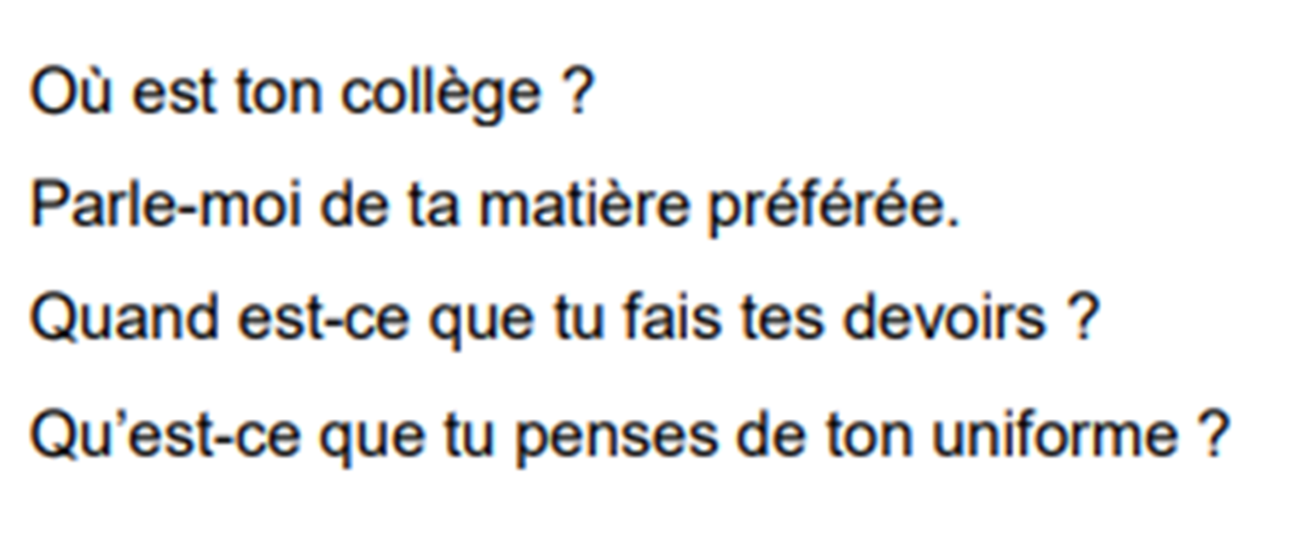
Here's an example of the sort of questions pupils will be asked:

Example unexpected questions following the Read Aloud task in the AQA SAMs


And here is a text I have written to go with these questions.


Où est ton collège ?     Mon collège est en ville à trois kilomètres de ma maison.

Remember, the pupils do not see the questions; they are being asked to respond immediately in full answers to a question they hear. So they will have the text in front of them and can read it through. Then I use it for quickfire questions (in order or out of order). The pupils register the question and can find the correct bit of the text to read aloud in order to give a full answer. Then we move on to letting them modify the answer in the text. And eventually to giving their own full answers to unexpected questions.

A couple of issues that came up when writing that model text. Firstly, I had the time to think about my answers! Especially to find a way to develop them. Secondly, I hope I the text is modelling the sort of language pupils will be learning and which will tick the success criteria. Thirdly, I was careful to avoid using the pronoun "it" in the answers about school or uniform. I deliberately repeated the noun. Knowing whether to use ce / il / elle for subject pronouns (plus knowing what to do with object pronouns) is too much of a trap at this stage and I will sidestep it by telling pupils to give full sentences I like my school... My school is... rather than bounce off the question and try to say I like it because it is... 

And finally, I don't want to give you or my pupils the impression that in the exam, the answers to the questions are to be found in the reading aloud text. That is not the case! This is a technique for getting lots of practice of responding to quickfire questions by using model answer texts. By the time we get to the exam, I am hoping my pupils will be able to cope with questions without any such support!

I don't know what focus on unexpected questions the textbooks from the various publishers will have. And how sustained any focus on developing quickfire response to unexpected questions will be in their books. But hopefully the ideas in this post mean you can try to build it in, whatever course you adopt.

Let me know what you think!