Saturday, 29 January 2022

Pupil Voice and GCSE Options

 It is Options time, and in order to find out what Year 9 are thinking, I have sent them a simple Google Form to ask them what they think about their progress in French.

What are their views on what is important in their own experience of language learning? I left it completely open, with no prompts. Just a question asking them to comment on what they thought had had most impact on their progress in French.

I was prepared for anything. I well remember making a video for Year 6 Open Evening, where I explained about step-by-step learning, about learning to use your language, and accumulating more and more of the key knowledge that allows you to express yourself. And then the Head of Year 7 got some pupils to do a video and they basically (and very enthusiastically) said, "We learned to say hello and the days of the week." And quite right. If that is their perspective of what learning a language means, we need to be aware. It is very focused on immediate take-away ability to say specific things. Then it's our job as teachers to make sure that all the little things they learn all add up to something bigger. And perhaps we can shift their focus a little onto recyclable language and an awareness of patterns and forms.

So by Year 9, what would our pupils volunteer as the key aspects? And would they be positive or negative?

Here's the grid of positives summarised by me in a spreadsheet. Of course the pupils' own words were much more effusive and cuter. But here's a spreadsheet:


OK, "building on the basics of reusable language" sounds suspiciously like the way I talk. But I think it's a fair paraphrase of statements like Learning lots of the little things and the in between words has helped me with writing paragraphs for different topics, and the right pronouns for things.

So online apps score highly. Many mentioned Quizlet, blooket and gimkit. Often in combination with comments about enjoyment but also memorisation. Some interesting comments about single words versus chunks as well. This doesn't differentiate between homework and lessons in the computer room. And it doesn't prove that these were necessarily effective for learning rather than merely enjoyable. But the question (and the pupils' answers) were about impact and progress. Anyway, when it comes to options choices, a positive is a positive, even if I personally would want to look further into its effectiveness.

And then I feel that given that these were volunteered by pupils, their answers were a remarkable match for the things we as teachers would think of as important:

Building on the basics of language in order to become more confident in developing writing into paragraphs. Confidence in speaking, with explicit reference to pronunciation and the use of the Francophoniques back in Year 7. And a cluster of comments around memorisation, testing each other, and miniwhiteboards which reflect an acknowledgement and understanding of what their teachers are putting in place.

Learning to say, "Hello and the days of the week", or any other references to specific items have almost disappeared. Almost but not quite. One pupil specifically summed up 3 years of learning by saying they had learned how to ask someone when there birthday is. We all know why that line is so memorable! Shame they didn't put "Using songs to create a change in long term memory."

In terms of the whole school focus on Explanation, Modelling, Scaffolding, Feedback, perhaps we did less well. With "clear explanations" being volunteered once. Although "long term memory" did get a mention in the comments on self-testing. Perhaps this is because Explanation, Modelling, Scaffolding and Feedback are so embedded and such a good fit for how we teach, that they are unremarkable. Or do we need to get pupils to think and to talk about their learning much more explicitly in these terms?

And so to the negatives.

A much shorter list. The top was "I don't enjoy it." This was outweighed by the pupils who specifically mentioned how much they did enjoy French. But when it comes to options it is obviously a factor. And I would like to know to what extent "I don't enjoy it" is a proxy for other things. Such as "I am overwhelmed by the demands of the tasks" or "the sequencing of the learning means I am left confused." And difficulty and confusion were also mentioned by some pupils, although where a single pupil wrote that it was difficult and confusing and they didn't enjoy it, this has been counted 3 times.

As this was in the context of options, several pupils did mention that French was something that didn't fit with their future ambitions. This number has gone down since the survey we did in September, so perhaps we have had some impact in talking to pupils about this. It is also extrinsic to the lessons. Important for us to understand, but not necessarily a comment on the teaching and learning.

Some pupils commented on feeling that their progress had been interrupted by disruption caused by covid and staff illness. And two commented on pronunciation specifically as an issue. These are issues that we are aware of and I am happy that our plans for the year go some way to focusing on these concerns.

The survey also showed that the majority of pupils would be happy picking French as a GCSE option. The numbers who actually pick French will depend on what other subjects are in the same column. This is interesting to know, as often when a pupil doesn't pick a language, this can be portrayed as a failure or a negative. When in fact there are 4 or 5 subjects (all perfectly valid choices) in the column so a realistic expectation would be for 20 to 25% to pick any one of them.

That will come out in the wash later. But for now, I think our pupils are very positive about their learning and about the teaching in languages. And I am very pleasantly surprised with the way their independent statements match the vision of the department.


Friday, 28 January 2022

The Cousins fighting in the Car Park - Teaching the GCSE Reading Exam.

 Once you realise how the AQA GCSE Reading Exam works, how do you go about teaching it?

In a previous post, I explored the workings of the Reading Exam and discovered:

1. It's not a Reading Comprehension. You can give a correct answer to the question and score zero. What you have to do is show AQA you can translate the exact wording.

2. The words that are critical to getting the mark, are not the same words you teach pupils for the Speaking and Writing or the Topic content of the course.

So here is a lesson aimed at teaching pupils how to think about these questions.

On the board you can see my "comprehension" questions. And next to each question, I have given the pupils the answer. With a cross next to them. Because although they are correct answers to the question, they would not be sufficient for a mark from AQA. 

This means pupils are now actively looking to improve the answers on the board. They know to pay attention to giving an answer which doesn't just answer the question, but which shows you understand all the words in the text.

So for Question 2, the answer "They argued" is a correct answer. But  it could score 0 because the sentence actually said, "They started to argue." We know from the She was impressed that they grew vegetables on PART of the school field answer that including words which are irrelevant to the question is expected by AQA.

Question 6 isn't in the photo. It was, "Why was everyone happy?" And the inAQAdequate answer was "Because the couple were in love and finally got married." The AQAdequate answer was, "To see a couple so much in love finally get married after so many years of being engaged." With the emphasis on words like so and so many.

Here's a brief summary of how the lesson was set up.

1. Pupils had previously learned words for talking about the topic of relationships and family celebrations. So they knew uncle, wedding, speech, argue, in love for Speaking and Writing about the topic.

2. I read them the text (below) and they listened out for any vocabulary items from the topic list.

3. I gave them the text and they followed as I read it aloud. They then turned it over and told me everything they thought had happened.

4. With the text again in front of them, I asked them comprehension questions and they told me the answers, showing they understood what the situation was and what had happened. With all the gory detail of the events, but NOT with every word translated. Because they were responding to the meaning and the story, not looking for words like so much or started to.

5. I wrote the questions on the board that you can see above. Deliberately designed to not reward what the pupils had told me they understood. And as you saw, I put the "right but wrong" answers next to the question. Pupils wrote their answers, including all the words from the sentence, not just the ones that answered the original question.

This focused the pupils on what AQA want, which is not an answer that shows comprehension. But an answer which shows you can translate every word. And with particular focus on the sorts of words that you won't be working on for the Speaking and Writing Topics.

Interesting that the new GCSE promises to sort out the problems with the Listening and Reading exams. Their solution is to restrict them to High Frequency non Topic vocabulary. And for pupils to answer the questions by showing word by word parsing. But it seems that the Listening and Reading exams are already very much like this.

It seems that actually the proposals will mean keeping the Listening and Reading exams very much the same.

And worse. Part of the issue currently is that there is a mismatch between the language tested in the Listening/Reading exams and the language taught for the Speaking/Writing exams. Which most people would solve by making the Listening/Reading better reflect what the pupils are learning to say and write. But no. The new GCSE proposes making the Speaking/Writing exams more like the Listening/Reading exam.


Tuesday, 25 January 2022

Dance Moms and GCSE French

 Instead of Tutor Time, Year 11 have been split into subject tutoring groups. So instead of my Year 11 form, for 3 days a week, I now have a twenty minute mini lesson with a small group of pupils who the data flagged up as needing a boost in GCSE French.

And it's lovely. The pupils are great and twenty minutes is my new perfect lesson length.

So what have we done, and how do Dance Moms fit in?

In the first week, we did building up an answer round the class. When they came in, they found I had written on their desk the key structures for giving opinions, justifying them, if sentences, (and but if not sentences), where we went, what we were going to do, what was said, (and the reply), what happened, and what we would have preferred to do. One structure per pupil, in that order round the class. And through the week, we picked different GCSE topics and built up an answer following the same development and using the same structures. Just by looking at where the other pupils sit in the classroom, they can recall a whole series of structures to deploy. I also read them the If you give a Mouse a Cookie story to show how once you say, I like... the whole rest of the story inevitably unfolds.

The next week, we did the conjunctions dice game. On a different topic each day. Again pupils give an answer starting with I like... and then at the end of the sentence, throw dice for and, especially if, because, so, for example, but... and carry on and on and on and on. I also ask them to use so as a trigger for the future: so at the weekend, I am going to... And use for example as a trigger for past: for example, last weekend, I was going to... (This is important because then in the speaking exam, I can just say, For example...? and know they will give me an example in the past.)

And so to Dance Moms.

Dance Moms was an American reality TV show which pupils still know from YouTube. Miss Abby hothouses the girls' (and sometimes boys') talent, and the mums fight over whose daughter is being neglected or favoured. And meanwhile each week they descend on another unsuspecting American city to enter the local dance competition, and sweep the board of trophies and medals.

How do they do this? Every week a new routine to new music. The answer to the question: "How do they have time to prepare a prize-winning dance routine every week?" turns out to be the key to the GCSE French speaking exam.

The answer is: The music is different, the routine is different. But the moves are the same. So in your French GCSE, you might get asked about School, or Work, or Holidays, or the Environment, or Free Time, or Life in France, or Living in Norfolk, or House, or Family and Relationships... So many different routines. But the moves that make up the routine? The moves are the same.

And what are the moves? Well, that was today's mini lesson. (After watching a bit of Dance Moms and seeing who could remember all their names.) You pick the moves based on what the judges want to see. So we looked at the criteria for the speaking exam. Opinions and reasons, extended speech, narration, past, present, future. That's it. That's the moves.

So tomorrow and the rest of the week, we will see how quickly we can make up new "routines" for different questions, making our life easy by recycling the moves, and knowing it's what will wow the judges. And I am absolutely sure that I won't be teaching them new moves. They know the French. What matters for the exam is being able to confidently put together a new routine for each topic or each question, made up out of your favourite moves.

And next week? Maybe the Football Game Plan metaphor just in case not everyone is a big Dance Moms fan.


Saturday, 22 January 2022

GCSE Listening and Reading Exams and "Topic" Vocabulary.

NB This post is looking at the importance of high frequency vocab in the OLD GCSE.


 My Year 10 Spanish class have just done a unit on School. In their speaking, they can talk about what lessons they like and why, clubs, trips, rules, facilities and relationships with other pupils. All built around expanding their repertoire of giving and justifying opinions, and developing little anecdotes in a combination of tenses. So I set about finding some past paper exam questions on the "topic" of school.

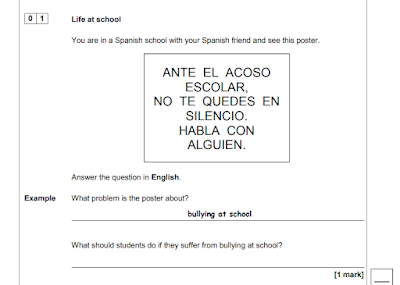
Here's one I found straight away. It's 2019 Reading. On the topic of school life.


Except it's not.

Pupils will know "acoso" and they know "habla". So if there was a comprehension question on the topic, for example, "Explain what advice this poster is giving", then they could say something like, If you are being bullied, make sure you talk about it. With the credit given, quite reasonably, for knowing the words they have learned, bullying and talk and understanding the advice.

But as we have seen, the current GCSE exam papers aren't about comprehension at all. Recognising the word bullying which they covered in the topic, isn't being tested. It is given to you in the question. The word talk, we see from the markscheme, isn't enough for a mark. The word that is required for the answer, the one word that this whole question is testing, the sole object of this page of photocopying, this invented poster with its subjunctive-negative-imperative and its ante-not-antes, representing the topic of Life at School... the one word it is testing is alguien. To get the mark you have to say, "Talk to somebody."

Somebody. Not a "topic" word at all.

And the search goes on, for a nice past paper question to use for Year 10 relevant to the Topic of School. I didn't find any. I went back to the old GCSE and found some that looked hopeful. Even then they mixed School and Healthy Eating and Technology. But the questions all relied on words like sin, tampoco, demasiado. Without, neither, too.

This was backed up by NCELP on twitter @ncelpmfl in a post showing that the current GCSE Listening and Reading exams contain higher levels of high frequency vocabulary than topic vocabulary. And @mfltransform also tweeted findings showing that at Foundation Tier, the current GCSE specificaton doesn't have much less "high frequency" vocabulary than the NCELP lists. But that the NCELP lists do have substantially less "topic vocabulary".

What does this mean?

For me, the problem with the current GCSE is that there is a dichotomy between the Speaking and Writing exams, and the Listening and Reading exams. The words I am teaching my pupils to talk and write about school, are not going to get them the grades in the Listening and Reading.

Both the NCELP approach and what many schools are doing using What I don't Call Sentence Builders, is trying to make Listening, Reading, Speaking and Writing all recycle the same language, so that pupils are exposed to input that matches what they are asked to produce.

But in different ways. One approach is to make Listenings and Readings out of the language that we want our pupils to be using. The other is to take the most common language in Listening and Reading texts and restrict pupils to using that in their Speaking and Writing.

We need to look carefully at the claims of the new GCSE here. If the problem is that there is a mismatch between what pupils learn for Speaking and Writing, and what they meet in the Listening and Reading, how should we solve this?

The friendliest approach at GCSE level would be to make sure the Listening and Reading exams were testing the sort of language that pupils are learning in their Speaking and Writing. The vocabulary linked to their growing core repertoire and the vocabulary for talking about the topic content they study.

 The new GCSE is proposing the opposite.

The new GCSE is proposing to KEEP the current Listening and Reading exams very similar. Focused on the non topic vocabulary. Focused not on comprehension, but on identifying language features. And even worse, they propose to solve the dichotomy by making the Speaking and Writing conform to the Listening and Reading. Not the other way round.

Insofar as (wow, is insofar a word!?)... Insofar as the NCELP high frequency approach goes, it turns out it may be a great tool for dealing with the current GCSE Listening and Reading. This is NOT an argument for changing the GCSE. This is an argument for pointing out the role of high frequency vocabulary in successfully teaching towards important elements of the current GCSE.

Insofar as the new GCSE proposals go, they are NOT proposals for changing or improving the Listening and Reading exams. What they quite possibly ARE proposals for, is making the Speaking and Writing as bad as the current Listening and Reading. That's not a pleasant prospect.

Monday, 17 January 2022

Calibrating Assessments

 Pupils have now taken our new assessments in KS3 in at least one unit. In response to the Ofsted Research Review, we have concentrated on making sure that they test the pupils on what they have been learning. This sounds obvious, but actually I think that our old assessments (and GCSE Listening/Reading) were actually testing pupils on their literacy, their confidence, their ingenuity and their cultural knowledge. We ended up labelling the pupils with strong literacy as "good at languages". And perniciously, labelled pupils with weaker literacy as "not doing well in languages".

We also made sure we used the test as an opportunity to get some feedback from the pupils on their learning, and to engage them in thinking about their progress.

The tests were designed to give feedback to the pupils about their progress on an intellectual level, but also on an affective level: helping them see the progress they are making and feeling positive about their learning. 

Rather than use tests to get a broad spread of marks in order to categorise pupils, we were looking for evidence that most pupils were successfully learning.


Given these changes, how to calibrate the test? How to decide what score is acceptable, what is great, and what requires action to be taken?

Further questions: If this is based on what pupils have been learning, should the expectation be that all pupils should get all of it right? Should the expectation be the same for all? Should we grade pupils at all, if the idea was to make them feel successful? What marks are reported, and how are these explained?

The question of how marks are reported is critical. Parents and pupils are told if the pupil is "on track" / "above" / "below expected". Where "on track" doesn't mean compared to the national average or compared to other pupils. It means "on track" for a pupil of similar prior attainment. So based on broad brush groupings of pupils based on KS2 results (Upper, Middle, Lower) which act as a proxy for predicted GCSE grades. If this is the information parents are receiving, then our tests need to provide us with evidence towards making these judgements.

We did the first round of tests without establishing thresholds. This meant we were able to then look at the data the tests gave us alongside other information. For a start, most pupils, as hoped, scored relatively highly, reflecting the fact that the tests were meant to be a recognition of what they had been studying. Secondly, pupils of similar prior attainment did seem to score within a similar range of marks. Looking at this range of marks, we were able to assign numerical values to what could be considered "on track" for pupils of different starting points. The fact that these were very similar for Year 7, Year 8 and Year 9 was also reassuring.

Where pupils fell above or below the mark of most other pupils with a similar KS2 profile, we were able to look at how this matched up with other information the teacher had: performance in Speaking and Writing tests, participation in class, absence...

The tests and the tentative thresholds did give us information that helped towards a bigger picture of individual pupils' performance.

Of course, this helps us judge the pupils' performance. But we also have to judge if as a department our planning and teaching is effective. As a school, we are given a data breakdown of how different departments compare. We have the percentage of pupils "on track", "above" and "below" in all subjects in each year group. And the same data by subgroups, such as gender, PPG, EAL or SEND. This enabled us very quickly to see that were in line with other departments and where we varied from the mean, it was towards having slightly more pupils "on track" than in other departments. As the new tests were designed to be a positive experience, this doesn't seem to be a problem. Although we will have to continue to be vigilant to make sure we are picking up where pupils might be under-achieving.

Next time, we are taking a bit of a leap in the dark and seeing if we can keep the same numerical threshold scores for the next unit. The tests will be different, but of a similar format. It will give us a starting point for similar discussions of how pupils' scores in different tests match up with how they are doing in class and help the teacher build up a picture of evidence.


Friday, 14 January 2022

Make the GCSE Work

 The publishing of the outcome of the proposed new GCSE consultation has left me feeling like Keir Starmer, with his oxymoronic, "Make Brexit Work". I will now have to Make the new GCSE Work. What might this mean?

The parallels between the new GCSE and Brexit are fun to explore, and cast light on our current situation and how to respond to it. Pushed through by a right wing "research" group claiming that their ideas were a solution to popular dissatisfactions back in 2016. That they would represent a fresh start, a wholesale new approach, a taking back of control.

Brexit was always going to be either painful or pointless. Painful if we gave up frictionless trade. Pointless if we remained in the Single Market but gave up our membership. Those were the choices. Deal or No Deal. And we ended up with a fudge that was both painful and pointless. The same applies with the new GCSE. Have the changes in response to consultation kept it as Painful or made it Pointless?

And how should we respond? After Brexit, should we try to have opt-ins to some of the benefits of membership? Should we try to continue to maintain good trading relations with the EU? Or does Brexit force us to adopt a different mentality: Scrapping for an advantage, a wheeler-dealer Britain acting in its own interests even when this means acting in bad faith? The same with the new GCSE. Can we stick to our principles because we believe they will still work in the new climate? Or do we need to fully swing behind the new orthodoxy if we want to survive in the dog eat dog world of exam results and accountability?

In order to summarise some aspects very quickly, I will link to other posts. And then move on to considering what I personally think are my choices in my school in order to Make the GCSE Work.

First of all, I think they have gone for the "Ugly Dog Statues" option. By tweaking the patently unworkable proposals to restrict vocabulary to the most high frequency words, they have pushed the rest of the proposals through.

In terms of their claims for Reading and Listening, I think that the proposals risk making the situation even worse. Their view of Reading and Listening as explicitly testing items of grammar and vocabulary, rather than comprehension of meaning, is precisely what makes the current papers so ridiculous. Having a defined vocabulary list might make the exams "easier", but as the same number of pupils will have to get questions wrong, then this will mean making the papers even tricksier. 

The compromises on Culture and topics won't become clear until we see what the exam boards come up with. Fundamentally though, this is about the content of the course, not how it is structured. The philosophy is still one of Phonics, Grammar and Vocabulary as the central pillars of teaching and learning.

And while some have claimed to see compromises around Communication, again we will have to wait and see what the exam boards come up with. But I am not hopeful. The scope for spontaneous interaction seems to be based on short exchanges in response to a text, some Role Plays and in response to a picture. Role Plays make me think of parrot-learning phrasebook style, with short responses. And short answers in response to texts or pictures doesn't fit with the way we teach pupils to improvise extended answers.

My biggest worry isn't just about having to abandon a focus on developing pupils' answers. It's not just the loss of Communication for its own sake that worries me. It is not even just about having to dismantle the whole literacy/oracy approach of working on coherence, development and spontaneity. It's a worry around the central process of language-learning. It's what building a repertoire and the ability to use it does for language-learning. Our curriculum is all about pupils having a core snowball of language that they can use. And more and more language sticks to that snowball. As I wrote here, this is what makes the difference between learning and language-learning:

I am very aware of the idea of a learner's "interlanguage". That they have an evolving conceptualisation of the language. Which is messy, partial, incomplete. Which evolves as they learn more and which can be called upon to express themselves. The alternative seems to be a collection of remembered structures and rules which if it isn't rolled up into a functioning proto-system, and remains as a set of discrete facts, isn't any sort of language at all.

I am very nervous of ending up with a curriculum that aims for an even covering of snow, with pupils memorising items without ever rolling it into a snowball. Or without having a core of the most important language that everything else can stick to. This is what teaching language as a working language offers over the alternative of teaching a language as an abstraction.

So to come to the question of Making the GCSE Work. I know from experience that sticking to your principles does not work. With the Controlled Assessment GCSE, continuing to teach pupils to speak spontaneously from a core repertoire of language did not work. What was rewarded was fancy language and large amounts of "information" learned off pat. With the opportunity for as many retakes as it took for a perfect recording.

This makes me think that it will not work to tweak our curriculum. We have to embrace the changes and the philosophy behind them. In my Keir Starmer role as head of department, how do I Make GCSE Work? This will inevitably be the topic of blog posts yet to come! Here are my first thoughts:

Is it possible to keep or tweak our KS3 and then swap to a Grammar and Vocabulary approach at GCSE? Possibly. But what is the point of teaching pupils in Year 8 to improvise extended answers if at GCSE there are other completely different hoops to jump through? It comes back to whether I think it's an important principle in language-learning. Or whether I now think that sticking to principles in a new climate is asking for trouble.

Will it be possible to keep Spanish? We currently start Spanish in Year 9 and make rapid progress based on pupils having a core repertoire of language they can deploy across topics. This "shortcut" actually turns out in practice to be very efficient in terms of helping their grammatical knowledge to crystalise and grow around the central kernel. With proportionally many more pupils going on to A Level Spanish than for French which they have studied since Year 7 or earlier. Again, prior experience tells us that through the period of the Controlled Assessment GCSE, teaching pupils a core repertoire to deploy spontaneously didn't get the results at GCSE, but did equip those pupils who went on to A Level to do better than schools who taught rote answers. But I am reluctant to get my fingers burnt again. If Making the New GCSE Work means abandoning our approach, then I am afraid it could mean abandoning Spanish. And the loss of a Sixth Form offering Spanish to the local area. This would be a tough decision to make, so watch this blog for developments...

Is it possible to mix and match? For example keeping our Year 7 based around communication - the French Art Exhibition, the French Café...? And our Year 8 based around a core repertoire of opinions, reasons, examples..? And then in Year 9 bring in a much higher focus on Grammar items and accuracy? This feels like a sudden change in direction at exactly the wrong time. We need to be able to continue to give pupils confidence that our KS3 leads directly to a successful KS4.

Is it possible to integrate NCELP materials with our existing course, or is it simpler to sweep away our curriculum and "buy into" the NCELP schemes of work from the start? Our snowball of language works because we make new language stick to what pupils already know and it expands their repertoire, taking time and practice to work on developing it to express themselves. The alternative, of having an even covering of snow, with a multiplicity of items to be learned and recalled, depends on incredibly intricate sequencing, interleaving and revisiting. The NCELP scheme of work, tracking how many times each vocabulary item is met in different texts and contexts, depends on meticulously detailed planning. I could not even start to make my own version and I wouldn't want to take it apart and rebuild it.

On the other hand, does something so precision engineered work in the real classroom? Every nerve in my body jangles at the idea of scrapping a curriculum which has evolved over decades in the real world, to replace it with something that works in the lab.

So, as the Brexit metaphor seems to have changed into one where the new curriculum has escaped from a research facility to infect us all, these are going to be my options: I don't think it is mild enough to ignore. Should I try to adapt to the new variant GCSE? Should I follow the official mandated approach? Or is it going to sweep away everything and a new curriculum will evolve in its place?


Saturday, 8 January 2022

The Case Against... Topics

 One of the several bombshells dropped without warning on the MFL teaching community by the new GCSE proposals, was the idea of "getting rid of topics". This tuned in to the unpopularity of the mismatch between some of the current topics and the exam criteria. The speaking and writing criteria are based around recounting personal opinions and experiences, which just doesn't fit with some of the topics, and leads to nonsense like: Do you like recycling? Tell me about some recycling you did recently. If you could, what would you like to recycle? (And even more bizarre or even offensive questions about encounters with poor people.)

The proposals to get rid of topics have been dropped into the middle of another on-going debate, around what the content of courses should be. Whether language-learning should be about useful transactional situations, about learners talking about their own world, or about exploring the cultures of target language countries. This has helped inflame debate, but it's not the central issue of the question here, which isn't about the content of the curriculum, but about how it is structured.

The argument for dropping a topic-based approach is linked to the proposals around a core of high frequency vocabulary. The idea is that we teach too many lists of nouns. In this caricature depiction of our teaching, the nouns are required to cater for the multifarious potential possessions and obsessions of the pupils in our classes. And while no one child needs to learn all of them, they distract from more important words.

It is definitely an interesting exercise to look at what the most frequent words in a language are. And to examine our curriculum to see if we are over-teaching obscure nouns. But it's not really based on an argument for getting rid of topics. It's more that if you follow the GCSE proposals to restrict the syllabus to the most frequent vocabulary items, then it's hard to see what topics would be viable. 

So this argument isn't really about topics. It's about the unviability of the high frequency vocabulary proposals. On its own terms, it falls down. A syllabus that specifies pupils should learn jouer Ã  for sports and jouer de for instruments, but which has no sports or instruments in its vocabulary, is a non-starter. And to come at it from the other side, NCELP are always keen to point out how many of the high frequency words can work for topics. So as far as this first argument goes, getting rid of topics seems like a desperate attempt to make the high frequency vocabulary proposals work, rather than a reasoned debate about the structure of the curriculum.

There are other arguments for not having a topic-based approach. Can you imagine a class where the lessons are based around a genuine conversation, a story, an object someone brings in, an authentic resource, a news bulletin, a date on the calendar, an event in someone's life, a drama experiment, recreating a TV show, a debate, a sporting or crafting skill to be learned...? These were elements of the training I had for teaching English abroad. But they are categorically not what is being advocated in the current argument for a step-by-step curriculum where nothing is incidental, where the demands of communication are an obstacle to learning, and where authentic materials are seen as inappropriate. This argument for freedom from topics is not what is being suggested!

Here's an argument for getting rid of topics that might stand up: By organising our curriculum by topics, we are creating separate pigeon holes of learning that don't add up to anything in the long term. Because we learn things which are then tested, declared finished, and then abandoned. Before then starting the next topic. It is a view of learning based on learning to say certain things, phrasebook style. To deal with one transactional situation, ticking it off and moving on to the next. Station ticket office, cafés, ice creams, lost property, giving directions, reporting a robbery, complaining about a hotel... And even where the substance of the course has moved away from transactional language, to topics such as My Free Time, My Holidays, My School, then perhaps the mentality of learning a set of language to be ticked off for that topic has persisted. Perhaps.

Is this true? Do we see our topics as a set of language discrete to that topic? Where the answer is Yes, then even so, I think we are aware of the need to revisit, interleaving learning, creating a spiral curriculum which comes back to topics not just to revise but to pick up that topic again now the pupils have progressed in their language knowledge. And that idea isn't new. The "spiral curriculum" was a current idea when I trained in the 1990s, as evidenced by the title of the KS3 textbook Spirale by the legendary Barry Jones and Jacqueline Jenkins. And today it is evidenced in the bendy road maps made to show how pupils' progression in their knowledge of the language is deployed in visiting and revisiting topics as their knowledge accumulates. 

Which means, actually, the answer to the question Do we see our topics as a set of language discrete to that topic? is No. We have an overall vision of how pupils accumulate topic vocabulary in each unit, but also of how they accumulate knowledge of the language as they move from topic to topic.

So far I've looked at the headline explicit arguments given as a rationale for getting rid of topics. Actually the most powerful argument isn't openly declared in the new GCSE proposals or even in the Ofsted Research Review. It's hidden in the webinars that accompany the documents or in NCELP training. In the examples they give of how think about what we are really teaching

I am very sympathetic to the idea that, for example, when I teach "pets", the list of beasties is not the most important thing for the pupils' language learning. From my point of view, it is a vehicle for teaching phonics. It is going to be an opportunity to deal with masculine and feminine, singular and plural. And the verb to have. Which persons of the verb? Should I include used to have? Questions and negation.

So the question is: Have I thought about what I want pupils to be learning, and then picked "pets" as a good topic to tackle this? Or did I teach "pets" because that's what you do in Year 7, and then realised as an after-thought what the language implications are? And how do these questions apply to my whole curriculum planning? Do I think of topics first, and then work out what structures pupils will need in order to communicate on those topics? In which case their accumulation of knowledge of the language risks being random, incidental, unstructured. And full of pitfalls because I haven't ordered their learning in a logical way. Or do I deconstruct the language and rebuild it step-by-step, carefully isolating each feature and only teaching one thing at a time?

And if I did this, would I get a bionic USAF Colonel Steve Austin, or would I get a Frankenstein's monster?

I have two problems with this argument. One is that it risks being insulting. Of course I have thought through my curriculum. Of course I understand the complexity of teaching new concepts. Of course I understand the importance of accumulating knowledge.

The other is that I am much more prepared for language learning to be messy. As I wrote here on the importance of Communication and Self Expression, I am very aware of the role of the pupils' evolving interlanguage: 

[Pupils] have an evolving conceptualisation of the language. Which is messy, partial, incomplete. Which evolves as they learn more and which can be called upon to express themselves. The alternative seems to be a collection of remembered structures and rules which if it isn't rolled up into a functioning proto-system, and remains as a set of discrete facts, isn't any sort of language at all.

The strongest argument for getting rid of topics seems to me to be an argument which has gone too far. It's this argument that language-learning consists of building up a grammatical system. That language-learning consists of learning patterns and rules to be understood, memorised and recalled. And that the step-by-step syllabus is transposed into the learner's brain as a set of structured concepts.

If this then neglects meaning, communication and self-expression, I think this has gone too far. It is an argument seeing language-learning from the point of view of someone who has a vision of the whole grammatical system. And who wants to break that down and feed it to pupils in bite-size pieces. 

(To pursue the metaphor, I am sure it's a diet that would contain the correct amount of each micro-nutrient, carefully weighed out and administered at the correct time. But not necessarily with any regard to the taste or appetising nature of the meal, individual preferences, social conventions, enjoyment, participation...)

We need to consider the point of view of the learner. The learner doesn't yet have the amount of accumulated language for links, patterns or structures to form a strong mental network. Pupils don't start to learn their first foreign language by looking for abstractions. Their first instinct is towards meaning. For example, if they are learning "pets", then they want to learn to talk about their pets. And the links they make are strongly to do with expressing meaning. The teacher will know what structures, patterns, forms will become more important and transferable as they accumulate more language. But the teacher doesn't want to do this by reducing pupils' focus on meaning and self-expression. In fact, we are careful to nurture this. It is central to what we are trying to achieve!

The arguments for "getting rid of topics" don't seem to be convincing. The fact that there are multiple arguments might seem like a strength, but in fact it's a mishmash of issues, each with important lessons, but lessons which teachers are capable of taking on board.

We will have to spend time, as the course progresses, adjusting pupils' focus away from meaning and towards forms and patterns. We will have to start to get them to adjust from focussing on words with high concrete meaning towards words which have a more grammatical function in a sentence. We will have to have a clear idea of what words and structures are going to be transferable across topics in order to build pupils' grasp of the language. And we can do all this successfully without throwing away the concept of structuring a course around "topics".


You will notice that I have not made the case for topics. I am merely looking at the arguments for suddenly dismantling what we currently do. With a concern that when a curriculum has evolved, it is often more complex than you might think. The arguments I've looked at can be taken on board without inadvisable top-down sweeping wholesale changes. Whereas a diktat to remove topics could in fact lead to the hasty construction of something which needs to be incredibly complex, from scratch, and without the necessary expertise and understanding of how to make it stand up. I am watching the NCELP experiment with interest.

Tuesday, 28 December 2021

If you give a mouse a cookie...

 If you give a mouse a cookie is a delightful children's book by Laura Numeroff and illustrated by Felicia Bond. Some pupils know it and always remember it fondly. When the time comes to use it in language teaching, I can either just tell the story, or take in a copy, or I think it's also available being read aloud on youtube.

Here's the gist of the story: If you give a mouse a cookie, he's going to ask for a glass of milk. If you give a mouse a glass of milk, he will want to look in the mirror to see if he's got a milk moustache. If you give a mouse a mirror, he'll probably notice his hair needs a trim... And so on.


And it's the "and so on" that makes it relevant to language teaching. That the next idea is at once inevitable, logical, and yet imaginative, creative.

We actually spend as much time teaching pupils to use their language, as we do on the language itself. How to develop ideas, narrate events, add detail, make it more personal, more sophisticated, more spontaneous. There is a strong oracy/literacy component to helping pupils come up with answers which take an idea and develop it. As well as meeting the requirements of the markscheme. And of course, all the practice working on what you can do with your language, is simultaneously working on the language. So despite what we are being told by Ofsted, it is not a waste of precious time.

So here's some examples.

If you give a mouse a cookie... he's going to want to ask for a glass of milk...

If you give an opinion, you are probably going to justify it.

No "probably" about it. This is an absolutely compulsory routine built in to what our pupils learn to say. Pupils love j'aime and j'adore. They latch on to opinions really well. Make parce que an obligatory part of what comes next. Some schools go with parce que c'est + adjective. I prefer parce que je peux / parce que je dois. Even if pupils use an adjective, I make them add can/can't/have to.

J'aime jouer au tennis parce que c'est passionnant et je peux aller au parc y jouer avec mes amis.


If you justify an opinion, you are probably going to explore the circumstances.

The "And so on" keeps on rolling. Either instead of the parce que or as well as the parce que, next I like pupils to use surtout or surtout si. It can be especially if I can go with my friends or especially if it is sunny or especially if I have to stay at home.


If you use one if sentence, you are probably going to follow it up with another.

Pupils like the idea of two for the price of one. If you have mentioned what happens if it is sunny, you will probably say, but if it rains... If you say what you can do with your friends, you will probably say, but if I have to go with my family...

J'aime jouer au tennis parce que c'est passionant et je peux aller au parc y jouer avec mes amis. Surtout s'il fait beau. Mais s'il pleut je dois rester chez-moi.


If you mention someone else, you are probably going to use a conjugated verb.

What to say next? Well, if you have mentioned my friends or my brother, then make it a rule that this is where you bring in some of those 3rd person verbs you have been using. Or the first person plural. Don't just learn them and wonder what to do with them. Have a plan with how they are going to fit in and extend your routines.

J'aime jouer au tennis parce que c'est passionant et je peux aller au parc y jouer avec mes amis. Nous jouons tous les samedis. Surtout s'il fait beau. Mais s'il pleut je dois rester chez-moi.


If you have given an opinion, you probably ought to give someone else's opinion too.

In French saying my sister likes is easy. As long as you can stop pupils saying ma soeur j'aime!! In Spanish it is more fun, as you have to say to my sister it is pleasing - a mi hermana le gusta. It's worth it, to show off some clever Spanish. But also, it's a natural development of the idea that makes it feel personal and detailed. And by introducing a note of conflict, it sets up a further set of possibilities. If you like, it could also include the subjunctive: my mum doesn't like that I go to Norwich with my friends.

J'aime jouer au tennis parce que c'est passionant et je peux aller au parc y jouer avec mes amis. Nous jouons tous les samedis. Surtout s'il fait beau. Mais s'il pleut je dois rester chez-moi. Par contre, ma soeur préfère aller en ville.


If you have given an opinion, you probably want to give an example in the past.

This might just be for example I played football at the weekend. But of course knowing what mice are like, the whole situation may become a little more complicated. Why not start with saying what I was doing or what I was going to do...? Use the imperfect just once to set up the situation. This could be what the weather was like, or j'allais faire mes devoirs or j'étais en ville...


If you say what was going to happen, you probably need a but... or a so...

As logically as milk goes with a cookie. If you say, il faisait beau... you are going to say, alors j'ai décidé de... If you say j'allais faire mes devoirs... you are going to say, mais j'ai décidé de...


If you are debating whether to do what you were going to do or decide to do something else, you would do well to bring in direct speech.

If you were going to do your homework but it was a lovely day, it makes sense that you would say to your mum, Je ne veux pas faire mes devoirs. Or that your friend would say, Je vais aller au parc. Because that's how decisions happen and plans get changed.


If you use direct speech, always include a reply.

As logically as trimming your moustache goes with looking in a mirror. If one person says something, another person replies. It brings your answer to life, makes it personal and detailed and makes it feel real.

J'aime jouer au tennis parce que c'est passionant et je peux aller au parc y jouer avec mes amis. Nous jouons tous les samedis. Surtout s'il fait beau. Mais s'il pleut je dois rester chez-moi. Par contre, ma soeur préfère aller en ville. Le week-end j'allais faire mes devoirs mais il faisait beau, alors ma soeur a dit, "Je vais aller en ville." J'ai dit, "Je dois faire mes devoirs." Elle m'a dit, "Tu peux faire tes devoirs demain." Alors j'ai décidé d'aller en ville avec ma soeur.


If you went along with what someone else wanted you probably might have some regrets.

In town, I wanted to see my friends, but my sister wanted to buy some shoes. At the beach, I wanted to play on the arcades, but my friends wanted to swim in the sea. This is the logical consequence of the difference of opinion that happened earlier in the book. Or the conversation that took place on the previous page. Worth learning words for unfortunately at this stage. And here is where you can deploy your past tense verbs to say what actually happened.


If you had some regrets, you will probably want to say what you would have preferred to do.

J'aurais préféré isn't any harder to learn than je voudrais, for example. And I'm not saying to throw it in randomly as an "impressive piece of language". It's here because it's doing an necessary job in the story of opinions, conflict, decision, disappointment that we have built up. Alternatively you could say what your plans are for next weekend, sticking to what you want to do this time!

J'aime jouer au tennis parce que c'est passionant et je peux aller au parc y jouer avec mes amis. Nous jouons tous les samedis. Surtout s'il fait beau. Mais s'il pleut je dois rester chez-moi. Par contre, ma soeur préfère aller en ville. Le week-end j'allais faire mes devoirs mais il faisait beau, alors ma soeur a dit, "Je vais aller en ville." J'ai dit, "Je dois faire mes devoirs." Elle m'a dit, "Tu peux faire tes devoirs demain." Alors j'ai décidé d'aller en ville avec ma soeur. Je voulais acheter des chaussures mais malheureusement ma soeur voulait voir ses amis. Alors nous ne sommes pas allées au centre commercial. J'aurais voulu aller aux magasins. Demain je voudrais retourner en ville mais je dois faire mes devoirs.


And there's your answer. It could have been about going to the beach. Or a school club. Or a holiday destination. Because the markscheme always asks for developed answers, giving and justifying opinions and narrating events. Just like a mouse always ends up eating another cookie.


Related posts with different ways to exploit this idea: 

Wednesday, 22 December 2021

And what if we are wrong...?

 Here is a slide from the inspirational Steven Fawkes from a recent Association for Language Learning event for early career teachers.


These are the values that language teachers hold dear. They give us our identity, our motivation, our energy to keep on going. It's what candidates at interview proudly tell us, and the things we reach for when we need to make our lessons more inspiring.

But what if we are wrong? What if these are precisely the things which increase the cognitive demands on pupils and get in the way of actually learning the language? What if they depend on prior cultural knowledge and expectations that mean pupils who are put in the position of having to "express themselves" are unnecessarily put off learning a language?

I remember my parents telling me that they had A Levels in languages but couldn't use them to communicate. And promising me that my school experience would remedy this. And for as long as I can remember, it has been axiomatic that you don't delay the ability to communicate in the language until mastery of the entire system has been achieved.

We can expect each generation to react to the generation before and move on. I remember in the 90s, being told not to show pupils the written form because it would interfere with their pronunciation. Instead of teaching them the sound-spelling patterns. One generation focusing on excellent pronunciation and oral fluency. The next, worried about pupils making up their own homemade spellings based on English. This oral approach was a response to "Languages for All", developing a style of teaching based on functional phrases, avoiding writing and light on grammar. But then, in my experience, "reluctant" pupils much prefer writing to speaking. And enjoy learning rules. And love terminology. Even if it is usually, "Masculine and feminine" or "Cognate".

But... Culture, Communication, Self-Expression, Creativity. These are big things to be wrong about!

Telling people they are doing everything wrong, Ã  la Michael Gove, is often counter-productive. And the coordinated pincer movement of Ofsted and the new GCSE proposals has not gone down well. The Research Review, the accompanying explanatory curriculum webinars, and the reported focus of deep dive inspections, have appeared to challenge teachers on their core values and competence. And the languages teaching community, across sectors, have reacted as if under attack.

Even if it has managed to alienate many of us, if we can ignore the manner of its imposition, we ought to examine the ideas in good faith, and continue to question our own assumptions.

One sweetener we are offered is that removing Communication means fairer testing. Pupils are to be tested on their knowledge and recall of what they have been taught. Not on their ability to use it. In particular, the proposed new GCSE promises to improve the Listening and Reading papers. I am not convinced by this. The reason the Listening and Reading papers are so appalling is precisely because they have lost sight of Comprehension of meaning. They are already designed to test pupils' ability to spot language features rather than to understand. The markschemes regularly stipulate answers which demand word by word transcription and reject ones which genuinely answer the question. The "She was impressed with a school because they grew vegetables on PART of the playing field" example isn't an aberration. It is how the exam board think of language-learning. And the new GCSE proposals are to go even further down this road!

What are the really good things that we could take from these proposed changes? Well, I am definitely sympathetic to an increased awareness of what we are "really" teaching. So for example if I am teaching pets in French, then yes, I am definitely aware that it is a great vehicle for practising the phonics we have been working on. And that we are going to meet concepts of singular, plural, masculine and feminine, and the verb to have. And it's my job as the teacher that while the pupils are learning to talk about their pets, that I keep sight of what the things are that are going to be most important and most useful. Which I agree, is probably not lists of nouns and obscure domestic fauna.

I think that pupils at this stage are focused on the meaning. They are relating the language they are learning to being able to express things about themselves and the real world. The connections they are making and their focus is all largely on meaning, perhaps on nouns and other words high in concrete meaning. While the teacher is at the same time starting to introduce structures, patterns, high frequency language, verbs, knowledge of what the individual words mean and their inflections... So what I am being challenged to ask is, "Is the focus on meaning and communication deleterious to what pupils are really learning?"

My first reaction is "No. It's a vehicle for what they are ultimately learning." And that I wouldn't want to sharpen a focus on forms by reducing my pupils' focus on meaning. But what I will do, is really watch out and see if there are pupils who successfully learn araignée but aren't picking up the difference between je and j'ai. I think there probably are. Is that because we teach araignée explicitly and leave them to pick up j'ai ? Or is is it because they are quite naturally focused at this stage on the words they perceive to carry most meaning?

And if "pets" is just a vehicle for teaching what pupils are really learning, then perhaps we need to look at our planning. Are we teaching the verb to have incidentally because it goes with what pets you have? Or are we teaching pets because it's a useful topic for meeting the verb to have? And so, have we planned our curriculum around a series of sets of nouns (and structures which incidentally turn out to be useful), or have we planned what the most useful structures are and matched the content to that?

The answer of course is that we have tried to do both. Have NCELP done it brilliantly and so well that we should all just adopt their scheme of work and resources because ours could never be so thorough? Possibly. And thank you to NCELP for doing it. It's a level of micro planning and careful thought that has been done so professionally and in such detail that does make me think I would be very silly to try to invent my own version.

Except for one thing. I am suspicious of the sufficiency of paper plans and resources. When learning happens for real in what is going on in the classroom and in pupils' minds. At my school, our curriculum is based on developing the pupils' growing repertoire of language and their ability to use it. We constantly work on pupils' ability to give and explain opinions and narrate events. Making sure that anything added to the repertoire enables them to expand what they can do as a next step in being able to give more detailed or personal answers.

And I am very aware of the idea of a learner's "interlanguage". That they have an evolving conceptualisation of the language. Which is messy, partial, incomplete. Which evolves as they learn more and which can be called upon to express themselves. The alternative seems to be a collection of remembered structures and rules which if it isn't rolled up into a functioning proto-system, and remains as a set of discrete facts, isn't any sort of language at all.

Rather than looking at the language as a whole grammatical system and mapping what they should meet when, we look at their kernel of language and decide what to add next. This seems like a totally different way of looking at things. Especially in the role of developing communication, oracy and literacy. But in terms of planning, it doesn't have to be in opposition. Good and thorough planning, step by step resources don't have to clash with our approach. We have introduced our Fluent in 5 lesson starters to recycle important language and to draw attention explicitly to forms. I have used some of the NCELP phonics resources in these starters, and I could certainly use some of their planning to help map what are the key structures and when pupils meet them.

This still hasn't got to the fundamental question of whether to relinquish a focus on Communication and Self Expression. I think I can manage some of the issues we've looked at. I can be fully aware of what pupils are "really" learning, and balance my underlying focus on form with pupils' immediate focus on meaning. I can make sure that pupils explicitly meet key recyclable language and grasp concepts and patterns. In fact this is fundamental to a curriculum which asks them to communicate, express themselves and be creative.

This leaves the cognitive load and cultural assumptions of pupils being expected to express themselves. Again, I would say that we have recognised this. And precisely because of this we spend so much time on it. We don't (I hope) leave behind pupils who have nothing to say in French or struggle with the language because thinking up what to say is too demanding. We tackle this head on, working on how to develop ideas, think up what to say, use the ingredients you have in order to make something nice.

But perhaps I should reconsider Culture, Communication, Creativity as being some kind of totemic magic wand to inspire struggling or reluctant pupils. They are the aim, not the means. Where pupils struggle, it certainly can be explicit, defined, step by step learning, with a clear focus on exactly what is to be learned, that can get them back on track. It must be possible to step back from polarised debate and take what works. I just hope Ofsted and the GCSE let us do this!


Saturday, 11 December 2021

Embracing Ambiguity in La Casa de Bernarda Alba

 Two of the most popular set "texts" for AQA A Level Spanish are Almodóvar's Volver and La Casa de Bernarda Alba by García Lorca. In a recent post, I looked at how having a clear idea of the "meaning" of Volver can give clarity to an argument. In this post, I am going to look at how embracing ambiguities and different interpretations can help structure an essay on La Casa de Bernarda Alba.

There are different views of the play, and rather than causing confusion, this is a gift to the student in the exam, offering the opportunity to explore an aspect of the play from different perspectives.

Here is a list of the opposing view points that might be confusing:

Is La Casa de Bernarda Alba García Lorca's masterpiece, or is it incomplete and flawed? It's survived the test of time, still being performed around the world and finding its way onto A Level syllabuses. So it must be good. But also it was never performed in García Lorca's lifetime and it maybe lacks the final polishing. The text itself in different editions has had to be "corrected". But does the lack of "finish" explain some of the ambiguities on this list, or are they deliberately creating tension between realism and drama?

Is García Lorca a "popular" poet and playwright or a heavy-weight intellectual? He famously took the theatre to the regions of Spain, was inspired by folk song and cante jondo, and loved puppet theatre. He was also an intimate friend of Salvador Dalí and Luís Buñuel, having moved away from Andalucía to Madrid.

So is his work realist or surrealist? There is a tension and a transition. The stage directions in Act One specify pictures on the wall, doors with curtains and bows, chairs. By Act Three, the set is to be of complete simplicity, with the walls described more as an effect of light. The Acts represent morning, afternoon and night. But not on the same day. So the audience experience an ambiguity in the passing of time. And each Act has a similar movement from the everyday to something more violent or dramatic.

And in his plays is Andalucía a deep and intimate source of roots and passion? Or a stereotype of a passionate land of black and white contrasts of life and death, love and hatred? Is it a "costumbrista" setting giving local colour or is it a world his immediate audience were familiar with in their everyday life? Or is Andalucía irrelevant in a work that is about the universal human condition?

Are his characters well defined individuals? Or are they more like a chorus of women, sisters all dressed alike, speaking with the same voice? The voice not of a dramatist, but of a poet.

And is that language poetic or vulgar? Does La Poncia speak in images and metaphors of a campesina, or is it the language of poetry? Is the play a web of symbols that accumulate poetic resonance, or are they concrete references to the world in which the play is set?

Bernarda. Is she in control, "dominanta"? Or is she in denial, in a permanent state of self deception? Before we even meet her, even as her servants are describing her in terrifying terms, they are stealing her chickpeas and chorizo. When she arrives and commands, "Silencio" it is in response to the servant talking about her relationship with Bernarda's late husband. Bernarda can command nothing except to silence the truth, even from herself.

So many questions. And great to challenge students to approach the play with an open mind. But also an excellent framework for any essay question. Pupils can use the ambiguities to write separate paragraphs looking at the title from different angles.

In an emergency, almost any essay can be tackled using this plan:

If you consider the play to be a melodrama of a family in conflict...

If you consider the play to be a sociological study of life in rural Spain...

If you consider the play to be a study of the human psyche, the conflict of the id and the superego...

Perhaps the play is about... a. García Lorca or b. All of us...

So ambiguity, tension, interpretation of different perspectives are there not to be resolved, but to be exploited. That's what writing an essay involves!

Saturday, 4 December 2021

Why I don't call it "The Summary Question"

 In the A Level Spanish Listening, Reading and Writing exam, there is a question called "The Summary Question". It comes up in the Listening section and again in the Reading section. In this post I am going to look at how to approach it, and why calling "The Summary Question" is a dangerous red herring.

I am going to look at the 2018 A Level Spanish paper. It is important to point out that what follows applies to Spanish but not necessarily to French. In French, it seems to be much more of a "summarise in your own words" task, based on re-writing the relevant parts of the text using synonyms and re-wording of sentences. And of course, if a new paper-setter comes along for Spanish, the nature of the task could change fundamentally in Spanish too, without warning. But my analysis of the demands of the task in previous Spanish papers, backed up by explicit comments in the Examiner's Report, suggest that it is not really about summarising points from the text in your own words. And once you understand what the hidden agenda of the examiner is, your students can approach the task in a completely different way.

Here is the first part of the reading summary text from 2018.

AQA 2018 A Level Paper 1

From the start, we have to be on our guard. The text is accompanied by a photo to give "context". Unfortunately, the topic of the text is a photo. But the photo discussed in the article is NOT the photo we are given. The photo we are given is presented as if it were part of the press article. But it's important to understand it is not part of it at all. It's part of the exam paper to gloss the concept of the Catalán human pyramids "los castellers." As students read the article, the false clue of the picture immediately leads to confusion.

Secondly, the entire first paragraph is also entirely for "context" and should not be part of your "summary" of the text. If you approach this innocently as a summary task, you can easily be trapped into including content which is just not on the examiner's markscheme. This is even more important when we come onto the Listening, as we shall see.

The first bullet point we are asked to summarise is, "According to Ana, what did she do that day?"

This is where we start to realise what is behind some of the examiner's thinking. The words, "according to Ana" direct us to the second paragraph. And as an innocent "summariser" I would say that what she did was to go to see the castellers, take a photo, and put it on social media.

Here is what the markscheme accepts for this bullet point. You will see that my innocent summary would score one mark at best. I don't have the specific detail they want, even though I thought I gave a concise summary answer to the question, "What did she do?".  


Now, we can rail against the bizarre markscheme - is what she wanted to do really the answer to the question what did she do? But instead, it would be more helpful to find out why the examiner accepts these answers. And why this is not really a summary question at all.

The first clue is in the Reject column. Answers in the first person are to be rejected. This is why the text is in the format of an interview. So that the student has to change the language from the first person to the third person.

The second clue is in the explanation of how the marks for language are awarded:


You could be forgiven for thinking that the mention of "complex language" might be an invitation to include fancy phrases or personal evaluation. But the key is in the words "where required by the task". You might expect this to mean "required by the bullet points" where the points are constructed in such a way that you have to give a certain angle that would require language for evaluating or suggesting. No. It's not the bullet points. It's the text itself. The examiners have built the complex language into the original text. You might think that your job as a summariser is to simplify this, expressing it in your own words, more concisely. This is where the word "summary" starts to be unhelpful.

A more specific clue comes in the definition of "serious errors". It specifically mentions "incorrect use of pronouns." This is going to be a very important area of interest to the examiner.

Let's look back to the example in the castellers text.

The answers are textually very close to the original text. Despite the requirement to write "in your own words". So the answer to "What did she do?" is to hunt for the verbs in the first person: I decided, I fancied, I posted and to turn them into the third person. And now you are looking at it this way, you will see throughout this text, they are feeding you verbs in different tenses and with little quirks (colgué - colgó...).

Except of course, "I fancied" isn't in the first person. It is a construction with "me". And this is where the reference to pronouns looms large. The direct object pronoun is me. The indirect object pronoun is me. The reflexive pronoun is me. But when you put it into the third person, it could be le, lo/la, or se. Have a look at this question and other examples of the "summary" and see how often this comes up. Now you understand why "le apetecía" is in the markscheme as a correct answer, even though it doesn't actually answer the question "What did she do that morning?".

It's not a Summarise the Bullet Points in your Own Words task at all. It is a Find the Complex Language and Manipulate It task.

This is confirmed by the examiner's report.


This understanding now tells us how to approach the Listening "summary".

The Listening question in the 2018 exam is about Miss World. Again, there is a first paragraph for "context" which is not to be used for the answer. Remember, the candidate has control of pause, play and rewind. They must not spend time re-listening to the introductory section!

Then the passage is again in the form of an interview. And the best way to approach it, once you have listened through to get a general understanding, is to transcribe the verbs.

When you do this, you find a selection of tenses, a bunch of expressions with me and some irregular verbs. Now you understand this is a grammar manipulation task, you can proceed to put these into the third person. Paying particular attention to se sintió and le encantó. And spotting that although the si no hubiera sido por... doesn't actually answer the bullet point "What does she remember?", it is irresistible to the examiner and IS on the markscheme as the correct answer.

You must not call this the Summarise in Your Own Words Task. If you use your own words you risk what you put not being on the list of acceptable answers. You must not go for simplification. The complex language is there for you to use. And finding the complex language will guide you to the parts of the text that the examiner wants, even when they don't seem directly relevant to the bullet points.

Hopefully if you are one of the happy few who made it to A Level Spanish, you already understood at GCSE that the examiner has a hidden agenda, and that the Reading and Listening questions are not comprehension questions at all. So the fact that A Level has its own bizarre secret society handshake designed to exclude the poor innocents will come as no surprise. But please, keep it to yourself. We don't want everyone knowing, or they will have to change the secret code!

Saturday, 27 November 2021

Why Randomise your French?

 Joe Dale has contacted me to let me know he's made a Spinner Wheel out of one of my Keep Talking Sheets


In the picture you can only see two of the four wheels. You can click to spin each wheel individually or spin all wheels at once. They are designed so that they produce grammatically correct French. Whether or not the sentence makes sense, is a different question. When you have spun the wheels, it will pop up the result in a text box for you to read.


Joe actually referred to it as a Sentence Builder but if you look at it, you will see it's not about building a sentence. When you have spun all 4 wheels, it doesn't come to a full stop. "I can sing in the garden, but if it is cold..." is the random sentence I got by spinning Joe's wheels. So now I need to spin again to carry on.


So I now have, "I can sing in the garden, but if it is cold I like to play the trumpet at the youth club, but if it rains..." and round again we go.

So the French is grammatically correct, the meaning is random, and the lack of full stops makes it ultimately incoherent. So what is the point?

There are 3 points.

1. Showing pupils that writing and speaking French doesn't happen by magic. It is built out of recombinable chunks.

2. You don't start with a blank piece of paper or a blank mind and wonder what to say and come up with nothing or come up with something you can't say. You start with the chunks, and make something out of them.

3. The French is actually easy. You just use the chunks you have been learning. You practise using them over and over. But the real job is, once the French is flowing, to make sure it makes sense, to make it coherent, to make it something you do want to say.

Joe was really pleased to send me this, because he knows it's something I have been looking for for a very long time. In 2006 the tech department made me one out of wood, with spinning cardboard tube barrels. And in 2011 I made this machine for writing French:


Instead of spinning barrels or wheels, this one works with a shape sorter. But it works on the same principle of producing a long sentence in French through mechanical non magical means. It was part of a series of sessions for a group of disaffected boys, to change their attitude to French by showing them the step by step processes.

So it might seem odd to produce random sentences, but it is the physical, mechanical nature of the process that we are trying to emphasise.

We do the same thing in speaking activities in class. We use dice for conjunctions so that where a sentence would end, the pupils always have and, but, so, for example, especially if, because... and carry on.


We tell pupils we want them to beat the world record for the longest French sentence:

This often brings two different reactions from pupils. One is that pupils love to make silly sentences, enjoying the creativity and fun. The other is that they desperately want to take control and make it make sense. Both of these reactions are good.

And the next step is to work on the coherence, taking one idea at a time and developing it. But the ability to talk and talk spontaneously, giving opinions and justifying them, always reaching for a conjunction to carry on, is the core of their repertoire across all topics. In the GCSE Game Plan, it is playing the ball out from the back, keeping possession without taking risks, moving the ball confidently and moving into space to get the ball back. (Before moving into the opposition half to try something fancy or score a goal.) In the food tech metaphor, it is the cake you can always make out of store-cupboard ingredients. (Before putting on the icing and smarties.)

So Spinner Wheel and Flippity are both fantastic for showing pupils how you start with the ingredients and combine them to create French. How do I use them in class?

I actually use them very rarely in class. In the early but important stages of moving pupils to thinking about how to use the French they have learned. It's as an initial demonstration rather than as an activity. Firstly for the mechanical process of putting chunks together. And secondly for evaluating meaning and coherence. Is our sentence a good one or does it need tweaking? Flippity has the ability to re-spin or even nudge the barrel, which is fantastic for sorting out sentences that are grammatically correct but not logical.

 I do like to use them for homework. Asking pupils to spin and write down the sentence in French and English. Because it's an activity they have to do, without being able to just use google translate.

I know other people use them differently. For example with the barrels/wheels in English for pupils to translate. Or with infinitives that the pupils have to conjugate depending on the person. Esmeralda Salgado's amazing blog has great examples.

We have come a long way since spinning toilet rolls on bits of wood!