Sunday, 7 August 2022

Explicit and Implicit Learning - rewriting the Year 7 Unit on Food.

 This is NOT a post about whether you say, "Je n'ai jamais mangé un croissant" or "Je n'ai jamais mangé de croissants."

It's a post about how we structure and sequence the curriculum.

We are supposed to be at a time of transition from a curriculum built around topics and situations, to a curriculum built around knowledge of the grammatical system. Supposedly we have favoured topics, ticking off things pupils can say and situations they can deal with. The grammar is supposed to have been incidental and randomly sequenced according to the demands of the topic, not the logic of the language.

Of course this isn't true. We have curricula which cleverly intertwine grammar and communication, visiting and revisiting, using and recycling grammar, in a process of meeting, spotting patterns, practising, applying, and transferring to a new topic in an ever-growing repertoire of language.

Confident in the statements of that last paragraph, I am re-writing all the KS3 booklets, to make the grammar and phonics sequencing much more explicit. I am trying to find the balance between the two caricature extremes and show that we do manage to develop grammar AND pupils' ability to use the language very much in symbiosis.

I have done half of Year 7, half of Year 8 and half of Year 9. With no real pitfalls yet. Year 7 has been the hardest because we don't want lessons to be booklet based. It's about interaction and using the language. So I've had to dabble in powerpoints as well as the booklets. But now in the Year 7 unit on Food, I have hit some issues that bring us back to the central question.

And it is around the words some / any / not any.

In the first unit, we have a fairly traditional start. Where pupils meet the indefinite article  un / une to talk about a brother, a sister, a dog, a cat and other animals. In the second unit, we deliberately move to something pupils won't have done in Primary school, and work on describing artworks for an exhibition. This sees further work on gender and adjectival agreement. And focuses on the definite article the. "Il y a une licorne rose. La licorne est sur le pont." So far so good. 

The picture is supposed to be that definite articles and indefinite articles are picked up in the next unit on Food, and joined by the partitive "some." It makes sense, and it's what we've always done: j'aime le pain. J'ai mangé un croissant. Je voudrais du lait.

And pupils always love this Keep Talking Sheet, that means they can say great things right from the first lesson.


So pretty soon, they can talk spontaneously and write like this:


No problem. Except this year it was. I'd been talking to the group about du, de la, des. And this was the pupil's first draft. Along with his comment.


It seems that not only does he not understand how to change the into some. It has also thrown him off being able to write enough instead of agonising over which one to put. And worse, he's written le hamburgers and la fromage.

This throws up several interesting questions. You could say that the fact that he's thinking about it, and cares about it, and with his booklet he is immediately able to correct it, all means that he's going through an important process of conceptualisation and understanding. Or you could say that what he needs is simply a lot more input so that le fromage becomes automatic. In both cases this is accepting that this is not the finished article and that the learning process will continue.

You might be relaxed about the mistake. Either because you think it just doesn't matter or is not the priority, or because you know it will slowly be sorted out. Or you might believe that it's a disaster because la fromage might become fossilised and that pupils shouldn't be asked to express themselves at this stage because unsupported use of the language leads to errors. I have written here about these different attitudes to error.


But there's a further question. Why are we teaching le, un, du? In particular, why are we teaching du? Because it's fundamental to the grammar? We've taken the logical language system as a linguist would see it, and we've identified this as a key feature that pupils must master? 

Scott Thornbury has written about the difference between chopping up "the linguist's grammar" and building up "the learner's grammar" here.

There has always been this difference in approach. The new element is that we are being asked to think of it as a social justice issue. In the past, maybe we thought that for the pupils struggling most with languages, it was important to concentrate on communication, on opinions, on the topic words. And that the little words weren't important, shouldn't get in the way, could be quickly passed over. We are being told to question this. What if confusion around these high frequency little words is precisely what is frustrating learners? And what if these are the learners with less cultural capital in terms of linguistic confidence, and who are the least able to figure these words out for themselves by osmosis?

So, for example in Year 8, a pupil who says j'aime au foot or je joue le foot. What you want is for them to be able to talk confidently. Does this mean not worrying about the confusion, because getting stuck on that is an obstacle to communication? Or does it mean you should sort it out, because the confusion is an obstacle to confidence in language-learning? 

Further questions: Do they need more input so this doesn't happen? Explanation? Or careful and deliberate sequencing of how each one is introduced and when they are contrasted? Or is it perfectly fine to go through a period of confusing the two because it will sort itself out or because it's not worth getting stuck on?

So when we plan our curriculum, is grasping du more important than learning the words for fromage, pain, viande? Is du more important than learning to give opinions? Is du more important than being able to ask for food in a restaurant? We are being invited to consider that the answer is Yes it is.

If it's so important, should we be planning where pupils are going to meet du again? Apart from when they talk about food, when do pupils need to know some? Year 8 is built around saying things like: J'aime aller au parc avec mes amis surtout s'il fait beau parce que je peux jouer au tennis si je veux. Not a du, de la, des in sight.

And when they do meet it, it doesn't translate as "some": il fait du soleil, je fais du skate. An explanation here is not going to be better than just knowing it as a chunk.

The non-topic approach is meant to be about getting away from lists of nouns and away from chunks. And shifting the focus to the high frequency words. So in j'ai un chien, it is j'ai and un which are the important words in the new approach. Our Year 8 curriculum is much stronger on verbs than on nouns. But because of that, there's hardly any du, de la, des either. Should I be bringing in more nouns, so we can have more articles definite, indefinite and partitive?

What to do? Is du so conceptually important that we need to build in more use for it throughout Year 8 and Year 9? Surely not. Not just for the sake of it. Or is it OK to only use it when a topic requires it? Or if it's not that prevalent, maybe we should we avoid it and get rid of je voudrais du pain and just stick to j'aime le pain? Because otherwise we're letting a focus on use and communication get in the way of sequencing the language properly.

So what have I done? I have reinstated quantities. Un kilo de, une barquette de... Which seems as if I am going down the communicative transactional route. But it's in order to get at the core meaning behind du, de la, des which is that de  means of. Then I'm keeping everything we used to do. With some explicit focus on j'aime LE pain, je mange DES céréales, je ne mange pas DE viande. But that doesn't mean explanation. Or over focusing on it to tie pupils in knots. It means being careful how each is introduced and contrasted, with pupils and lessons focused on meaning and communicating about food.

I don't want to be over-thinking the curriculum around this. It brings me back to the idea that teachers had this in balance. Why? Because it has evolved that way. A curriculum honed over decades. Keeping a balance between meaning and form, communication and concepts. Messing about with it, trying to produce something meticulous on paper is bound to produce something that doesn't always get it quite right in the classroom. I'll keep going. And of course, what matters is what happens in the classroom next year! Watch this space...


Monday, 1 August 2022

J'aime la glace. J'aime manger de la glace au chocolat. J'aime la glace avec des guimauves.

 Excellent. Really have something to think about. And I think I know the answer, but I have to be open to the alternative and give it a real chance.

I am rewriting our Year 7 booklet on the topic of food. The booklet contains this sort of thing: Strategies for learning food words. Giving opinions about food. Ordering food in a restaurant. Looking at food on French menus. Talking about allergies and what you do / don't eat. Looking at food around the world and talking about what people eat.

Or in grammatical terms: food and genders; opinions and the definite article; functions for asking and "some"; tu and vous; present tense of manger; negatives with "de"; taste adjectives with is and are and adjectival agreement.

Some of this grammar is not new to pupils in this unit.

It brings us up against the arguments about whether to teach pupils "to say things" or to teach pupils language that exemplifies specific forms.

If we are teaching a synthetic syllabus, the language is carefully selected and sequenced around the "logic" of the language. Not the meaning. So we wouldn't be teaching the topic of "Food" at all. We would be teaching opinions and the definite article. Ranging from j'aime le chocolat to j'aime les chiens to j'aime les maths.

With this example, I've always found it very useful when we come to the topic of School, to be able to refer back to the topic of Food. Pupils learn j'aime le chocolat by the sound, the feel, the rhythm, the music of it. And so when it comes to je n'aime pas la géographie, they are perfectly fine with it. But I do want to think through where teaching topics might mean we are overloading underlying grammatical complexity.

I don't think that "explicit" always means "explaining". Things can be made obvious in other ways. Starting with how the syllabus is organised and structured. And then by focus on a form, isolating it, contrasting, spotting patterns, manipulating.

What I have come up against with the Food topic, is that there's a particularly nasty bit of complexity going on with articles.

J'aime le pain. Je n'aime pas le pain. J'aime le pain avec du beurre. Je mange le pain au petit-déjeuner. Je mange du pain. J'aime manger le pain. J'aime manger du pain.

This is an example of where a synthetic syllabus, built around carefully selected and sequenced language, wouldn't attempt this. It would stick to j'aime le pain. Teaching the rule of opinion + definite article. But it would risk sacrificing the desire to communicate, to talk about food, to express yourself. Because pupils have to recombine what you have taught them, but go no further. Because the teaching objective isn't for them to learn to say things. It's to learn about how the language works.

If you believe that mistakes are harmful, and that language learning means acquiring building blocks in a predetermined way based on the logic of taking apart the language, and that frustration with language-learning comes from all those confusing little words that can't be pinned down, and you think that explicit knowledge is all important, if you think pupils shouldn't play with language because they might break it... then it's a sacrifice worth making.

If you welcome mistakes, because it's a sign of pupils using their language with growing independence instead of regurgitating... If you think that language learning follows the logic of growing pupils' constantly evolving language repertoire and conceptualisation... If you think that pupils are focused primarily on meaning rather than form... If you think language learning happens from hearing the sound and the rhythm and the meaning... If you think pupils can pick language up and play with it... then you won't be worried.

And I never was worried. Pupils picked up j'aime le pain and je voudrais du pain and j'aime le pain avec du beurre. And if they get it wrong, then for me it wasn't a disaster. Firstly because there's plenty more time for it to straighten itself out. Secondly because it's not as important as communicating and expressing meaning.

And thirdly because focusing on it won't magically make it any better.

Sometimes I think that the communicative approach relies on a kind of "magic". Statements like "Language learning happens when pupils interact with meaning." It seems something of a statement of faith rather than an argument. (Although it's an argument I can make, but now is not the time.) But I don't see anything different in an argument about explicit knowledge. Explaining le / du isn't going to magically make it work. In fact it may make it worse. The same as teaching that je suis allé means I am gone doesn't make it less likely that pupils will mix it up with I am going.

To spell it out. I can explicitly tell pupils that the cheese is le fromage. And that du fromage means some cheese. But this explanation leaves them none the wiser when it comes to saying: I like cheese. I eat cheese. I eat bread with cheese. English doesn't have a the  or a  some. And in French you will need le or du depending on each different case.

Anyway, I never worried. Until all this started. And we were told to be acutely aware of the sequencing and grammatical logic of what we are teaching. And then this is what happened...

Here's a lovely piece of writing from a Year 7 pupil this year.


It's based on speaking, as you can see from the and... and... but... and...  structure. And it's a pupil enjoying expressing themself on a great topic for having opinions. But it didn't start out like that.

Here's their first version.


In this first draft, it seems they haven't got it at all. Singular, plural, gender. All gone wrong. And the comment. "I wrote a good sentence but I am not sure about the/some. I was so worried about the/some I didn't write a lot."

Interesting.

How to react to this? Is it a good thing that they were aware they were making mistakes? Especially as they were able to immediately correct this by checking in their booklet? Is it a bad thing they were making mistakes because it shows a lack of conceptualisation of number and gender? Is it a bad thing they were making mistakes because they just haven't had enough input to know that la fromage does not exist? Is it entirely normal they might make exactly these slips because their attention is on what they are saying and these little words don't matter to them at this stage?

Personally I would say all of the above. Even when they are contradictory. Because it is all part of a process with ups and downs and round and rounds.

Another question is "Has my teaching made it worse?" By explicitly looking at le / du or by setting up a situation where the pupil needed to use them. We had talked about learning du, de la, des. And whether it was better to have a rule or just to pick it up from lots of examples. A great discussion with the class. With this very pupil making the point that an explanation will need lots of examples.

So I think we come back to what I hinted at earlier. "Explicit" teaching of grammar isn't about how you teach it. It's about what you chose to teach. And what not to teach.

Rewriting the booklets isn't about whether you learn le, du by explanation or by example. It's about whether you decide to teach pupils to talk about food (including opinions, ordering, what they generally eat, what they can and can't eat) which introduces more complexity than you might have expected. Or whether you teach opinion + definite article, and avoid anything more that might confuse or complicate matters.

You want me to give an answer?

My answer is that on paper it looks as if you should limit, select, sequence. But that as soon as you are in the classroom with real pupils and teachers, then meaning and communication take over. Language is complex, but the human brain is up to the job.

Tuesday, 26 July 2022

GCHQ Challenges

 There's lots to fill you in on with how I'm doing rewriting our booklets - although the really interesting part will come when we see how they go down in the classroom. Meanwhile, I need to do an update on the GCHQ challenge our International Leaders did with Year 8.

I was wondering if GCHQ were going to produce materials to promote languages. I know they have done spectacular Cyber Challenges and Competitions in the past. As languages is part of their core activity, I would have expected them to be leading the way in promoting languages in schools and their usefulness for the UK. I have heard that they are going to be launching a national languages competition sometime soon. So I very much look forward to that. Meanwhile they have these school activities on their website.

The activity takes the form of a scenario: You are listening to intercepted conversations with members of an organised criminal gang. GCHQ identify and exemplify 4 different features of their work: decoding encrypted messages; language skills; cultural references; "veiled" or opaqe use of language. The scenario requires all four of these activities.


Our Year 9 International Leaders tried out the materials and decided the "Year 11" ones would be best for our Year 8s. It was done as a Tutor Time challenge, with pairs of International Leaders going to each form for 2 twenty minute sessions.

They gave a brief introduction to GCHQ as the UK's intelligence gathering organisation and talked briefly about careers there - there are further videos on the GCHQ website if teachers want to follow up with these. Then they gave out the resources for pupils to tackle the scenario. First a simple substitution cypher to decode encrypted words. Then work with dictionaries to translate the French. This went better than expected, with Year 8 pupils well able to look for the overall meaning of the sentence rather than getting bogged down looking up words like "sont" or being frustrated by not finding feminine forms of adjectives in the dictionary. I think this was down to expert help from the Year 9 International Leaders.

 The "veiled" language was not a problem for pupils who had paid attention to the instructions, where it was spelled out that the criminals often used names of fruit to refer to drugs. Perhaps the criminals stole this idea from a previous generation of French teaching resources,- didn't "cauliflower" refer to smuggled diamonds in the 1970s BBC schools series set in a French fishing village? 

This left the pupils with some cultural knowledge to tackle. To pinpoint the date of the illicit transaction, the criminals referred to French festivals. The Year 8 forms were given an overnight deadline to find this information and submit their answers.

All forms submitted what information they thought had been intercepted. And we gave out certificates for participating and for the winners.

The materials were great for illustrating the 4 facets of interpreting communications that GCHQ wanted to exemplify. They were a fun challenge for pupils to tackle involving French. The Year 11 materials were more suitable for Year 8, and were easily tackled by pupils working independently supported by the International Leaders. For my purposes, this was a key aspect: I am looking to recruit a new cohort of International Leaders from this year group for next year, so this was a great opportunity to highlight their role.

I do suggest you have a look at the resources. And hunt around on the GCHQ site for videos of what it's like to work there and how they use languages. I have taught at least one pupil who has used their languages in intelligence, but I can't reveal any details. And I am really looking forward to the national competition that GCHQ are preparing. I hope they can continue to support language-learning in schools with activities like this which highlight the importance of languages and the usefulness of language-learning.

Saturday, 2 July 2022

Re-writing booklets. Year 7 Unit 1.

 I don't know how it's been for you, if you've followed developments in language teaching in England over the last year a bit, but for me, writing this blog has been useful to start to think through some of the issues and I am ready to make some decisions.

I am rewriting the booklets we use as a department. The headline for this blog is that I am going to make it much clearer to teachers and pupils how the learning can be broken down. And how we balance the focus on meaning and the focus on the form of language. The sub heading is that overall, I am going to change as little as possible.

Here's what I'm doing with Year 7 Unit 1, as an example.

Rather than take lots of little pieces (phonics, verb to have, verb to be, gender rules, high frequency vocabulary) and see what it adds up to, we will be starting with whole phrases, whole conversations. Year 7 pupils love hearing French and being pleased they can figure out what is being said. They love getting their tongues around sentences, and the challenge of being quick to reply. Teachers love having French as a medium of communication in their classroom right from the start. What we will do, is exploit those conversations for phonics, meaning, and grammar. Then we will work on the component parts so that pupils can move on from the scripted conversations. First of all to adapt them to themselves. And then to be able to vary and manipulate them more and more widely, using their growing knowledge of how the language works.

We are going to have real French characters through the booklet and reappearing in future units.

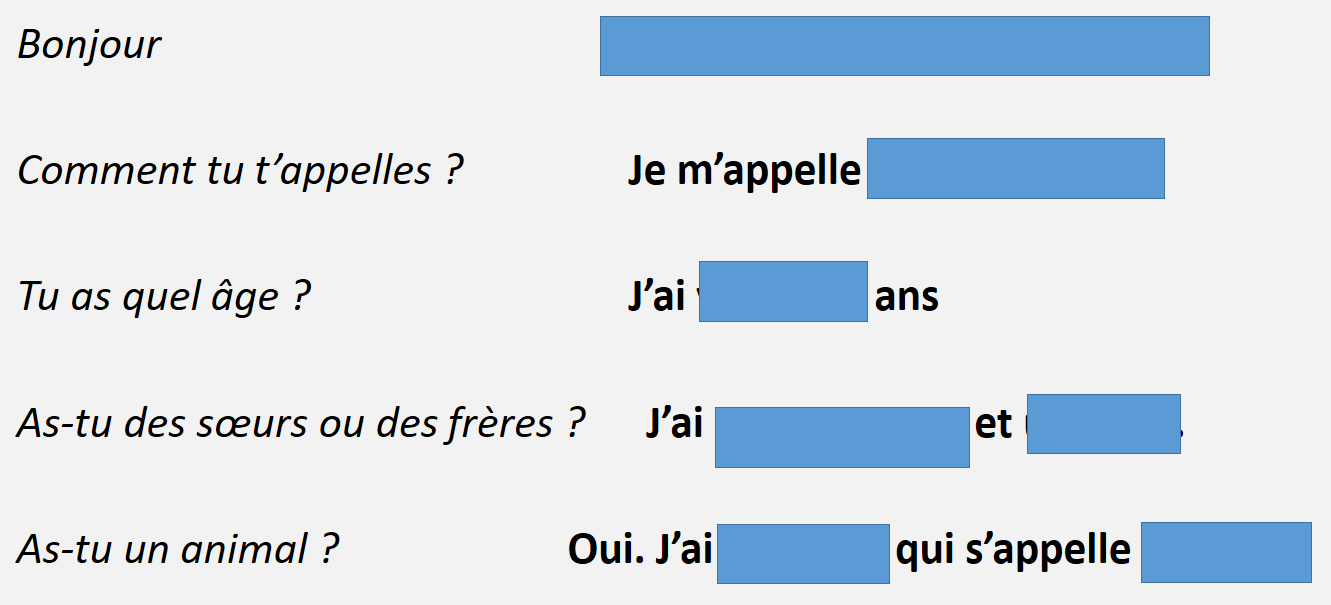
The first character is the actor and singer Louane. Here's the first dialogue for pupils to find out some basic information about her.


We will work on understanding what it says. But also what it literally means and the ways French is different to English.


We will exploit it for phonics. We use Rachel Hawkes / Comberton Village College Francophoniques. There are keywords and actions for the sounds. We work intensively on this so that the actions become linked not to the word, but directly to the sound. So the teacher can anticipate the pronunciation of the word comment with the dents action for the sound en.


Then we work on memorisation and fluency.


At this point, we are still ostensibly working on the original Louane dialogue, but I don't think pupils or teachers will be able to resist substituting their own details.

That's what happens next. We work on pets, numbers, months, family members. Each in turn exploited for phonics and grammar. So pets, with oiseau and poisson, works brilliantly for phonics. And it also means we have to tackle un / une. Where again, the issue of pronunciation is perhaps more critical than gender. Pupils do get gender (and increasingly refer to using the correct definite/indefinite articles as getting the "pronouns" right). But everything falls apart if their pronunciation of un / une is indeterminate. And with pets we introduce je and ai and our friend Mr Apostrophe. And je  and ne and ai and pas. Again, in an expression with meaning first, before breaking it down. Not the other way round. And numbers and plurals.

And then similarly family members, numbers, months. All great for phonics. And then, the pupils are equipped to go back to the Louane dialogue and adapt and manipulate it.

Then we go through the process again adding personality (je suis and adjectival agreement) and physical description to the Louane conversation. And then to the pupils' own conversations. And then to seeing the Louane information written up in the third person. And the pupils writing about themselves in the third person.

The next step will be to introduce Bigflo and Oli as characters. And go through the same process, to introduce a conversation with vous / nous and written up texts with ils.

It's a tricky first unit to do as a booklet. So much of it is spoken, it's not going to be booklet based! When I was working on rewriting the Year 8 Unit 1 booklet, I found that sequencing the focus on grammar and phonics didn't mean you were making anything that added up to how a lesson would work. So this Year 7 Unit 1 has turned out to be not so much a booklet as a series of powerpoints. Which teachers can then adapt.

This the key thing. What I am doing is about how we manage consistency and individual strengths in the department. This isn't about me, or a theoretical debate about language learning. This is about my own specific individual department that has had staffing fluctuations and where we are all still only just getting back to working together in the long (and not over yet) aftermath of covid.

I haven't invented or added anything I don't already do or that wasn't already in the scheme of work. But it is spelling out and making clear how everything is supposed to work. Maybe some teachers focus relatively more on the building blocks of language but don't develop how well pupils can use it. Maybe some teachers' pupils have a lovely accent and fluent responses, but don't have such a good understanding of the individual building blocks. I know consistency is in fashion, but this is all about balance. Florencia Henshaw sent me a picture of the swing of the pendulum which made me think about it in a different way. We know that the politics of language teaching swing from one extreme to the other. But Florencia's image is of the Newton's Cradle, where the ball in the middle is constantly bashed from either side, but actually does not move at all. That's us in the middle. Trying to keep on making learning happen in our lessons.


Friday, 10 June 2022

Developing Writing with Year 8

 You already met my Year 8 French group, with a Ready Steady French lesson that went a bit wrong, but turned out all right in the end because they really got the idea of using your French ingredients to make something good.

I've had a look through their books to see how we have developed their writing over this unit of work.

Of course, there was plenty of speaking too. With activities like Being Ben and Connectives Dice (in the second half of this earlier post).

The Connectives Dice involves throwing dice to get and, especially if, because, so, for example, but... to keep talking ad infinitum, without worrying too much about making sense. Just concentrating on really getting the French flowing. The written equivalent is World Record Sentences.

A world record attempt (unsuccessful)

In World Record Sentences, I ask pupils to write 99 words without a full stop. Instead, whenever they finish an idea, they use a conjunction to carry on. And on. And on. Except without the full stops. Some students love the anarchy of this. They enjoy using their French to write and write. To try out bizarre ideas or humorous contradictions. Other pupils cannot bring themselves to do it. They want to use full stops. They want to make sense. Both these alternatives are great. Because incoherent long sentences are just a first step. Once pupils see that they can write in French, then from now on we work not on the French, but on the quality of the piece of writing.

Coherence, convincing personal detail, variety, logic, and paragraphing. From linking ideas together, we move to taking one idea and developing it.

The next step on this journey is Pimp My French. I give the pupils a piece of simplistic French. Repetitive. Short sentences. Incoherent. And it is their job to transform it. With a budget of exactly (in this case) 55 words.

Pimp My French

Pimp My French

Both of these examples started with the same piece of simplistic writing. And both pupils have done their best to rearrange and re-write it. It is a very powerful process, where they start to work on the quality of the writing. It can be done just by adding conjunctions and removing repetition. For example by replacing j'aime... j'aime... j'aime with "J'aime... parce que je peux... et j'adore..." Or it can involve more sophistication in developing ideas or adding coherence.

We work on model answers on the board. And practise translating model answers in and out of French. We annotate model answers in colour and talk about which one reads the best.

Then we wrote the piece of work from last week's post, just writing "French out of my head". Again to prove that the French isn't the problem. And to make sure everyone has their ingredients ready. Here's a reminder:

French Out of My Head

You can see from the feedback, that we are again moving from focusing on the French, to focusing on the quality of the writing. So this week, the pupils wrote their "Excellent Paragraphs". Trying to take one idea at a time and develop it.

This is the sort of thing we got.

Excellent Paragraphs.

Read their Paragraph!


Add convincing personal detail...

The pupils are now very aware of their own progress. The end of unit Listening and Reading assessments show them how well they know the French they've been learning. And they understand that what happens in their books (and in Speaking) isn't about the French anymore. It's about how well they can use their French. In Speaking, it's increased spontaneity, fluency and self expression. In Writing, it's increased coherence, self expression and detail.

There are so many important things happening here. There is a strong oracy and literacy role that Languages plays in the curriculum. And an important self-efficacy impact, with pupils able to see how to improve their own work and take a pride in what they can do. It is structured and also open ended, for all pupils to move from mechanical and incoherent writing, to something personal, coherent and organised. And in that process, of successive iterations, the language learning happens. Pupils have practised speaking and writing over and over, trying out ideas, improving their work. Until they know it well enough to use accurately and spontaneously.

I can't believe that we are going to have to stop working on how well pupils can use their language. And give all this up, so we can work on testing what they know. These Year 8s will be the last year group to have the Conversation in the GCSE Speaking Exam. The last year group to be assessed on how well they can show off their ability to express themselves, develop answers and use their language.

Looking at their progress this year, or across this unit on Free Time, and how it's boosted their confidence and their grasp of the language, I don't think I can or should stop doing this. Even if we are told that it's not what's wanted anymore.

Friday, 3 June 2022

Pupil Feedback

 In our new KS3 assessments, we always have a section for pupils to reflect on their learning and give us feedback.

So impressed with this pupil's ideas about their own language-learning

It's useful for me to have feedback, but I also want the pupils to feel engaged. The more we can get them thinking about why they are learning a language, how they are learning, and how they are doing, the better they will get at thinking of themselves as language-learners.

Of course, I love it when they pick out as important things like phonics, gender, high frequency words, opinions. Or developing a core repertoire to express themselves. And often I think it is because they recognise the importance. Not just because they've heard me say it so many times and give me the answer they think I want to hear.


Phonics. And "I am a squirrel".


And one thing that hasn't come from me, is how frequently they talk about phrases for basic situations. Saying hello, finding the way, ordering food. It seems entirely natural to them that we should teach them what they need, to be equipped with some sentences ready for common situations if they travel abroad.


In case you are kidnapped. And it makes you look smart.


I think we do have to listen to this. And keep it in mind when balancing our curriculum. Lots of them do comment on the nitty gritty of powerful words, grammar, improving their speaking and writing. But they also think it is a perfectly reasonable expectation that we teach them useful phrases. Our pupils are a useful and sane counterbalance to the Ofsted diktats that language should be about exemplifying forms, not communication.

Then you get comments about pupils' view of themselves as language-learners, which are invaluable in building a shared sense of purpose and positivity:

Cats are French

Pride because he worked for it

Why wouldn't they?

Impress my mum

Tuesday, 31 May 2022

Are we allowed to talk about the Speaking Exam yet?

 Are we allowed to talk about the Speaking Exam yet? Even though the speaking window is closed, I think we should be careful about discussing specifics of cards because these will be next year's mocks and also our pupils don't need us dragging this up as they focus on keeping going through their weeks and weeks of exams.

But after 2 years of not doing the Speaking Exam, it would be nice to discuss some general experiences.

I was frightened that in the interim, AQA could have found a new paper-setter with a slightly different style. Specifically, I was worried that the Role Play could have shifted to being more transactional style situations. What I mean is rather than requiring the pupils to say something built out of the Spanish they know, it would be wholesale phrases learned by rote. Edexcel are more prone to this. With things like "My wallet has been stolen" which is grammatically beyond GCSE which but has come up as a phrase pupils are supposed to have learned along with a collection of situational phrases. The AQA exam has a mix of situations and contexts, but I think generally they could still be done by pupils making their own sentences out of their repertoire of Spanish.

I did actually sit in on one Edexcel Speaking Exam for a pupil taking an exam in their own parents' language. For the purposes of anonymity and exam security in this post, let's say it was Italian. (It wasn't.) But what happened in the role play was the prompts were that they were talking to an "Italian" teacher. It wasn't at all clear if this meant a teacher who was English but a teacher of Italian. Or an Italian teacher visiting a school in England. Or if the pupil was visiting a school in Italy. And because the pupil themself was "Italian", were they pretending to be English? And the teacher conducting the exam was an Italian pretending to be Italian. This was OK until the unexpected question, which was about the pupil's experiences so far in "this school". They had no idea which school, and neither did I or the teacher conducting the exam.

The AQA cards, of course, are not immune to this kind of confusion. Having the prompts in the target language was imposed on the exam boards. They are the experts in exams, and they knew it wouldn't work. The prompts couldn't gift the pupils the words they needed. But without using those words, it's impossible to convey what you are asking them to say. It is one of the paradigms of a good exam, that you don't have to take time out of teaching the subject, in order to teach the exam technique. This would be easy to fix if they just did what everyone wanted and put the prompts in English. 

One thing I have to work on: Pupils asking questions. Not because they couldn't ask questions. But because they couldn't ask the question prompted by the card. There's a question mark and a single word. And they have to ask a question about that. They didn't. They asked questions of their own invention. They just couldn't read the examiner's mind and guess what question they were supposed to be asking.

This is why I tell the pupils the Speaking Exam is like a football match. After the Role Play you will probably be 3 - 1 down. Your job is to come out in the second half and score 10 goals in the Conversation so you win 11 - 3.

The Photocard. There was one card that stood out as a bizarre image. On a topic that is in the specification. But which was just mind boggling. I'm not going to give any more away, but if you did the AQA Spanish exam you will know which one I meant. It fell to a near native speaker. Who just shook their head and we moved on to the other questions on the card. I don't actually remember much about the photocard part of the exam. I just read my script and did the timing. And worked out what Conversation topics were coming next. It's all a bit of a blur, to be honest.

The Conversation. Pupils answered the questions. Giving opinions, reasons and examples in past and future. I asked obvious questions to get started. And followed up with and... so... Why..? for example..? And asked questions that flowed logically from the answers they were giving. Some were better than others. None were as good as the very best I've seen when it's not an assessment. They responded well to the interaction. But could maybe have done better at dropping in some set piece language for things like what was happening or what could have happened. That's fine. They can save that for the Writing exam. Maybe they were confident in their ability to develop answers on the spot. But I wish they had maybe done a little more preparation to have a balance of spontaneous answers alongside something up their sleeve to show off if the opportunity arose.

There was one pupil who had diligently done preparation, memorising possible answers. Delivering these word by word, they were nervous and making mistakes. As soon as I interjected and moved them away, they were much more comfortable making up answers from their repertoire of Spanish.

One big thing. And I remember it from previous years too. The Speaking Exam highlights neurodiversity. In particular allowing pupils to choose the first Theme of the Conversation. Specific pupils then have this very much in the forefront of their mind. To the exclusion of everything else. They are focused on this one Theme, the possible questions they might expect, and also a question they might ask the examiner. Coming in to the exam with this in mind, makes the Role Play (already cryptic and confusing), a huge stumbling block. Often they blurt out things they are expecting for the Conversation as their answer to the Role Play. And then having said them in the Role Play, when they realise they should be saying them again when it comes to the Conversation, it all confuses them further.

The exam, with its separate parts, confusing stimuli and different success criteria, is a marathon through a mine field. Pupils have to be agile, quick and clear thinking, resilient and responsive. Pupils who focus best on one thing find it incredibly confusing.

In terms of conducting the exam, it's worth remembering that after 2018, AQA made it clear that it is malpractice to tell the pupils that the Themes will be cut down to certain topics. So my pupils all knew that they had to be able to answer on the full breadth of the Theme. And anyway, the photocard can include any of the topics. In conducting the exam, my priorities were to give pupils the opportunity to demonstrate they could give opinions and justify them, talk about past and future, narrate events, and respond to further prompting. Some topics are better suited to this, so I started with topics like House, Region Family, Free Time, Travel, School, Careers (as dictated by the Theme). And I found that by the time pupils had developed their answers, and I had followed up with questions that logically picked up on their answers, the time went very quickly and I didn't ask a lot of questions on Social Issues and the Environment or Festivals in Spain. I hope it's clear to the examiner that precisely what I was doing was not allowing pupils to give rote-learned answers to a pre-agreed list of questions!

The Conversation, as in 2018 and 2019, continues to be the best part of the whole GCSE. Where pupils can show off what they can DO with their language. Speaking spontaneously, developing answers, interacting with the examiner. And it's central to their language-learning. It's when that core repertoire starts to gel, that other structures start to stick. It is heartbreaking that the new GCSE (in the name of ending the rote learning that was happening back in 2016) is going to stamp out this part of the exam and this aspect of learning.

Sunday, 29 May 2022

What will the new GCSE change?

 We are starting to think about what we will need to change with the introduction of the new GCSE. The pupils starting Year 8 in September 2022 will be the first to take the new exam. So we should be starting to think about what they are learning and how we are teaching.

The new GCSE is part of a drive to make us change the way we teach. Together with Ofsted's "Research Review" and with the support of NCELP, we are supposed to be focusing on phonics, high frequency vocabulary, and grammatical knowledge. The hardline view of this set out in the Ofsted webinars on curriculum design, is that we should concentrate on boiling down our teaching to the essentials of language knowledge, avoiding complex or rich contexts.


But if we look just at the implications of the GCSE, perhaps we can minimise the changes needed.

I am sure the exam boards will want to keep as much continuity as possible. For them, the exam isn't about setting the curriculum. It's about creating an instrument which consistently, year on year, discriminates between pupils of different grades. I think that the look and the feel of many of the questions on the Listening and Reading paper will be very similar to what we are used to.

This is reassuring on the one hand. But not great on the other. Because the Listening and Reading papers are widely criticised. And while the new GCSE proposals seemed to be promising to offer an improvement, I think that actually, what they are offering is more of the same.

Their big offer was a restricted vocabulary list, based on the most high frequency words. In fact, looking at the current exams, this does not represent a big change. The texts are largely constructed out of non topic words. As I showed in this earlier post, there is a preponderance of non topic words. And the scattering of topic words are familiar ones or cognates. Also the words which unlock the correct answers are the non topic words. As I discussed in this post, it's words like, too, started to, was going to, never, so much... which make the difference between what AQA accept and reject.

The issue with the current Reading and Listening is that this focus on directly translating all the little words means that what masquerades as a comprehension question, is anything but. In this earlier post, we saw that a correct answer to the question, "What impressed her about the school?" (They grew fruit and veg on the school field), is not accepted. Pupils had to write "They grew fruit and veg on PART of the school field." This is clearly not a comprehension question. What impressed her was indeed the fact that they grew fruit and veg on the field. What AQA want is an answer, not that answers a question with comprehension of the text, but an answer that shows knowledge of the non topic words. 

Also, it requires an answer based on parsing the whole sentence word-by-word. Of course, when listening to a foreign language, we don't understand by a one way street of understanding every word to arrive at meaning. We keep in constant review what we think the word is and what the overall sense is. Especially in French, where you can't even decide if the word you hear was porc or port until you've started to put together more of the context. But the exam board, wanting to test knowledge of items of language, not ability to construct meaning, often use slightly off-beat contexts, in order to throw pupils back on word-by-word parsing. I'll say that again. The exam boards deliberately pick contexts to bamboozle the pupils. This leads to a mixture of hilarity and concern amongst teachers on twitter. At once amused and outraged by texts on unicycling mountaineers (yes, really). But this idea of being tested on word by word (unnaturally slow) sentences is key to the new proposals. So yes, the exams will be very similar. Because they are intent on keeping their worst features.

In fact, with a reduced defined vocabulary list, the exam will still have to discriminate in the same way, with the same number of candidates getting questions wrong. So it is likely to be even more based on tricks and traps and tying pupils in word knots than the current exam.

It is true that there is a huge vocabulary list for the current GCSE. But this is a bit of a red herring. (Or red hake in the case of the 2020 Spanish exam.) Every year there is a question that comes up with words teachers have never heard of. But which turn out to be on the list. This hits the headlines, but it's not central to how the exams are constructed. And it demonstrates that we are NOT building our curriculum around the list of words in the specification. Teachers weren't even aware the words were there. We are mainly getting on with teaching pupils the language they need for the Speaking and Writing.

The current situation is that there is a discrepancy between the language we teach pupils in order to speak and write, and the language they need for the Listening and Reading exams. For the Speaking and Writing, we teach the most powerful language for giving opinions, justifying them, talking about past and future. For the Listening and Reading they need non topic language like so much, too, a bit, not very, started to, part of, never, until. I think a genuine attempt to solve the discrepancy would have been to make the Listening and Reading more similar to the language we teach for the Speaking and Writing. But they've decided to do it the other way round!

There will be some differences in the Listening exam. The biggest of these will be the dictation. This is supposedly to test phonics. But as we saw with porc and port, you can't transcribe the word without grappling with meaning. Or in the case of porc and porcs grappling with the grammar. The earlier we all get started with practising dictation, the better. It's not a simple phonics test. Pupils' brains will naturally try to make sense of what they hear. And then maybe write words they know, rather than transcribe the sounds. And as part of a GCSE, the dictation has to grade the pupils. So it won't be a friendly check of the sound spelling link. It will need to be a test where a grade 5 pupil on the higher tier gets half of it wrong. There may be some help with the idea of untangling listening for meaning and transcribing the words, if the exam boards use a text which has been previously used in the same exam as a comprehension question. I'm not quite sure how this is going to work with the stipulation that the comprehension questions are made of known words, but the phonics dictation should contain some unknown words. My money is on names of people and places.

The Speaking exam will look largely familiar. With Role Plays and a Picture based task. These will require short answers. Whether these will be phrasebook style, or built out of the pupils' knowledge of grammar, I don't know. The thrust of the reforms is that they should test accuracy and recall, but we shall see. All we know is that the responses are to be short. Which brings us to the biggest thing about this exam. And which will have the biggest impact on our teaching. There is no conversation. No scope for pupils to show what they can do with their language to express themselves, develop answers, interact.

I think the new GCSE is reacting to the horrendous situation under the old Controlled Assessment GCSE, where pupils learned and delivered fancy scripts by rote. The proposals are based on a review of languages from 2016 by something called "The Teaching Schools Council". And they don't want to go back to long rote-learned answers. Unfortunately, because their research is from 6 years ago, they are replicating what the Controlled Assessment GCSE did: stamping out teaching which develops pupils' ability to use their language, extending answers spontaneously.

If like me, that's what you spend KS3 and KS4 doing, then just like in 2011 (remember the longest ever TES forum thread when we realised?) you will have to abandon teaching pupils to use a growing core repertoire and how to get good at deploying it. Unless... Unless you believe this is fundamental to language-learning and make the foolhardy decision to persist with it.

In the Speaking exam, as with the Listening exam, there is a new Phonics test. This time it is a reading aloud test. I am a big fan of phonics and I think reading aloud is important. Thinking of it as part of an assessment is going to take a lot of working out. Again, it will have to be a GCSE test which discriminates between pupils of different grades, with most pupils getting a lot of it wrong. As with the dictation, I am worried about how pupils do when simultaneously focusing on meaning and the sound-spelling link in an exam situation. This is compounded by the fact that pupils will also have to respond to comprehension of the meaning of the text, with questions on it (or on the topic?) after they have read aloud. Again, if this means there's a clash between texts for comprehension being made of known words and texts for phonics containing unknown words, 

I wonder if the solution is names of people and places? If it's names of Paris metro stations, then it would panic me personally! How do you say Barbès–Rochechouart? Or Ménilmontant? Wagram? Or perhaps they could use cognates, so that the words are comprehensible but still a test of phonics. This would set alarm bells ringing because when the pupils see a cognate, it takes a huge wrench to tear themselves away from pronouncing it the English way.

I don't know about the Writing exam. Is this because less is known? Or have I not been paying attention because I'm focused on the removal of developing spontaneous answers in the Speaking exam? My money is on more translation, so the exam can focus on knowledge of specified language features. And on accuracy.

I don't know how much difference all this will make to your teaching. Start trying out dictation and reading aloud. Make sure you've got phonics sorted. Work out how you can increase your focus on grammatical accuracy. Reduce the amount of time you spend getting pupils to express themselves, improve their answers and think up things they can say with a repertoire of language. Instead focus on their recall of specific language you want to test them on. Decide whether to keep and tweak your curriculum, or whether to throw it out and use the NCELP scheme of work and resources. Or if it makes sense to mix and match - although unless I am mistaken, the strength of the NCELP resources is their meticulous sequencing and revisiting, so dipping in and out might not work. And decide what to do with the pupils already starting Year 8 in September 2022.

It's all a bit of a conundrum. And I still don't know what to do after a year of reflecting on it.


Saturday, 28 May 2022

Failure

**Important update. Now this post stands out as a clear calling out of the "gaslighting" MFL teachers suffered under the previous government, I do need to make it clear that there is no personal blame or attack on MFL figures who were trying to make things work. Or indeed succeeding in driving forward the debate around MFL teaching. The Ofsted Research Review was produced in a formulaic landscape of other subject reviews, all tied to the spurious Novice-Expert model, trying to fit MFL teaching into an ambitious step by step approach just as the Frameworks of Objectives had done a generation earlier. And NCELP stand out for their work on an incredibly intricate curriculum where every word counts in a way that had never been envisaged let alone attempted before. And the people leading these initiatives are the most respected and loved individuals in the MFL community. As well as driving forward the debate on language teaching, they are renowned for their generosity and for championing the work of others.

Here is the post as it was written in 2022 under the former government:

 The government want to bring in a new dawn for modern languages. Where teaching based on a meticulously sequenced curriculum of incremental knowledge puts an end to pupils' frustration and confusion. Implicitly (or even explicitly) this is labelling the current teaching of languages as "failing". And putting the blame on the values and practices of teachers.

This accusation of obdurate failure of an entrenched educational "blob" goes back to Michael Gove and Dominic Cummings. They wanted to "move fast and break things" and have said that they were surprised at how far they were able to go without meeting resistance. It is a favourite of politicians who want to be seen to be doing something, or with an idea to push.

So how true is this picture of failure?

If it is based on the level of language that pupils achieve, it's worth pointing out how this has progressed. In the 2000s, for a top grade at GCSE, pupils needed to write short pieces of coursework on familiar topics, including opinions, reasons and reference to past and future. They could do this using all their resources and previous pieces of work. There were marks for presentation. It is what we routinely teach in Year 8 and Year 9 now. At GCSE in 2022, pupils have to write extended pieces in exam conditions, on unprepared questions.

If it is based on the 2016 curriculum review by something called "The Teaching Schools Council", then this was during the disastrous period of the Controlled Assessment GCSE. The exam favoured rote-learning of fancy long scripts. Teachers who tried to teach pupils to speak and write spontaneously using a growing repertoire of language found they could not compete with schools whose pupils just memorised answers. It was the zenith of competition between schools and punitive pressure to succeed. It was the period of targets and the imperative of getting pupils "the grade they deserve". Ironically the Controlled Assessment approach, brought in after the Dearing Report found the speaking exam was "intimidating", turned it into an unpalatable chore. And put a stop to successful language teaching for a decade. I am not confident that we aren't going to return to something similar. 

If it is based on GCSE grades, then these have been set in advance, and are nothing to do with teachers' or pupils' levels of performance. Before the first pupils even started studying for the new GCSE in 2016, it was already set in advance that they would typically get lower grades than in their other subjects. Because this is how the grades are given out. Ofqual know that it is a problem. As I wrote in an earlier post, Ofqual know that grades in MFL at GCSE and A Level are not aligned with other subjects. But it's not their brief to make sure they are. It's Ofqual's brief to make sure standards in each subject stay the same year on year. Within this brief, they have tried to do what they can to move MFL results more into line with other subjects. They looked at the fact that for an elite subject with a high number of A grades, A Level languages had a dearth of A*s. They looked at the effect of native speakers on A Level grades. At GCSE they looked at how levels matched up with European pupils, in a desperate attempt to find something in their legal brief (international comparability of standards) that would allow them to intervene.

And of course because the outcomes are set to be lower in languages, the targets pupils are given are lower than in their other subjects. Giving them a clear (and correct) message that they are likely to achieve a lower grade in languages. What isn't always made clear to them, is that this isn't any reflection of their individual ability in the subject. Or their teachers' performance. Or the difficulty of the content. It is just the way grades in languages are allocated.

If it is based on the number of pupils choosing languages, then how is this judged? The government wants 90% of pupils to be entered for GCSE languages by 2027. Again, we are being set up for "failure". If the government wanted, they could make languages compulsory again, give it back the status of a core subject, have a national strategy and a plan for recruitment and staffing. Instead, they use the cowardly and phoney "ebacc". Which masquerades as something pupils can gain, when in fact as a qualification it is utterly spurious. If languages are one subject in an option block of 5 or 6 subjects, and all perfectly good subjects, like history, geography, computer science, drama, technology... then why is it a "failure" for languages if pupils pick those other subjects. And in many schools the number of GCSEs pupils pick has been reduced, without noticing a particular further squeeze in how many are opting for languages.

In our school, surveys show that the majority of pupils in Year 9 are positively considering taking a language. Even when they don't end up opting for a language. The surveys also show that even before we ask pupils to start thinking about options, our pupils have a career in mind and have ideas as to whether or not a language is important for this. And we know from a recent Cambridge University study, that the parental attitude to languages is twice as powerful as anything that happens in school, when it comes to picking (or not picking) a language at GCSE. 

We mustn't be bullied into thinking we are "failing" because of ridiculous targets.

Then there's the whole caricatured narrative around how we teach. Ofsted seem to think that we have never considered the balance required between a focus on communication and a focus on grammar. Or considered that in the reality of the classroom, the two may not be opposites at all. We don't refuse to teach pupils the sound-spelling link. We don't bamboozle pupils by talking at them in the target language until it alienates them. We don't teach phrases wholesale without pupils knowing what the words mean. We don't have a curriculum driven by ticking off things pupils can say, without thinking about the development of their grammatical conceptualisation. We don't teach lists of nouns without enabling pupils to use them. We don't teach topic content and then abandon it when we start a new topic.

The whole narrative is a political fiction. It's us, the teachers, who are making the whole system work, in the face of the externally imposed nonsense of targets, grading, performance measures, assessments. We'll be the ones making the new GCSE work too.


It turned out all right in the end

 One problem with tweets and blogs is you only see the shiny successful fancy stuff. Never the lesson that went wrong. Probably less because people don't want to talk about it or won't admit that it happens. More because we're wary of portraying our schools and our pupils in a negative light.

Anyway, we all know it happens. Here's what happened to me last week with a lesson that just flopped and how it turned out alright in the end, because it's not about one activity, one lesson. It's about progress and moving forward together.

I was planning on doing Ready Steady French with my Year 8 middle set. I know Ready Steady Cook is from before they were born, although it has been revived recently. So I briefly explained that it was a cooking programme where people brought along ingredients and had to make something tasty out of them.

The metaphor of "ingredients" is particularly powerful. Through this lesson, I wanted to get across the idea that you use the French ingredients you have. To make something tasty. And it's not about learning more and more French. It's about getting better at using the ingredients you have. And using them in the right proportions. Lots of cake, a bit of icing, and a couple of smarties. And not sitting there making nothing because you've decided to make something that requires ingredients you don't have. 

And for the Ready Steady French format, the distinction between store cupboard ingredients and the specific ingredients you've brought in or been given.

I had borrowed the Red Tomatoes, Green Peppers logo to shine on the board and I'd set up three rounds. Round One was an individual round, working with one ingredient plus our store cupboard ingredients. How many things can you make out of "nager"? Making single sentences and exploring all the things in our store cupboard we can always use. Things like opinions, verb + infinitive, conjunctions, people and places.

Round Two was going to be a pairs round about combining ingredients. So with "nager", "jouer", "faire les magasins" and "aller", could you use the store cupboard ingredients to make a mini paragraph along the lines of "I love to swim in the pool but if I go to the beach I don't like to swim because I prefer to play football on the beach..."

Round Three was going to involve them making a bag of "ingredients" picked from the unit vocabulary list to give to another pair to make something nice out of in French. This did not happen.

They just were not buying it. I don't know if they were thrown by the format? Or didn't take it seriously. Or if I was too focused on the activity and not enough on taking them with me. Or if one of them was confused by the metaphor and thought we were really cooking. Or if the set changes made by the head of year had changed the group dynamic and they'd already had a bad lesson in history. Or if the fact we were working on paper instead of exercise books changed their attitude. I thought the paper was so they could try things out and have a go. Did they think it was a test? Anyway, we struggled through Round One. And then did Round Two together rather than as a challenge.

Then I abandoned Round Three. Instead I gave them a "recipe" on the board to follow and made them do a bit of writing following it. Basically the recipe was:

positive opinion        because I can...        especially if...

but     negative opinion    because I have to...    I prefer...

I also did list the ingredients on the board so they had everything they needed.

It kept to the ingredients/cooking metaphor but got rid of the format. And they did it very well. It could be that the TV show format had unsettled them. And they worked better just being told to work in silence on their piece of paper. Or it could be that this class often have ups and downs, not necessarily linked to what I am asking them to do. I know their history teacher says the same thing.

So what happened next? The next lesson I told them I still wanted to see how good they were at using their ingredients. I stressed it wasn't a test. And that I was going to give them a series of opportunities with different levels of support. But that first I wanted to see what they could do just with the French they carry around in their head.


This is the sort of thing that I got. Or this:


Confident writing, from the store cupboard ingredients they use for all topics. Plus topic specific vocabulary for Free Time which is what we are working on. All unprepared and written with French they know.

My comments on their work aren't about the French at all. They are all about what we can do in our next piece of work to make it a better piece of writing. Better organised, more personal, less repetitive. And that's what we will do after half term. I told them this was just me looking at what they could do and that they would have the chance to improve it. We'll see what they come up with!