Friday, 7 April 2023

Language World 2023 Part Two

 In Part One of these two posts on my talk at Language World 2023, I looked at how we find ourselves in the middle of a polarised debate about language-learning. On the one hand, there is an emphasis on explicit learning of well-sequenced grammar, selected vocabulary, and phonics. On the other is the idea that communication and meaning come first, with grammar only making sense once pupils have enough language for the patterns to emerge.


At the end of the first post, I said that for me, the key thing is a well-structured and deliberately sequenced curriculum. But one that shifts the focus from just accumulating knowledge of the language, to a deliberate development of what pupils can do with the language.

And we don't have to look far for validation of this approach. We may be worried about Ofsted or even our own schools being obsessed with knowledge, but what we are required to teach is the National Curriculum. And the National Curriculum is very clear that our pupils should be making progress in what they "know and can do" with the language.

What do I mean by developing what pupils can do with the language? I mean a curriculum where we deliberately focus on how well pupils can develop their answers in speaking and writing, with increasing spontaneity, detail, personalisation, complexity, accuracy and independence.

The next few slides showed examples from my school's curriculum to show what I mean by this. Here I will give links to previous posts explaining activities in greater detail. And at the end I will come back to look at some overall principles and what "grammar" really means for me.

First an example that happened just before the conference so featured as a last minute extra, without a slide. Here's a story for you.

One of my Year 10 pupils arrived early before the others. I asked him, in Spanish, "Do you like to go to the zoo?" He looked puzzled because zoo pronounced in Spanish doesn't sound like a word. So I wrote zoológico on the board and asked him the question again. He said, "Sí, me gusta." I raised an eyebrow in expectation. He thought and said, "Sir. I am going to need the words for monkey and scratch." I put these on the board for him. He then said, in Spanish, "I like to go to the zoo because I can see the animals. In the holidays I went to the zoo and I saw a monkey. He was eating a banana. But while he was eating the banana, he scratched his... I was sick."

This is where I want pupils to end up. Able to develop answers spontaneously. With a secure repertoire they can deploy. It meets the GCSE criteria of extended answers, justified opinions and narration. And pupils with this kind of a working core of grammatical knowledge do well when they move on to A Level.

In my talk, I went back to the beginning and showed how first of all we work on fluency and spontaneity. Even saying/writing nonsense. Just to get the French flowing with activities like World Record Sentence or Connectives Dice (see second half of this post).
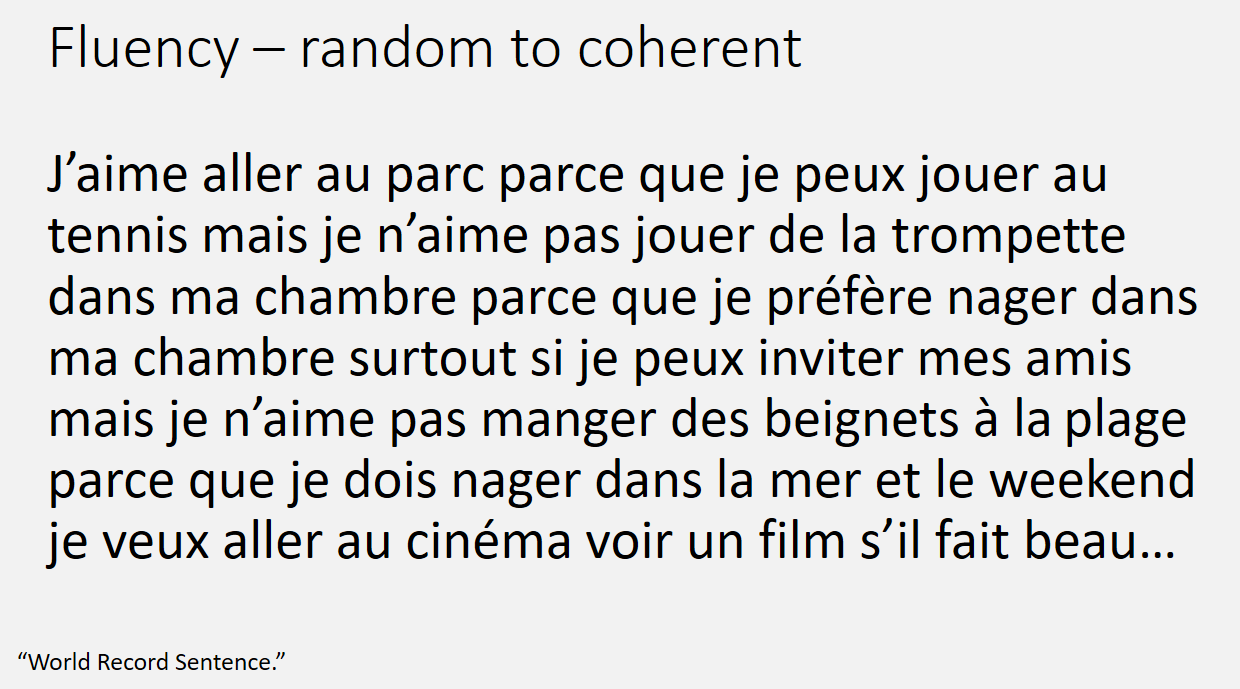


With activities like this, two things can happen. On the one hand, pupils relish the randomness of the sentences and enjoy saying things that no-one has ever said before. (Isn't that the point of grammar?) Or on the other hand, they try to make it make sense. Which is taking the next step in the right direction.

We quickly establish that knowing the French isn't the issue. What we need to spend time on is getting better at using our French. Thinking of things to say, what to say next. Making it coherent, varied, more sophisticated, more detailed, more personal.

Activities like Pimp My French focus on this, by taking a simplistic repetitive answer and improving it using all our repertoire. Annotating model answers and writing in colours helps pupils think about how to deploy their repertoire and create a better answer.

We look at how creating a piece of writing with just one infinitive has positives and negatives. Positive: it sticks to one idea, it shows off the whole repertoire of what you can do with an infinitive, it saves your other infinitives for another paragraph, and perhaps this person really likes playing with a ball.


But of course, this paragraph is also repetitive. So we look a paragraph (C) with more infinitives. Which turns into a bit of a list with and, and, and,  because there was no real link between the activities. And then a paragraph (A) with carefully chosen activities which do link into a coherent paragraph. You can see, the pupils then write their own versions of these 3 paragraphs.


Except often they don't. When you ask them to write paragraph (B) or (C), they instinctively want to improve it and make it read well!

You can see the beginnings of my Year 10 pupil's monkey story here, as pupils start to develop one idea, rather than just link ideas together.

In my talk, I moved on to explaining how to develop this kind of narration.


I expect you probably already all teach the structures involved. Opinions. Verb + infinitive. Past Tenses. In my talk I showed how we deploy them to create a narrative. Each pupil has ownership of one of the key structures. And we go round the class to build the story. Here's a post on how to set this up. Initially it follows a template, but as it gets transferred across topics, pupils deploy the repertoire more and more flexibly, (as shown here) until they can spontaneously develop answers on any topic.

So where does this leave grammar? Firstly, you can see the accumulation of grammatical forms. But the important thing is that they are added on to a working repertoire. And they are added because they are needed and useful. With a specific use. Imperfect to set the scene and say what was happening. Preterite or Perfect to say what happened. Different persons of the verb when you need them to create conflict or a difference of opinion. I talk to pupils about their "snowball" of language. Instead of leaving their French to melt, they have to grab hold of some, make it their own, and then more and more language will stick to it.

And secondly it takes a slightly different definition of grammar. Rather than taking the formal grammar in the sense of a linguist's dissection of the overview of the language and chopping it up into what seems logical chunks and sequencing, it focuses on the pupils' grammar. Grammar in the sense of their growing repertoire and ability to deploy the language. How the language is articulated, put together, used by the pupil to create meaning and develop answers. Scott Thornbury has a metaphor for this. He says that the synthetic grammar syllabus is like trying to make an omelette by taking an omelette, chopping it up, and trying to rebuild it back into an omelette. Instead, what I am trying to do is to take the raw ingredients and slowly cook them into something tasty. Developing the pupils' grammar, not chopping up the linguist's grammar.

I finished my talk with a third metaphor, bringing it back to the title, "Having your cake and picking the cherries," with the idea of language-learning as similar to Food Technology. You have your ingredients and you learn to use them to make something nice. If you have ingredients left over you didn't use, there will be something missing. And don't keep demanding ingredients you haven't got. Make something tasty with what  you have got.

And I added one last image. We often talk about the swing of the pendulum. From one pole to the other. In this case, from Communication to Grammar. But rather than a single pendulum, this is a Newton's cradle. The balls on the end swing wildly. But the balls in the middle never move. We are bashed from both sides, but we can find a middle way!


Thanks for coming to my talk!

Photo byHelen Myers.


Saturday, 25 March 2023

Language World 2023 Part One

 Fantastic to meet up with so many people at Language World 2023! As always at Language World, there's a wonderful atmosphere and an opportunity to recharge your batteries by talking to people who share the same passion and purpose.

My talk was about balancing Communication and Well-Sequenced Grammar.

In this first post, I shall pose the questions. And in a later post, I will sketch some possible answers and try to redefine the debate.


Surely the two things are not incompatible? Sometimes we are being invited to see them as sitting at different ends of a spectrum.


On the one hand, we are being told that the most important thing is explicit and direct teaching of phonics, grammar, and vocabulary. And on the other hand, we hear that language is acquired through Comprehensible Input and developing intercultural competency. It is argued that that we should give pupils lots of exposure to the language before starting to break it down and look for grammatical patterns.

In our teaching, this supposed incompatibility is reflected in something as fundamental as the idea of teaching a series of topics. What if, when we teach a topic, we then abandon that language and move on to another? What if the topics we commonly teach mean that because each pupil wants to be able to talk about their own interests or pets or family or ambitions or outfits, then our teaching becomes a list of trivial fluff, mainly lists of nouns so they can each say the thing they want? Planning the curriculum by equipping pupils to talk about a series of different topics or scenarios may not be the best way to sequence the grammar. And there may be things in the unit that we teach them to say, which contain grammar that is incidental rather than planned. What if we are focused on the outcome of the unit; a test or conversation or poster, rather than the learning?

All of these are great questions. But none of them mean we have to abandon communication or self expression. Or even topics. All of the above dangers are present when our Year 7s create their Art Exhibition. But surely, if we bear these questions in mind, it can and does work. So the whole point of teaching the grammar of gender, agreement, articles and word order, is so that each and every pupil CAN write what they want. They all create different artworks but we have equipped them with the grammar to be able to describe them. Grammar is a shortcut where knowing the rules means you can say things you want to be able to say, not just rehash what you have learned. Grammar is creativity and communication. That's the whole point.


So, to borrow from Professor Henshaw, on the one hand we are being asked to see language learning as a collection of grammatical forms. And on the other, we are being invited to see it as a collection of things pupils can say.


There must be a middle way.

So how can we ensure that well-sequenced Grammar teaching and Communication are compatible. What does it look like in practice?

Well, there are many ways that each school can do this, once they've set themselves the challenge of making it happen. In the rest of my talk, I showed examples from our school's curriculum that demonstrate how we do it.

But there is a principle involved. Our curriculum is based on what the National Curriculum asks us to do: Develop what pupils know and can do with their language. And the key element is that we are deliberately developing what they can DO.

So if at one end of the spectrum there is a grim emphasis on Knowledge (just look at the slide from the Ofsted webinar on the principles of curriculum design) and at the other end, there is a hope that just letting them interact with the language will see acquisition happen, then we are trying to sit somewhere in the middle. 


We are school teachers, so we do explicitly teach grammar and vocabulary. But we also constantly work on the quality of what pupils say and write. By quality, I mean increasing spontaneity, fluency, development of ideas, personal expression, independence, accuracy and complexity.

None of these things happen by accident. They are deliberately worked on.

Here you can see the exemplars for each of the units in our Year 8 curriculum.


You can see, we do have topics. If you look closer, you can also see that the language for all topics is very similar. It is based around opinions and reasons (using verb + infinitive constructions) and conjunctions. This forms a strong core, to which other grammar is added. Present tense verbs, perfect tense verbs. But the main thrust of the year is not about learning more and more French. It is about getting better and better at using your French.

In part two I will look at materials, activities and examples of pupils' work to show what I mean by this focus on how well pupils can use their language. And try to work out what this means for what grammar we teach and how we define grammar.


Sunday, 5 March 2023

Top Tip for Dictation

 This post is going to start out as a top tip for Dictation. And may end up being just the tip of the iceberg when it comes to what Dictation means for teaching listening in MFL.

It's inspired by @MissWozniak's talk at this weekend's TM MFL Icons Teach Meet. (Recording here.) Listen to Jennifer's talk for ways to start thinking about how to make Dictation accessible, especially in French.


My top tip is, instead of using gapfills, use whole sentences with a word that is changed.

So for example you could give the pupils the sentence with a gap:

J'aime aller à la plage parce que je peux _________ dans la mer.

Then they hear the full sentence J'aime aller à la plage parce que je peux nager dans la mer. And they have to write in the word nager.

I have found it's much easier to give the pupils a full sentence for example:

J'aime aller à la plage parce que je peux jouer dans la mer.

They listen and change jouer to nager.

Our KS3 tests contain this kind of exercise and it is generally done well and with far less panic than you get with a sentence with a gap in it.


I can see two possible reasons for this. Firstly, if you are giving pupils a sentence with a gap, there is already a level of cognitive challenge. The sentence is meant to be there to support them, but with a word missing, they are having to work hard to access the "help". In this case the missing word nager is a key word from the sentence, strong on meaning. Perhaps the first word that they would have been drawn to if they were given the complete sentence to make sense of. We, as experts can make sense of the rest of the sentence without the key word, using meaning and form to deduce what might be missing. This is an exercise in itself for the learner.

Secondly, maybe the tendency is for pupils to focus on the gap. To ignore the rest of the sentence, which as we saw may not be as helpful as it was intended to be. So when they listen, they are focused entirely on the gap in isolation, trying to work out which sounds to fill it with. Which inevitably come and go too quickly, without putting together sound and meaning let alone spelling.

So giving them a whole sentence with one word to be changed means that they have to listen to the whole sentence in order to spot which word is different. And the sentence they are given is a complete sentence that they can start to make sense of. They don't need to try to work out what type of word might go in the gap. They can see jouer and it's then just one step to replacing it with nager.

From experience, I would say it has been quite successful as a way to start asking pupils to transcribe words from dictated text. If you just want a top tip, you could stop here. Because, as I said, this could be just the tip of the iceberg!

What I think this is really getting at is the nature of dictation. It is not a simple exercise in phonic transcription, a friendly test of pupils' grasp of the sound-spelling link.

The Ofsted Research Review is wrong when they say that comprehension of French proceeds in a linear fashion from decoding sounds, to recognising known words and grammar, to arriving at meaning. You cannot tell if the word you heard was port or porc from the sound of the word. You have to have a feedback loop between meaning and sound at the sentence level.

And in French there is a multiplicity of ways of phonetically transcribing any utterance. Some of them meaningful, some of them nonsensical, some grammatically plausible, some not. So dictation is always going to be a test of meaning and grammar as well as the sound-spelling link.

Here's a fun example based on one of the proposed example dictation texts from one of the exam boards: Demain j'ai un concert. This is phonologically indistinguishable from deux mains géants qu'on serre. Of course no pupil is likely to write that. And it contains a grammatical error in the gender of mains. But it shows the wild variation in how an utterance can be interpreted. And makes us question exactly what our pupils are hearing when they listen to French.

We had a similar thing when we created listening materials to go with some of the recordings that go with the KS3 Expo textbook. Each listening question from the textbook turned into a 4 page set of activities that the pupils did in the computer room, with access to the listening track so they could pause and rewind as required. And we used it with GCSE groups not KS3. In order to make the listenings from the KS3 book accessible to KS4, we needed to structure 4 pages of work per listening track. Because they were not accessible at all. Here's one ridiculous activity that was in there that really makes the point: What are our learners "hearing" when they listen to these tracks?


One of these is inspired by the pupils always hearing huit tissues instead of produits issus. Not to mention what they hear on the listening, again from Expo, about les_expositions!!! Oh, and there's another one where dans la chambre is now universally heard as Donald Trump. Once you've heard it you can't unhear it.

Picking the correct option in each case, is less to do with the sound you hear and much more about making sense of the sound. And turning it into words that make sense as a sentence.

So this isn't really just about dictation. It's about our whole approach to Listening. I think the inclusion of dictation in the new GCSE will be the start of unpicking what happens when we use Listening in the classroom and in the exam.

Firstly, I think dictation will end up not being dictation at all. Because it can't. You can't have an exam which pretends to be a phonics check but which inevitably is much more a check of grammar and meaning. You can't have an exam where there is a near infinite number of correct phonetic renditions of a text. What you will have instead is an exercise where there are sentences read out, but what is really being tested is the spelling of know words. Like nager in the example we began with. So the pupil isn't transcribing, they are recognising the words and being tested on whether they know how to spell it. Or perhaps it's more accurate to say, they are being tested on their ability to spell known words and not attempt to transcribe them because that's where interference from English phonics would lead to error.

Secondly, I think the difficulty of dictation will reveal the difficulty of Listening, as I have sketched out above. The current situation of Listening in the GCSE exams is absurd. I remember being on a panel of mainly Spanish native speaker teachers who thought that our Listening exam level was low. Because we have slow scripted speech and questions in English. It was only when they themselves got some of the questions wrong, they began to realise what was involved. They were used to training pupils to listen to natural speech and answer questions that showed they understood details of what was being said. I have written about it here, but basically they realised that our Listening is not about comprehension but about processing word by word and being tested on specific language features. Not on meaning, but of knowledge of the language. In a kind of dictation that you have to do in your head. A sort of word by word processing is required with a focus on the exact language, which is different to the comprehension of meaning as you listen.

And this will again come back to the error in the Ofsted Research Review. Our learners do not arrive at meaning by processing word by word. They start by approximating overall meaning, content, context. And then proceed to the detail of the language, holding bottom up meaning of words and inflections of words in constant tension with overall top down meaning. The questions in our GCSE target the lowest level of that process: the grasp of the tiniest inflections, sometimes even losing sight of the meaning of the overall sentence. For example the question, "What did one school do that really impressed her?" The answer that shows comprehension would be "They grew fruit and veg on the school field." But this was not an acceptable answer. You had to show word-by-word processing and put "They grew fruit and veg on part of the school field." Can you see how the approach to Listening has lost sight of comprehension of meaning?

I think the difficulties of dictation mean we will have to re-examine what we are doing with listening. On the one hand, where we are expecting word-by-word transcription, it will have to be fairly basic. And it may reveal that listening questions in the past have required mental word-by-word transcription to the extent that they are impossible. Perhaps this revelation may lead to a reconsideration of listening.


Saturday, 4 March 2023

Deep Learning or Distraction?

 It's March, so it's time for the Year 7 French Exhibition at the local Windmill arts exhibition centre.


Every pupil in Year 7 creates an artwork and describes it in French. Then it goes on display to the paying public.

The idea is that from the beginning, pupils can use their French creatively, for a real purpose and for a real audience. In 2011 we won the European Language Label for an MFL curriculum built around creative outcomes for every unit. This post outlines how it was part of a LinkedUp project between schools, using tangible outcomes as a driver of pupil engagement and deep learning.

The idea of Deep Learning is that it should be creative, personal, collaborative, involve time outside the classroom, and have a real purpose beyond the classroom. It should have an outcome that is big and important. There should also be a creative process where the pupil makes decisions crucial to the success of the project.

The opposite view, which is much more in fashion at the moment, is that all this is a distraction. That we shouldn't have to motivate pupils or show them the relevance of what they are studying. Instead, we decide what is important, we break it down into explicit steps, and they learn by memorising and being tested on it.

Through this shift in thinking, we have kept our curriculum and examined it in the light of the changing fashions in ideas. We have rewritten the booklets to make the teaching of grammar and phonics more consistently explicit for all teachers in the department. The question is, do projects like the Windmill Exhibition now feel more of a distraction than a driver of deep learning?

How could it be a distraction? Here's why: 

  • What if we are focused on the product not the process? So there's a deadline and we skip over important learning because we need to get the picture and the text done.
  • The pupils' attention might be too directed towards the meaning and not enough towards the forms of the words.
  • What if the pupils' descriptions bring in random words that they are never going to need again? When we should be teaching carefully selected vocabulary that exemplifies grammar patterns and which they will meet over and over in a carefully programmed way.
  • What if pupils are trying to say things they can't? So they fall into error but we gloss over it because they are "communicating well."

I think all of these considerations do need to be taken into account. In fact this Unit of work very much brings you up against them. But while they are things to be aware of, they are not things that mean we should abandon the approach.

Here's an example of one of the exhibits:


You can see what the grammatical objectives of the unit are: Word order, gender, adjectival agreement, prepositions.

Here's a page from the booklet using describing shapes and colours to work on the concept of gender and why French sentences need it:


So what is really happening in a curriculum that asks pupils to use their language for a purpose? From the "Deep Learning" point of view, they are taking ownership of their language, relating it to things that are important to them, and taking responsibility for the quality of work that is to be presented to an audience.

But from the point of view of well-sequenced grammar teaching, it also works. Asking our pupils to be creative is exactly what drives the need for grammar. Grammar, by definition, is what allows you to say an infinite number of things, not just repeat what the teacher has taught you. They may decide to draw a pirate ship or an astronaut or a daffodil or a heron. Good. The possible plethora of random items they put in their pictures is grammar in action.

The description of any one of the artworks looks simple. Stating what is in the picture, the size, the shape, the colours, the position. But the fact that hundreds of pupils can all produce their own unique version using the French that they have been learning, is what you want from grammar learning. We teach definite and indefinite articles, gender and and word order, precisely so that pupils can use any nouns and adjectives they chose. This isn't wasteful low frequency fluff. This is the whole point of teaching grammar. Grammar is creativity.


Sunday, 5 February 2023

Everyone's an expert now

 This post isn't about politics. It's about economics. It has links to politics in the same way that education has links to politics and to Politics. But it's about economics, and ideas not personalities, let's be clear.

It turns out I have quite a lot to say about economics, so let's get my main point clear in case it gets lost in what follows:

Liz Truss spooked the markets because she showed a basic lack of economic understanding. She wanted to use tax cuts to create growth. Without realising that her measures would create inflation. Which would oblige the Bank of England to increase interest rates. Which would choke off any growth.

It wasn't the effect of her policies that caused alarm. It was her obvious lack of understanding of the basics of economics. She had no credibility and the market reacted, losing all confidence in government bonds.

To take a step back, economics is a lot like teaching. In that everyone thinks they know about schools because they went to one. And everyone thinks they know about economics, because they pay taxes. Ironically this argument would bar some of the current bigwigs, as they are the ones who seem not to pay taxes! Also, the fact that we hear politicians and journalists getting the wrong end of sticks about education, makes us think that maybe they aren't totally reliable when it comes to the economy or the racing tips. Economics is also like teaching in that it is a bit of a mysterious art. We are always on the look out for a clear method, but when we are presented with one, it always turns out to be political rather than educational/economic. There are orthodoxies and heresies. And the power of belief. If an approach makes sense to a teacher, it may well work in their classroom. If the markets think a policy is necessary, then it may work.

The mother of a good friend of mine went to university to study economics. The first lecture was on the debate around controlling the money supply and whether it affected the economy. She thought, "If they don't even know that, what's the point of studying this?" She switched to Social Work and went on to have a long and distinguished career in doing good and affecting public policy.

So, as with statistics, we shouldn't feel intimidated and think that we have no right to comment on the economy. Our attitude to things that make no sense is often to think, "Someone cleverer than me understands it." For example throughout my life the attitude to public utilities has been to privatise them. The claim is that this brings investment. Does anyone understand how an approach which is about taking money out as profit or dividends is a model for putting money in to public services? It makes no sense but we have been cowed into thinking we aren't qualified to comment.

So back to Liz Truss. She is in the papers saying her tax cutting agenda wasn't given time. Let's look at it. She wanted to cut taxes to generate growth. She wasn't clear if this was simply because flooding people's pockets with cash would give a boost to the economy and through the discredited trickle down effect, lead to sustained increased economic activity. Or whether this was a long term structural change to encourage investment (= taking money in or taking money out?) in the UK. There's an easy answer to that question of whether it was meant to be an instant boost or a long term incentive. It was neither. It was simply following through on an empty mantra: We want tax cuts. It is the mantra of the tiny number of Tory party members. They justify it by saying, "It will create growth" but that's a slogan, not an economic argument. Liz Truss was elected by the Tory members after a campaign in which she pooh poohed the idea that tax cuts would cause inflation when it was put to her by her rival. She did not engage at all with economic debate. It was a simple gift in return for being elected. Even if I am wrong and there is more to her argument, you can see that this is how it appeared, and when it comes to the markets, appearance and belief is powerful.

Why would tax give aways cause inflation? Inflation is a result of free market bidding for resources. When things are in short supply, those with more money can pay more and get their hands on the goods. Because they are paying more, the prices go up. In happy times, the supply of goods and the amount of money to buy them are in balance, the economy is stable, and inflation is low. Liz Truss became PM at exactly a time where energy was in short supply. Paying more for it might mean you got your hands on more of it, out bidding those who are poorer. But it doesn't actually mean there is any more energy available. So putting more money in to the economy through tax cuts wouldn't make any more energy become available. Or solve the supply issues of an economy coming out of Covid or facing obstacles to trade after leaving a trading bloc. It would just mean more money to bid for the scarce resources, pushing up the prices.

This argument IS used by Liz Truss when it comes to putting money into public sector pay. At the moment, the things we want to buy are in short supply, so giving more money to teachers and nurses wouldn't actually solve that. It would just mean we had more money to bid for goods, pushing up prices. As the government can't solve the supply issues, they present it as a problem of too much money sloshing around, and restrict pay.

This blindness to the effect of putting money into the economy in different ways is also there in their growth policies. So the Truss economic mantra says that putting money into the economy through tax cuts causes growth. And forgets that it will cause inflation. Yet it also says that putting money into the economy through pay will cause inflation. And ignores the fact that it could also create growth. The argument is political, not economic. Just like education policies are political, not educational.

These economic arguments are not complicated. Their fallacious and facile nature is there for all to see. But for too long we have assumed that when something makes no sense, it must be because we don't understand it. Messing about with financial levers of tax and spending and easing generates flows of cash that some can feed off, but in macro economic terms, tend to cancel out. Creating growth without inflation is very hard, otherwise all governments of every stripe would do it.

If you were serious about creating growth, it wouldn't be through these economic levers at all. It would be through real world policies that remove obstacles to economic activity. Government spending on infrastructure that doesn't affect the mythical balance sheet, because you are getting an asset in return, not just giving the money away and hoping for the best. Restoring the free flow of trade would have a huge effect. Childcare, transport, flexible and inclusive working, infrastructure, training, local initiatives... all these would have a positive effect on economic activity, with a multiplier effect of the money generated being spent or reinvested back into the real economy.

Saturday, 4 February 2023

AQA GCSE Reading Exam Success

Sometimes I can be a bit slow. Eating out in restaurants in Spain with teachers from our exchange school, I often would think, "Gosh, the starter is quite big." Or "Thank goodness the main is quite small." It wasn't until we went over as a family to stay, that my wife said, "Spanish starters are bigger than the mains." And then it all made sense. The same thing happened with the AQA GCSE Reading Exam.

In the 90s and 00s, the Listening and Reading exams didn't need a lot of focus. You worked through the topics and you concentrated on building pupils' repertoire so they could speak and write. The Listening and Reading exams, while containing tricky distractors, were based around testing the language that pupils were learning. So different foods, or numbers, or places in town, or illnesses. At some point this changed. And I missed it.

It might have been around the time we moved from Coursework to Controlled Assessment. When the GCSE that destroyed language learning came in, we were preoccupied with how to preserve teaching pupils how to speak and write spontaneously, when the exam rewarded pre-learned fancy monologues. But while we were grappling with that, there was a change in the Listening and Reading exam that suddenly meant pupils were doing much worse.

I started to notice some things, but it wasn't until the current GCSE came in that I was able to clearly identify them and take them into account in how to prepare for the Listening and Reading exams.

Here are the two main points:

1. The current GCSE has a huge topic vocabulary list in the specification, reflected in the published coursebooks. But the exam boards have wisely ignored most of this vocabulary. Instead, the texts are largely built out of the non topic vocabulary. If this is a new idea to you, click on the link to this previous post to see examples.

2. The Questions in the Listening and Reading exams are not comprehension questions. This previous post gives an explanation, but the most egregious example is the question that asked, "What impressed her about one of the schools?" The honest answer to the question was, "They grew fruit and veg on the school field." But AQA only accepted "They grew fruit and veg on PART OF the school field." Now clearly, the fact that it was part of the field was not the thing that impressed her. But for AQA that was required for the mark. Because AQA questions aren't comprehension questions. They are show you know what all the words mean questions.

And you've probably spotted it. But like with the Spanish starter dishes, it took me a while: The two points above are one and the same. Not only are AQA texts largely based around the non topic words, but these words are also the key to the accepted answer.

So this is what we've been doing with Y11 this week.


Perhaps the usual exam technique would be: Read the questions, locate the answer, answer the question. Instead, we concentrated on identifying Topic and Non Topic vocabulary. This is the version on the projector as we fed back as a whole class. But in the lesson, the pupils had their own printed version. For the first paragraph, I gave them a list of non topic words to find and highlight in yellow: more, then, if, often... In the second paragraph, they are going to be hunting for them for themselves. And they are looking for topic words to highlight in pink.

This led to useful discussion about the importance and difficulty of the pink words and the yellow words. The topic words are often basic words that they know, or are cognates. And where they are unknown, their meaning is often easily deduced from the context. Because they are words strong on "meaning". In a tricky text, the topic words were surprisingly accessible. 

The yellow words. For a start there are lots of them. Many of them should be known. But do they get relegated and ignored compared to the topic words? They are often harder to deduce. Because they are more about nuance or the relationships between words in a sentence, rather than referring to concrete meaning. And some of them can have more than one meaning depending on context.

For a comprehension question, the pink words might have been enough. For an AQA answer, you are going to need the yellow words.

Next lesson:


The same text. With questions on the board. And answers on the board too. But while the answers are not wrong, they would not get the mark chez AQA. So for example, "Why are young people healthier?" has the answer, "They are active." Which is correct, but would not be acceptable to AQA. Pupils have to read the text carefully and give the answer, "They are generally more active than older people."

Then you can see the questions for a subsequent paragraph. Here I haven't provided the inAQAdequate answers. It's up to the pupils to make sure their answers reflect what they understand about what AQA require.

I strongly suspect that this will continue with the new GCSE. It's definitely in line with the intentions of the reforms. And the exam boards, if their specifications are accepted, have done a good job of minimising the changes. But once you realise what is going on, it has the potential to change something frustratingly stupid, into an understanding that can help your pupils get more marks!

Wednesday, 1 February 2023

Year 9 Spanish beginners - writing on the tables, telling their own stories

 You may have been following my Y9 after school beginners Spanish lessons, as we work on narrating amusing stories about aquariums, theme parks and sea gulls. Last week's lesson went really well, with the pupils confidently rebuilding the aquarium story from their knowledge of key structures and verb endings. After a lesson the previous week where I worried I had got the pace and challenge all wrong. So this week I wanted a lesson that was going to stretch and support and move them on to the next level.

So I used Writing on the Tables to enable them to create their own stories.

First we recapped the aquarium story quickly, going round the class. Then we transformed it into the theme park story, keeping the key structures but with new infinitives. This is where we were up to at the end of the last lesson. The template is flexible, but roughly like this:

I like to go to a theme park because I can go on the rides, especially if it is sunny, because if it rains I prefer to go to the aquarium. My brother doesn't like to go on the rides. He prefers to buy loads of sweets and fizzy pop. Last year, we went to Chessington. I said, "I want to go on the rides." My brother said, "I want to buy lots of sweets and fizzy pop." We decided to buy sweets. Later we were riding on a roller coaster and my brother vomited. I cried.

You can see it contains the verbs go, buy, ride, and vomit. We throw in cry for free because it is the ending of all the stories!

Then I gave each pair of pupils a felt tip and a dictionary. They each chose a place - stately home garden, cinema, beach, park... And they chose 4 infinitives to look up in the dictionary - words for something they like doing, something their nemesis likes doing, and something that went wrong. I don't know what the fourth infinitive was for. Probably cry.

They wrote the infinitives on the desk with their felt tip. In the first half of the story, the verbs stay in the infinitive. But in the second half, they need endings. So they wrote their infinitives again, this time ready to be changed. They had to decide which of their verbs was going to be what was happening. And which were the things that happened. Then they rubbed out the ar/er/ir endings - remember these are written on the desk in felt tip. And added the endings. For first person endings, they can do this from memory. For 3rd person endings, they used their verb tables.

Then they were ready to write their stories:


So, I like to go to the waterfalls because I can take photos of nature when it is sunny. But if it is raining, I prefer to go to the cinema. My friends like to have a picnic. We went to Crystal Falls. I said, "I want to take photos." They said, "I want to have a picnic, pretty please." We were taking photos of the waterfall when I fell. I cried.

What is the point of doing it on the tables? Firstly it's fun. Which I know is a dirty word, but you can see it comes out in the gleeful excitement of the stories. Pupils are excited about writing. Excited by all the words in the dictionary. Excited by the felt tips and the spray to clean the tables. Excited by the possibilities of saying things they wanted to say, excited by the progress they are making, excited by their Spanish lesson. It doesn't take a lot! And secondly it's memorable. I know. I know that there are those who will say, "They will remember writing on the tables and getting to wipe it off with spray and a paper towel, but they won't remember the learning." Except they will. They will remember the very physical process of writing the infinitives. Changing the endings. Inserting them into the story. It highlights the process of writing.

Here's a post on more ways to use different approaches to writing. And another one on making constructing sentences physical, to break it down step by step for pupils who don't think writing French is something they can do.

And what is the point of the stories? Firstly they meet the GCSE criteria of opinions, reasons, tenses, narration, developed answers, spontaneity. Secondly they meet the national curriculum criteria of developing what pupils can do with their language, not just what they know. Thirdly, the core of language the stories contain, allows more and more language to stick and transfer across topics.


Saturday, 28 January 2023

The lost art of teaching with the whiteboard?

 I thought I had messed up with my Year 9 after school Spanish beginners. Last Monday we were doing the round the class My brother touched a starfish story. And I hadn't pitched it quite right, or they were a bit tired after school, or something else. But probably, I hadn't pitched it quite right. So this week, I made sure that the pace and challenge of the lesson evolved directly and flexibly in response to their interaction. Teaching with a whiteboard and a whiteboard pen. No plan except the unfolding logic of what the pupils need next.

So when they arrived, the story of the Brother and the Starfish was on the board. They were pleased to see it, and before the lesson started, were already telling each other what they remembered it meant.


Several things to note. Firstly, it's a nice story of going to an aquarium and dropping your phone in the touch pool. Secondly, it is designed to meet the GCSE criteria of opinions, reasons, tenses and narration. And thirdly, it is built around the powerful core language pupils are going to use across topics.

We began the lesson with reading aloud and translation, in pairs and then picking pupils to tell the class. It was good to see that something which had stretched them the week before, was now something they were enjoying working on.

Next, I removed the words and verb endings that make up their core repertoire. Just by rubbing them off the board. I have removed the words like I like, because, I can, I went and the endings for what was happening and what happened:


As a class, we went round and told the whole story. This is helped by the fact that each of the structures "belongs" to a pupil - in the original Brother touches a starfish lesson, they had it written on their desk in board pen. So if one pupil gets stuck, there is always one pupil in the class who definitely knows the structure. We did it as a class with each pupil in turn supplying their missing word. Then the pupils did it in pairs, telling the whole story. Then we did it with a class, with me deliberately NOT picking the pupil who owned each word. Here you can see us in the process of telling the story and putting the missing words back in.


Of course, now we've put the core repertoire words back in, I can now delete all the aquarium words:


In pairs, the pupils reconstructed the story and as a class we took turns to tell the whole story together.

Then I rubbed the board completely and pupils told me the story.

And before we left, we did this:


A list of infinitives for the Theme Park story. So using the same (now rubbed off) template as the aquarium story, the pupils told me a completely different story by changing the infinitives. We did this quickly at the end of the lesson with each pupil in turn deploying the structure they have "ownership" of. And next lesson, that's where we will start. Going through a similar process as in this lesson, with the new story.


Friday, 20 January 2023

Join the Dots Speaking

 Had fun (some of them rather too much fun) with Year 11 doing this easy and effective speaking activity today.


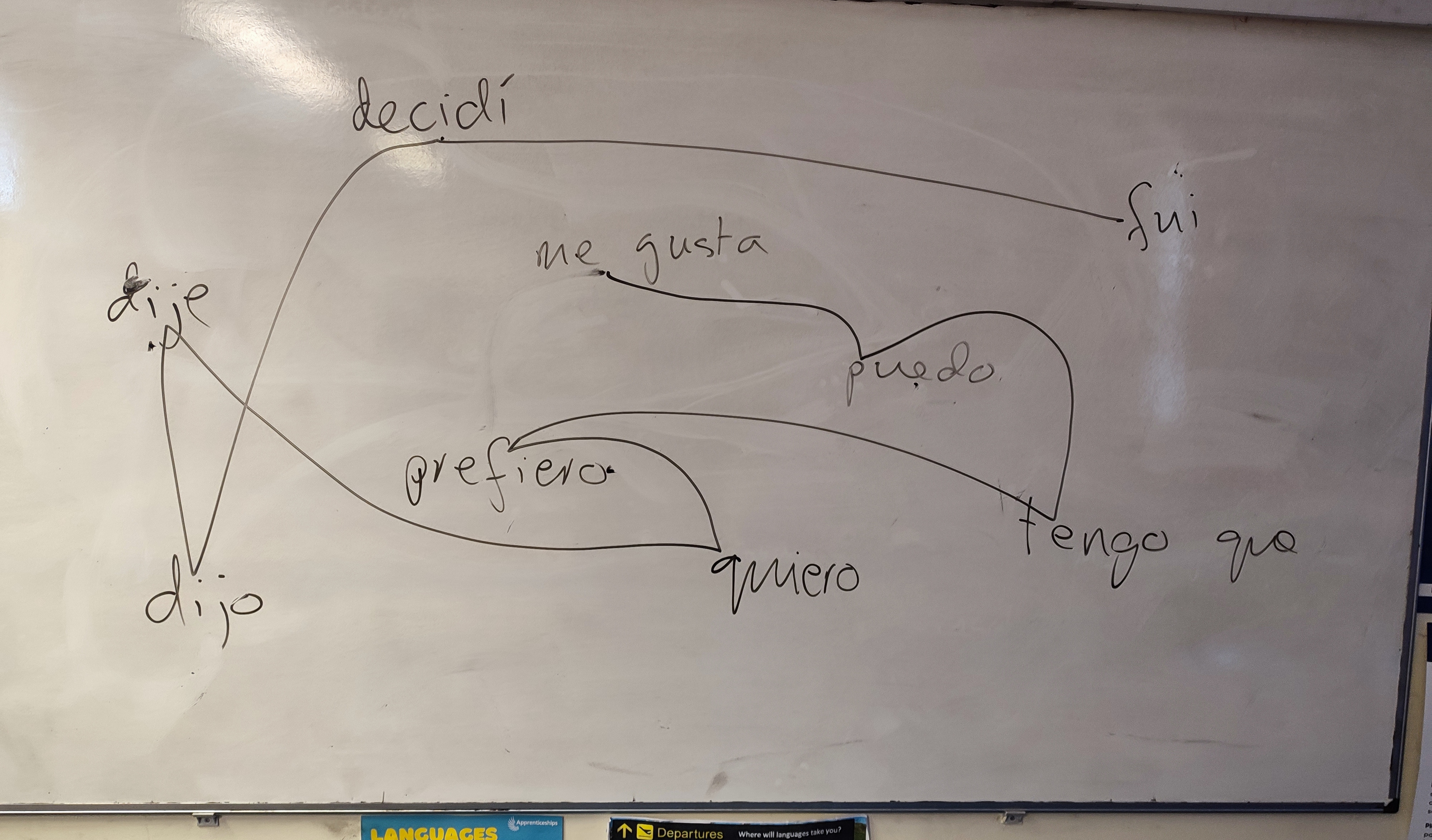
It was at the end of the lesson, and I put the words I like, I can, I have to, I want, I said, he/she said, I went... on the board. Pupils took it in turns to speak using the words. As they spoke, a pupil at the board listened out for any of the words and joined them up in the order they were used.

So in the example you can see, it was something like this (but in Spanish):

I like to to to the beach because I can swim in the sea but if I have to go with my family, I prefer to go to a café because I want to drink something. At the weekend I said, "I am going to the beach" and my dad said, "I don't want to". I decided to go on my own and I went swimming.

Then we look at the picture and try to decide what they have drawn. In this case, I'm not sure. We thought it was probably someone whose shoe laces have got tied together and has fallen over in the mud.

Then I can rub off the drawing, add more key words on the board, and ask another pupil to pick another topic to speak on.

So another pupil could say something like:

I went to McDonalds because I like to eat fast food, but if I go with my parents I have to eat a salad. I prefer to eat hamburgers. At the weekend I said, "I don't want a salad" but my dad said, "You can't eat a burger."

And we would end up with a different picture!

It can be easily adapted with different words, and pupils can work in pairs on paper instead of on the board.

It works really well. Pupils think how to make sentences while moving logically from one word to another in the order that best suits what they are saying. They get used to developing answers spontaneously, thinking what to say next that makes sense. They build answers that meet the key criteria of giving and justifying opinions, giving examples in past and future. And instead of having one fixed answer to learn by rote, they are confident making up answers on the spot from their repertoire of Spanish.

My lovely Year 11s started off picking their next word based on the logic of what they were saying. But they quickly worked out they could draw rude pictures on the board by carefully choosing what word to use next!


Saturday, 14 January 2023

Disciplinary Literacy and MFL

 Disciplinary Literacy is one of the latest terms to be imported in to the school context. You can tell it belongs elsewhere because of the use of the word "discipline" in a very academic sense, not the everyday meaning it has in schools. It means the literacy of the specific school subject. And it's about time we paid attention to it rather than seeing literacy as an extension of the English department somehow foisted on the school. We have entire subjects which are teaching pupils language at least as much as content. In Geography, the subject consists of teaching pupils that their Anglo Saxon words are not good enough. They have to learn the Latinate words. So erosion not wear away. Saltation not bounce down the river. Precipitation not rain and snow. Irrigation not water the crops. I could go on about this at length but I need to get on to MFL.

So in MFL, when we are asked how we pre-teach vocabulary and whether we define the vocabulary pupils are learning, then we can smile and say yes. If we are asked how we make sure that vocabulary is recycled and not lost, and how we make that vocabulary intellectually rich and age appropriate, then we frown and say that's what we are working on. If we are asked when we deliberately programme the teaching of High Frequency Vocabulary, then we get into an argument about fishing and wrestling.

But what if we are asked how we explicitly foreground Technical Vocabulary?

Technical Vocabulary. What would it be? How important would it be? Would it be helpful to test pupils on it explicitly? I have lots of separate ideas and arguments and I need to bring them together, discuss them with everyone else in the department, and decide if we need to change what we do.

There is a social justice argument that we have wrongly neglected explicit grammar teaching. That we assumed pupils who struggle with language-learning need an approach that avoids terminology. And so we are depriving them of the clear building blocks they need. We can also say that pupils appear to love terminology. We know as soon as they put their hand up to answer a grammatical question, they are going to say, "Is it masculine/feminine?" "Is it a cognate?" "Is it a doing word?" These are the 3 most common and perhaps the only explicit grammatical concepts pupils cling on to. And invariably you know they are going to come out with the wrong one for the question you have asked.

So is it worth foregrounding the teaching of grammatical terms? Or is it secondary to an intimate knowledge of the language itself? It is possible to know the terms raven, nightingale, albatross from literature, without being able to identify one in the wild. Just as it is possible to closely observe that little bird with the loud song and sticky up tail in your garden without knowing its name. What makes more sense? To learn lots of names of abstruse (avestruz) birds in the hope one day you see one? Or to see lots of birds and learn their names?

Here are some immediate thoughts that will eventually get pulled together, I promise:

Connectives or Conjunctions?

Conjunctions is a grammatical term. Connectives is an invented term, popularised under the Labour government Literacy Hour drive. It is not a grammatical category. My first instinct is to avoid using "connectives" as non-grammatical and out of use under the current Primary SPAG regime. It includes things like relative pronouns as well as conjunctions. We will come back to this and I may have a surprise.

Modal Verbs?

If you have read any of my posts on our curriculum, you will know the emphasis we put on building pupils' repertoire of language, heavily based around verb + infinitive constructions. Some people call some of these 'Modal Verbs'. Including some teachers in the MFL department and also in some resources used by the English department. The definition they are using is un-grammatical. It's based on a confusion of two ideas. Firstly it is related partly to their function in a sentence - they are followed by an infinitive. So they include can, have to, want to. But they don't include like, love, prefer, going to. Which have exactly the same position in the sentence. Because they use a secondary definition based on a vague idea of meaning - wanting, wishing, probability. This attempt at defining Modal Verbs doesn't delineate a grammatical category. As a definition, it is gaining currency, and I have even seen it transferred into native speaker French grammar definitions. Even though French does not have modal verbs. It's something that English takes from its Germanic roots.

A modal verb is a verb which has no infinitive and is invariable for 3rd person. So can, might, will, would, could, should and must. You can't say "to can" or "he cans" for the verb which means "to be able to."

My instinct is not to use the term Modal Verbs when teaching French. And unlike on Connectives, I don't think I am going to change my mind. We shall see...

Indefinite Articles

I'll talk about Articles. But really they are a proxy for all the other grammatical terms. Definite articles, partitive articles, comparatives, superlatives, possessive pronouns, subject pronouns. Do we need pupils to know the terms? Do we need pupils to know that un/une are indefinite articles? Or 'determiners'? Or do we just need pupils to know that un/une are the French words for a? My instinct is we can give them the label to make the teaching neat and tidy, but what we want is for pupils to understand and use the words un/une correctly.


Let's start to pull some of this together.

Using the example of Indefinite Articles, I am not in favour of SPAG style learning to label things for labelling's sake. Knowing to call something an Indefinite Article is not the point. The point is being able to use the word un/une in a sentence.

Where the technical term is useful in expediting an explanation, a conceptualisation, a distinction and the ability to apply it directly to real language, then we can make use of them. And I think this will be very specific to the grammar which is being learned.

With the case of un/une, we might label this in the booklet as Indefinite Articles, but there is plenty to be dealing with (gender, pronunciation, memorising), without adding terminology to be learned.

So maybe in the case of connectives/conjunctions, I turn out to be in favour of connectives. Because conjunctions is an abstract grammatical category. Whereas connectives is a description of how certain words are deployed, and an invitation to use them in order to improve your expression.

Having a word for can/have to/want to might be useful. But I am not going to stretch to calling them "modal verbs" because French doesn't have modal verbs. In this annotation/highlighting activity (pic below), we don't have a name for them. The best I can do is "verb + infinitive". Which perhaps is enough. Especially when it comes to distinguishing between using a verb in this way, or by conjugating it.


So what terminology is useful? We've discussed this at school, and everyone I spoke to shared the idea that the important terminology is self selecting. Where we need to use it in order for pupils to understand how to deploy their language correctly, then those are the terms we need to highlight and teach explicitly. So there is no need to consider what technical language we "should" be teaching. What is required is that we look at what language we are already using. And make sure we are not assuming that pupils know it without ever explaining it.

So for us, Technical Disciplinary Language means the words we actually use to talk about language. The words we use to guide pupils through the correct selection, formation and deployment of words. 

We'll be meeting as a department this week to look at this. My candidates to get us started would be: 

verb, infinitive, conjugate, tense, person, regular, irregular, negative

noun, gender, singular, plural

ending, agreement

connective (?!)

These aren't the list of words we "should" be teaching. These are the words we use all the time, perhaps without ever pausing to think if we have checked pupils know what we are taking about.

As always, it brings us back to Scott Thornbury's analogy. It's not about chopping up the cold dead omelette of the language and trying to piece it back together. It's about how you take raw ingredients and cook them into something tasty.


Tuesday, 10 January 2023

Part 4. Year 9 Les Loisirs Booklet: Stories

 We left the booklet at around page 12 in Part 3. With pupils using past tense "cheats" to write their stories. And seeing model stories in French using the imperfect to set the scene and the perfect to say what happened. This post will take us through some of the pages up to the end of the booklet, with pupils making up their own stories in speaking and writing.

We've seen that all the language and the activities have to be scaffolded, so that all Year 9 groups can use them successfully. We have seen that it builds on pupils' well established repertoire of French. We have seen that all new (or nearly new) language is integrated into their existing repertoire. And we have seen that learning to deploy their language is just as important as learning the language itself.

The first thing we do is get the verbs ready that we are going to need in the rest of the booklet. This is so we can do it methodically, working through the step by step process of choosing tense, type of verb, person of the verb to arrive at the correct ending. Then when pupils need them later, they know they have them ready. This is part of the way we use Food Tech or other Technology subjects as a metaphor for language-learning. Pre-prepping some of the tricky ingredients is familiar to pupils from Food Tech, as is the idea of then assembling the dish for the customer.

Here's the page for the verbs in the Imperfect. There is a grammar explanation and an accompanying powerpoint. Then the pupils prepare the exact verbs they are going to be needing later.


Then there is a double page working on the verbs in the Perfect. The explanation and examples on the left act as a guide to assembling the verbs they are going to need on the page on the right:


The page on the right contains the verbs they will be needing later in the booklet.


The first story to assemble is the Aquarium story. You may remember that the pupils read a version of this earlier in the booklet as a model. This can support them now, but it is worded differently so they can't just copy word for word.


They retrieve their imperfect and perfect verbs from the chiller cabinet and have them ready for when they are needed. Then they translate the story into French using their core repertoire, adding the ending saying what was happening and what happened using the the verbs they had ready.

They do exactly the same process again for a story about going to a museum. And for the unpleasant experience on a roller-coaster story you will remember from Part 3. But this time, they write the story in French.

By the end of the booklet, they are invited to select their own infinitives. They process them into Imperfect or Perfect, and make up their own stories in speaking and writing:


So by the end of Year 9, the pupils are producing answers which meet the GCSE criteria of: opinions, reasons, personal detail, past and future, and narration. We work on their ability to do this with increasing coherence, accuracy, confidence, independence and spontaneity. Having the core repertoire means new language sticks, and it helps with the development of a conceptualisation of grammatical structures. Most importantly, all the language they learn is language that they use. They have it at their fingertips and they are keen to learn more.

Monday, 9 January 2023

Part 3. Booklet. Year 9. Les Loisirs

 We left Part 2, with the pupils happily riffing on any infinitives you care to give them, spontaneously developing answers with opinions, reasons and if sentences, working on making their answers coherent and realistic. And we promised a story about a terrible combination of roller-coasters, sweets and fizzy pop. We'll get there!

We are up to page 7 of the booklet. And we are going to start adding tenses to the repertoire of opinions and reasons. First of all we do this with some past tense cheats.


We are still on the topic of La Plage, and the pupils have the next iteration of the Beach Keep Talking Sheet. This time with I was going to, I said, He/She said, the weather was..., and I decided to... As you can see from the little anecdote above, these cheats can be very effective in developing answers into little stories.

Pupils work using this template, modifying the story using different infinitives:


Again, some of the work is listening to the teacher, spotting the changes in the text. Then the pupils produce their own answers, maybe starting slow, carefully and in writing. But the aim is for them to be able to riff on any infinitives they are given, using their template to create spontaneous answers.

We are going to move on from the "cheats" to using verbs in the imperfect and the perfect. The imperfect doesn't work on its own. Just as I was going to... is followed by but I decided to..., so any verb in the imperfect (I was swimming...) is followed up with but something happened.

Pupils have seen the imperfect separately for describing what somone was wearing. And the perfect for saying what they did at the weekend or in the holidays. But here they are being used together to create narrative. So we work on spotting one from the other, and then have lots of examples where pupils are reading or listening to stories modelling how they are used:


Pupils work on identifying the verbs and identifying the meaning, before substituting other verbs into the story. At this stage, they are given the verbs conjugated in the infinitive and in the two past tenses, so they are selecting the correct form to replace the verb in the original story.

And now we are ready for some more stories. At this stage they are models given to them in French so they can concentrate on meaning, on the form, and on how the models are constructed.

First this one:


And then the famous roller-coaster story:


In Part 4 we will move onto pupils manipulating the tenses and creating their own stories...

Friday, 6 January 2023

Part 2. Year 9 Les Loisirs Booklet

 Instead of moving on (yet) to how the booklet introduces tenses, I want to spend a bit more time on one of the activities from the previous post from the early pages in the booklet.

Pupils look at this version of the Going to the Beach Keep Talking Sheet. It's on its way to building up to the full version, but without any reference to past events at this stage.


For the first activity, the pupils are concentrating on the middle column - activites / verbs in the infinitive. The teacher is going to read out 3 texts. For each one, the pupils listen for any of the activities mentioned and circle them in the middle column of their Keep Talking sheet.

Here's the first text to be read out:


You can see it has four infinitives: walk, look for shells, explore, return home.


The second text only has one infinitve: to play with a ball!


You can see that apart from the choice of infinitive, it is deploying very much the same repertoire of opinions, reasons and if sentences as text 1.


Text three has 8 activities:


Go to the beach, swim in the sea, make sand castles, draw elephants in the sand, go into town, drink something in a café, take photos, see my friends.


Once the pupils have done these as a listening, they turn to the page with the texts and again identify the activities/infinitives in the text. Then as a class they discuss what they think of the 3 different texts. Some of their ideas will be related to the content: whether they can identify with the person's experience. Of course, what I really want is a discussion about the writing: The last one has lots of detail and nice ideas; the second one is too repetitive; the first one is a bit boring; the second one shows what you can do with only one infinitive if you are stuck; the last one turns into a bit of a random list.

There is a "right" answer. The right answer is to carefully choose a limited number of infinitives which go well together to make a coherent paragraph. Like Text 1.

This kind of focus is key to how we teach languages. Our mantra is that it's NOT always about learning more and more French. It is vital to work on how well you can USE the French that you have. There's a strong literacy/oracy imperative here - working on pupils' ability to develop ideas. And it's also central to language-learning. It gives the rationale for re-working the same language. It means everything pupils learn is added to their repertoire with anything new fitting in, and with nothing getting left behind. And it helps create that idea that they have a growing body of language that they can deploy.

So here's the next activity:


Pupils write 3 texts of their own. One with a carefully selected number of infinitives. One with just one infinitive. One with a random list of infinitives. In each case they recycle the same repertoire of language. And what they are working on is thinking ahead, choosing ideas that link well, and developing the coherence of their writing.

This gives us a glimpse into what's to come in the second half of the booklet when we start to introduce tenses. If you have these infinitives, can you see how the answer is going to develop?

go to a theme park    go on the roller-coasters    eat sweets    drink fizzy pop    vomit

From focusing on the coherence of answers based on opinions, reasons and if sentences, we are going to move into story telling in a combination of tenses...